Cape Dune Mole Rat

Cape Dune Mole Rat

Bathyergus suillus

Silhouette: Kai R. Caspar · PhyloPic

LCLeast ConcernNTVUENCR Endemic
Daily sighting probability ~30% · Possible
at West Coast National Park

In 3 days ~60% in a week ~90%

26 Verified sightings at West Coast National Park From 2019 to 2026
208 In all 3 parks
July Best month
☀️ Diurnal When it's spotted

About the Cape Dune Mole Rat

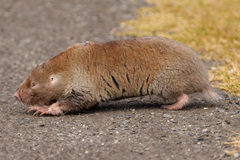
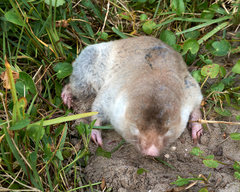
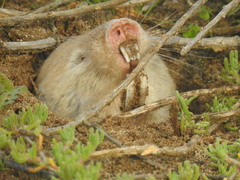
The Cape dune mole-rat (Bathyergus suillus) is a species of solitary burrowing rodent in the family Bathyergidae. It is endemic to South Africa and named for the Cape of Good Hope. The Cape dune mole-rat is the largest of all the blesmols, measuring 27 to 35 centimetres (11 to 14 in) in head-body length, with a short, 3 to 4 centimetres (1.2 to 1.6 in) tail. Males are generally much heavier than females, weighing anything from 570 to 1,350 grams (20 to 48 oz), compared with typical female weights of 590 to 970 grams (21 to 34 oz).

Both sexes are sturdy, large-bodied rodents, with blunt snouts, cylindrical torsos and short limbs. The forefeet are heavily adapted for digging, with powerful curved claws. To enable to move more quickly through tight tunnels, the body has few visible external features; for example, there are no pinnae or scrotum, and the penis retracts into a concealed sheath. Lip-like flaps of skin are able to close behind the incisors, preventing soil from falling into the mouth. The eyes are small, but not permanently closed.

Unlike its relative the naked mole-rat, the Cape dune species has a thick pelt of soft fur over its entire body. It is cinnamon... Wikipedia →

Global Distribution

Parks Where Found

# Park Country Daily sighting probability
1 West Coast National Park 🇿🇦 South Africa
~30%
2 Table Mountain National Park 🇿🇦 South Africa
~10%
3 Garden Route National Park 🇿🇦 South Africa
~10%

Cities Where Found

# City Country Daily sighting probability
1 Cape Town 🇿🇦 South Africa
~20%

Before you go

What are the chances of seeing a Cape Dune Mole Rat in West Coast National Park?

Possible

About 30% of wildlife watchers report a Cape Dune Mole Rat sighting in West Coast National Park on a given day, based on 26 verified sightings from GBIF citizen-science data from 2019 to 2026. It is the 10th most-seen of the 21 mammals we can rate there. Over three days the chance rises to about 60%, and over a week to about 90%, if each day is a fresh chance.

When is the best time to see a Cape Dune Mole Rat in West Coast National Park?

February and June–August

In those months about 40% of wildlife watchers report a Cape Dune Mole Rat in West Coast National Park on a given day, against under 5% in April–May and October–December, the lowest months.

What time of day is best to see a Cape Dune Mole Rat?

Between 9 am and noon

Across all the parks we cover, that three-hour window holds the most Cape Dune Mole Rat sightings with a recorded time, and nearly all of them come between 6 am and 6 pm: it is a daytime animal.

Is West Coast National Park the best place to see a Cape Dune Mole Rat?

Yes

Of the 3 parks where we can rate Cape Dune Mole Rat sightings, West Coast National Park has the highest daily chance: about 30%. Next come Table Mountain National Park (South Africa, about 10%) and Garden Route National Park (South Africa, about 10%).

Where does the Cape Dune Mole Rat sighting chance come from?

GBIF citizen-science records

It is estimated from how often the Cape Dune Mole Rat is recorded against all the mammals logged in West Coast National Park (26 verified sightings from 2019 to 2026), calibrated against known sighting rates. Figures are rounded to the nearest 10% because citizen-science data supports honest approximations, not decimals, and months with records from fewer than five people show "—". How it works.

← Back to West Coast National Park