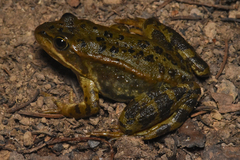
Columbia Spotted Frog

Columbia Spotted Frog

Rana luteiventris

Silhouette: Sharp Photography, sharpphotography.co.uk · PhyloPic

LCLeast ConcernNTVUENCR
Daily sighting probability ~20% · Possible
at Yellowstone National Park

In 3 days ~60% in a week ~90%

187 Verified sightings at Yellowstone National Park From 2019 to 2026
373 In all 5 parks
August Best month
☀️ Diurnal When it's spotted

About the Columbia Spotted Frog

The Columbia spotted frog (Rana luteiventris) is a North American species of frog. It is green to brown in color with spots on the dorsal surface. The belly and upper lip are white in color. Individuals can be distinguished from other Rana species by their shorter back legs, narrow snout, and upturned eyes. Since they spend most of their time in the water, they also have more webbing in their hind feet than similar species. Although not threatened, this animal has been studied as a model species for the effects of habitat fragmentation.

The Columbia spotted frog is a medium-sized frog reaching lengths of up to 3.5 in (89 mm). Its color ranges from a dark, olive green to light brown with irregularly shaped black spots on its back and legs (rendering its name). Its skin texture, like the rest of the genus, varies from a rough to a smooth texture, with small folds of skin along the back. This frog exhibits a unique feature regarding its color. A light-colored strip runs along the upper lip, and the ventral sides of the frog are usually colored either pink or yellow, but only in the adult form.

This frog is well known by a few of its physical characteristics, as well... Wikipedia →

Global Distribution

Parks Where Found

# Park Country Daily sighting probability
1 Glacier National Park 🇺🇸 United States
~30%
2 Grand Teton National Park 🇺🇸 United States
~20%
3 Yellowstone National Park 🇺🇸 United States
~20%
4 Jasper National Park 🇨🇦 Canada
~10%
5 Great Bear Rainforest 🇨🇦 Canada
~10%

Zoos & Centres Where Found

# Zoo / Centre Country
1 Grizzly & Wolf Discovery Center 🇺🇸 United States In captivity

Before you go

What are the chances of seeing a Columbia Spotted Frog in Yellowstone National Park?

Possible

About 20% of wildlife watchers report a Columbia Spotted Frog sighting in Yellowstone National Park on a given day, based on 187 verified sightings from GBIF citizen-science data from 2019 to 2026. Over three days the chance rises to about 60%, and over a week to about 90%, if each day is a fresh chance.

When is the best time to see a Columbia Spotted Frog in Yellowstone National Park?

June to August

In those months about 30% of wildlife watchers report a Columbia Spotted Frog in Yellowstone National Park on a given day, against under 5% in October to March, the lowest months.

What time of day is best to see a Columbia Spotted Frog?

Between 11 am and 2 pm

Across all the parks we cover, that three-hour window holds the most Columbia Spotted Frog sightings with a recorded time, and about 9 in 10 of them come between 6 am and 6 pm: it is a daytime animal.

Is Yellowstone National Park the best place to see a Columbia Spotted Frog?

3rd of 5

Of the 5 parks where we can rate Columbia Spotted Frog sightings, Yellowstone National Park ranks 3rd at about 20%. The best odds are in Glacier National Park (United States, about 30%) and Grand Teton National Park (United States, about 20%).

Which relatives of the Columbia Spotted Frog live in Yellowstone National Park?

Same order: Anura

The closest relatives of the Columbia Spotted Frog that you can see in Yellowstone National Park (order Anura, Frogs and Toads) are Western Toad (about 20%) and Boreal Chorus Frog (about 10%), with each one's daily chance of a sighting.

Where does the Columbia Spotted Frog sighting chance come from?

GBIF citizen-science records

It is estimated from how often the Columbia Spotted Frog is recorded against all the amphibians logged in Yellowstone National Park (187 verified sightings from 2019 to 2026), calibrated against known sighting rates. Figures are rounded to the nearest 10% because citizen-science data supports honest approximations, not decimals, and months with records from fewer than five people show "—". How it works.

← Back to Yellowstone National Park