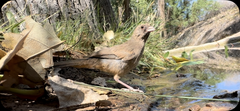
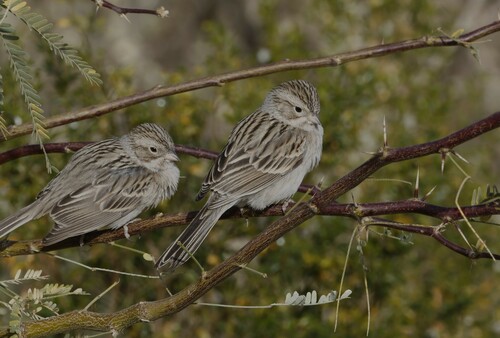
Abert's Towhee

Abert's Towhee

Melozone aberti

Silhouette: Edwin Price · PhyloPic

LCLeast ConcernNTVUENCR
Daily sighting probability <5% · Rare
at Zion National Park

In 3 days <5%

14 Verified sightings at Zion National Park From 2019 to 2026
3,132 In all 2 parks
July Best month
☀️ Diurnal When it's spotted

About the Abert's Towhee

Abert's towhee (Melozone aberti) is a bird of the family Passerellidae, native to a small range in southwestern North America, generally the lower Colorado River and Gila River watersheds, nearly endemic to Arizona, but also present in small parts of California, Nevada, Utah, New Mexico, and Sonora in Mexico. The name of this bird commemorates the American ornithologist James William Abert (1820–1897).

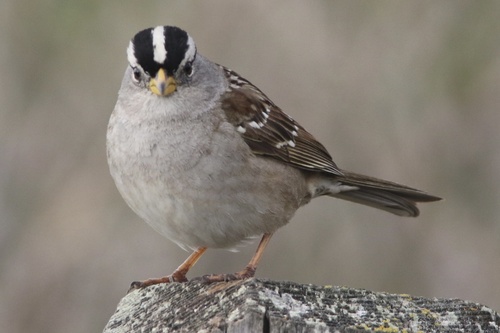
Abert's towhees are recognized by their relatively long tails, dark faces, and overall brown plumage. They are related to sparrows and juncos but are more similar to thrashers in appearance. They may be confused with the California towhee, but their dark faces are more distinct, and the range of these species only slightly overlaps. The Abert's towhee is the longest species in the diverse New World sparrow family at 21 to 25 cm (8.3 to 9.8 in) long, but its length is boosted by a relatively long tail, at 10 to 12 cm (3.9 to 4.7 in) in length. Males weigh from 40–54.1 g (1.41–1.91 oz), with an average of 47.1 g (1.66 oz), while females weigh from 39.5–51 g (1.39–1.80 oz), with an average of 44.8 g (1.58 oz). In terms of weight, it is outweighed by several other towhee... Wikipedia →

Sounds

Song0:27

United States · 2022

© Paul Marvin · XC703926 · CC BY-NC-SA 4.0

Duet0:51

Mexico · 2021

© Richard E. Webster · XC662405 · CC BY-NC-SA 4.0

Call0:09

United States · 2021

© Bobby Wilcox · XC639341 · CC BY-NC-SA 4.0

Global Distribution

Parks Where Found

# Park Country Daily sighting probability
1 Saguaro National Park 🇺🇸 United States
~40%
2 Zion National Park 🇺🇸 United States
<5%

Cities Where Found

# City Country Daily sighting probability
1 Mesa 🇺🇸 United States
~80%
2 Phoenix 🇺🇸 United States
~50%
3 Las Vegas 🇺🇸 United States
~20%

Before you go

What are the chances of seeing an Abert's Towhee in Zion National Park?

Rare

Under 5% of wildlife watchers report an Abert's Towhee sighting in Zion National Park on a given day, based on 14 verified sightings from GBIF citizen-science data from 2019 to 2026. It is the 164th most-seen of the 183 birds we can rate there. Over three days the chance rises to under 5%, if each day is a fresh chance.

When is the best time to see an Abert's Towhee in Zion National Park?

Any time of year

In every month with enough records, under 5% of wildlife watchers report an Abert's Towhee in Zion National Park on a given day, so our monthly data shows no clear season.

What time of day is best to see an Abert's Towhee?

Between 7 and 10 am

Across all the parks we cover, that three-hour window holds the most Abert's Towhee sightings with a recorded time, and about 8 in 10 of them come between 6 am and 6 pm: it is a daytime animal.

Is Zion National Park the best place to see an Abert's Towhee?

2nd of 2

Of the 2 parks where we can rate Abert's Towhee sightings, Zion National Park ranks 2nd at under 5%. The best odds are in Saguaro National Park (United States, about 40%).

Which relatives of the Abert's Towhee live in Zion National Park?

Same family: Passerellidae

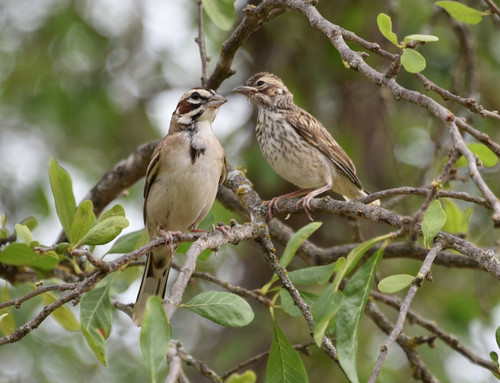
The closest relatives of the Abert's Towhee that you can see in Zion National Park (family Passerellidae, New World Sparrows) are Spotted Towhee (about 60%), Dark-eyed Junco (about 30%) and Song Sparrow (about 30%), with each one's daily chance of a sighting.

Where does the Abert's Towhee sighting chance come from?

GBIF citizen-science records

It is estimated from how often the Abert's Towhee is recorded against all the birds logged in Zion National Park (14 verified sightings from 2019 to 2026), calibrated against known sighting rates. Figures are rounded to the nearest 10% because citizen-science data supports honest approximations, not decimals, and months with records from fewer than five people show "—". How it works.

← Back to Zion National Park