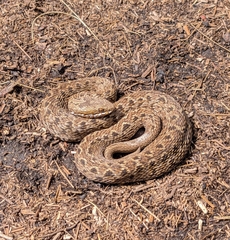
Kenya Montane Viper

Kenya Montane Viper

Montatheris hindii

Silhouette: Steven Traver · PhyloPic

LCNTNear ThreatenedVUENCR
Daily sighting probability ~10% · With luck
at Aberdare National Park

In 3 days ~30% in a week ~60%

8 Verified sightings at Aberdare National Park From 2019 to 2026
8 In 1 park
March Best month
☀️ Diurnal When it's spotted

About the Kenya Montane Viper

Montatheris is a monotypic genus created for the viper species, Montatheris hindii, a venomous snake also known by the common names Kenya mountain viper, Kenya montane viper, montane viper, and Hind's viper. This is a small terrestrial species endemic to Kenya. There are no subspecies which are recognized as being valid.

The specific name, hindii, is in honor of Sidney Langford Hinde, a British military medical officer and naturalist. M. hindii is a small species reaching an average total length (including tail) of 20–30 cm (7.9–11.8 in) and a maximum total length of about 35 cm (14 in). The head is elongated and not very distinct from the neck, while the eyes are small and set in a rather forwards position. The dorsal scales are strongly keeled.

M. hindii is known only from isolated populations at high elevations on Mount Kenya and the moorlands of the Kinangop Plateau, Aberdare Mountains. The type locality listed is "Fort Hall, Kenya District, 4000 ft." Since Fort Hall is at an altitude of only 4,000 feet (1,219 meters), Loveridge (1957) questioned whether this was accurate.

M. hindii occurs at high elevations... Wikipedia →

Global Distribution

Parks Where Found

# Park Country Daily sighting probability
1 Aberdare National Park 🇰🇪 Kenya
~10%

More parks will be added in future updates.

Closest Relatives at Aberdare National Park

No species of the same family or order lives in Aberdare National Park, so these are its closest relatives here: other reptiles.

Before you go

What are the chances of seeing a Kenya Montane Viper in Aberdare National Park?

With luck

About 10% of wildlife watchers report a Kenya Montane Viper sighting in Aberdare National Park on a given day, based on 8 verified sightings from GBIF citizen-science data from 2019 to 2026. Over three days the chance rises to about 30%, and over a week to about 60%, if each day is a fresh chance.

When is the best time to see a Kenya Montane Viper in Aberdare National Park?

January and March

In those months about 30% of wildlife watchers report a Kenya Montane Viper in Aberdare National Park on a given day, against under 5% in June to December, the lowest months. Those are among Aberdare National Park's driest months, with about 80 mm of rain a month against 210 mm in May.

What time of day is best to see a Kenya Montane Viper?

Between 8 and 11 am

Across all the parks we cover, that three-hour window holds the most Kenya Montane Viper sightings with a recorded time, and nearly all of them come between 6 am and 6 pm: it is a daytime animal.

Where else can you see a Kenya Montane Viper?

Only Aberdare National Park, in our data

Aberdare National Park is the only park on Wallace's Line with enough records to rate Kenya Montane Viper sightings: about 10% of wildlife watchers there report one on a given day.

Where does the Kenya Montane Viper sighting chance come from?

GBIF citizen-science records

It is estimated from how often the Kenya Montane Viper is recorded against all the reptiles logged in Aberdare National Park (8 verified sightings from 2019 to 2026), calibrated against known sighting rates. Figures are rounded to the nearest 10% because citizen-science data supports honest approximations, not decimals, and months with records from fewer than five people show "—". How it works.

← Back to Aberdare National Park