Helmeted Chameleon

Helmeted Chameleon

Trioceros hoehnelii

Silhouette: T. Michael Keesey (from a photograph by Frank Glaw, Jörn Köhler, Ted M. Townsend & Miguel Vences) · PhyloPic

LCLeast ConcernNTVUENCR
Daily sighting probability ~60% · Likely
at Aberdare National Park

In 3 days ~90% in a week >90%

23 Verified sightings at Aberdare National Park From 2019 to 2026
49 In all 2 parks
January Best month
☀️ Diurnal When it's spotted

About the Helmeted Chameleon

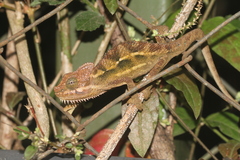
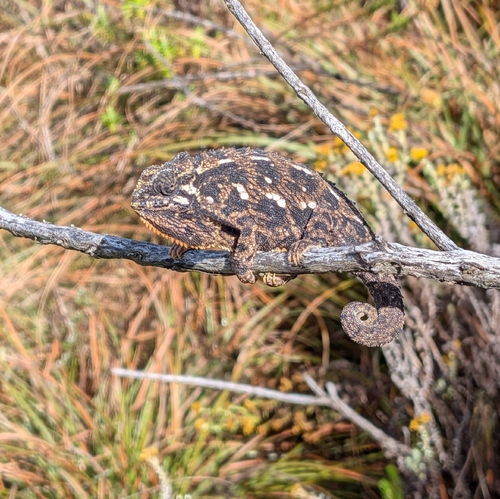
Trioceros hoehnelii, commonly known as von Höhnel's chameleon, the helmeted chameleon, and the high-casqued chameleon, is a species of chameleon, a lizard in the family Chamaeleonidae. The species is native to eastern Africa.

Both the specific name, hoehnelii, and one of the common names, "von Höhnel's chameleon", are in honor of Austrian explorer Ludwig von Höhnel (1857–1942). T. hoehnelii is found in Kenya and Uganda. T. hoehnelii is a small to medium-size chameleon, growing up to 10 inches (25.4 cm) in total length (including tail). Coloration is highly variable across its geographic range. During morning hours, it may be seen basking in the sunlight, almost completely black in color to capture heat energy from the sunlight. This species has a single horn on the rostrum, a serrated back crest, and a spiny throat crest. Males are typically larger than females with a larger casque, horn, and enlarged tail base.

Most chameleons in east Africa tend to be territorial and the high-casqued chameleon is no different. If males are placed together, they will hiss at each other, turn black, and inflate their bodies... Wikipedia →

Global Distribution

Parks Where Found

# Park Country Daily sighting probability
1 Aberdare National Park 🇰🇪 Kenya
~60%
2 Nairobi National Park 🇰🇪 Kenya
~30%

Cities Where Found

# City Country Daily sighting probability
1 Nairobi 🇰🇪 Kenya
~20%

Zoos & Centres Where Found

# Zoo / Centre Country
1 Downtown Aquarium, Houston 🇺🇸 United States In captivity

Before you go

What are the chances of seeing a Helmeted Chameleon in Aberdare National Park?

Likely

About 60% of wildlife watchers report a Helmeted Chameleon sighting in Aberdare National Park on a given day, based on 23 verified sightings from GBIF citizen-science data from 2019 to 2026. Over three days the chance rises to about 90%, and over a week to over 90%, if each day is a fresh chance.

When is the best time to see a Helmeted Chameleon in Aberdare National Park?

January and April

In those months about 80% of wildlife watchers report a Helmeted Chameleon in Aberdare National Park on a given day, against about 10% in October and November, the lowest months.

What time of day is best to see a Helmeted Chameleon?

Between 8 and 11 am

Across all the parks we cover, that three-hour window holds the most Helmeted Chameleon sightings with a recorded time, and about 8 in 10 of them come between 6 am and 6 pm: it is a daytime animal.

Is Aberdare National Park the best place to see a Helmeted Chameleon?

Yes

Of the 2 parks where we can rate Helmeted Chameleon sightings, Aberdare National Park has the highest daily chance: about 60%. Next come Nairobi National Park (Kenya, about 30%).

Where does the Helmeted Chameleon sighting chance come from?

GBIF citizen-science records

It is estimated from how often the Helmeted Chameleon is recorded against all the reptiles logged in Aberdare National Park (23 verified sightings from 2019 to 2026), calibrated against known sighting rates. Figures are rounded to the nearest 10% because citizen-science data supports honest approximations, not decimals, and months with records from fewer than five people show "—". How it works.

← Back to Aberdare National Park