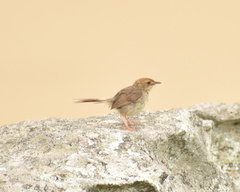
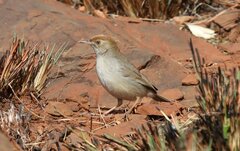
Rock-loving Cisticola

Rock-loving Cisticola

Cisticola aberrans

Silhouette: Sheatherius · PhyloPic

LCLeast ConcernNTVUENCR
Daily sighting probability ~10% · With luck
at Addo Elephant National Park

In 3 days ~10% in a week ~30%

29 Verified sightings at Addo Elephant National Park From 2019 to 2026
132 In all 7 parks
May Best month
☀️ Diurnal When it's spotted

About the Rock-loving Cisticola

The rock-loving cisticola (Cisticola aberrans), also known as the lazy cisticola, is a species of bird in the family Cisticolidae. It is widespread throughout sub-Saharan Africa and is usually associated with rocky wooded terrain with interspersed patchy grass tussocks. It was formerly considered to be conspecific with the Huambo cisticola (Cisticola bailunduensis).

The rock-loving cisticola was formally described and illustrated in 1843 by the Scottish zoologist Andrew Smith under the binomial name Drymoica aberrans based on specimens collected near "Port Natal" (now Durban) in South Africa. The specific epithet is from Latin aberrans, aberrantis meaning "deviating" or "aberrant". The rock-loving cisticola is now one of 53 cisticolas placed in the genus Cisticola that was introduced in 1829 by the German naturalist Johann Jakob Kaup.

Seven subspecies are recognised: Wikipedia →

Sounds

Call1:21

Zambia · 2026

© Magnus Wadstein · XC1185137 · CC BY-NC-SA 4.0

Song0:31

Zambia · 2021

© Dries Van de Loock · XC745554 · CC BY-NC-SA 4.0

Alarm call0:28

Malawi · 2019

© Murray Christian · XC513827 · CC BY-NC-SA 4.0

Global Distribution

Parks Where Found

# Park Country Daily sighting probability
1 Golden Gate Highlands National Park 🇿🇦 South Africa
~10%
2 Addo Elephant National Park 🇿🇦 South Africa
~10%
3 Hluhluwe-Imfolozi Park 🇿🇦 South Africa
<5%
4 Hwange National Park 🇿🇼 Zimbabwe
<5%
5 Kruger National Park 🇿🇦 South Africa
<5%
6 Masai Mara National Reserve 🇰🇪 Kenya
<5%
7 Serengeti National Park 🇹🇿 Tanzania
<5%

Cities Where Found

# City Country Daily sighting probability
1 Johannesburg 🇿🇦 South Africa
<5%

Before you go

What are the chances of seeing a Rock-loving Cisticola in Addo Elephant National Park?

With luck

About 10% of wildlife watchers report a Rock-loving Cisticola sighting in Addo Elephant National Park on a given day, based on 29 verified sightings from GBIF citizen-science data from 2019 to 2026. It is the 138th most-seen of the 243 birds we can rate there. Over three days the chance rises to about 10%, and over a week to about 30%, if each day is a fresh chance.

When is the best time to see a Rock-loving Cisticola in Addo Elephant National Park?

January–February, May and August

In those months about 10% of wildlife watchers report a Rock-loving Cisticola in Addo Elephant National Park on a given day, against under 5% in March–April, June–July and September–December, the lowest months.

What time of day is best to see a Rock-loving Cisticola?

Between 8 and 11 am

Across all the parks we cover, that three-hour window holds the most Rock-loving Cisticola sightings with a recorded time, and nearly all of them come between 6 am and 6 pm: it is a daytime animal.

Is Addo Elephant National Park the best place to see a Rock-loving Cisticola?

Among the best

Of the 7 parks where we can rate Rock-loving Cisticola sightings, Addo Elephant National Park ranks 2nd at about 10%, level with the leaders once rounded. The best odds are in Golden Gate Highlands National Park (South Africa, about 10%).

Where does the Rock-loving Cisticola sighting chance come from?

GBIF citizen-science records

It is estimated from how often the Rock-loving Cisticola is recorded against all the birds logged in Addo Elephant National Park (29 verified sightings from 2019 to 2026), calibrated against known sighting rates. Figures are rounded to the nearest 10% because citizen-science data supports honest approximations, not decimals, and months with records from fewer than five people show "—". How it works.

← Back to Addo Elephant National Park