



Completed


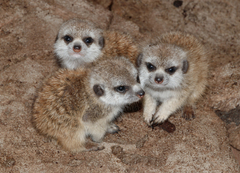


Slender-tailed Meerkat
Suricata suricatta
Silhouette: T. Michael Keesey · PhyloPic
- KingdomAnimalia (Animals)
- PhylumChordata (Chordates)
- ClassMammalia (Mammals)
- OrderCarnivora (Carnivorans)
- FamilyHerpestidae (Mongooses)
- GenusSuricata (Meerkats)
- SpeciesSuricata suricatta (Slender-tailed Meerkat)
In 3 days ~60% in a week ~90%
83 Verified sightings at Addo Elephant National Park From 2019 to 2026
198 In all 3 parks
August Best month
☀️ Diurnal When it's spotted


Completed
About the Slender-tailed Meerkat
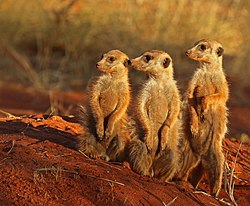
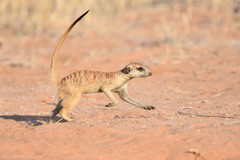
The meerkat (Suricata suricatta) or suricate is a small mongoose found in southern Africa. It is characterised by a broad head, large eyes, a pointed snout, long legs, a thin tapering tail, and a brindled coat pattern. The head-and-body length is around 24–35 cm (9.4–13.8 in), and the weight is typically between 0.62 and 0.97 kg (1.4 and 2.1 lb). The coat is light grey to yellowish-brown with alternate, poorly defined light and dark bands on the back. Meerkats have foreclaws adapted for digging and have the ability to thermoregulate to survive in their harsh, dry habitat. Three subspecies are recognised.
Meerkats are highly social, and form packs of two to 30 individuals each that occupy home ranges around 5 km2 (1.9 sq mi) in area. There is a social hierarchy—generally dominant individuals in a pack breed and produce offspring, and the nonbreeding, subordinate members provide altruistic care to the pups. Breeding occurs around the year, with peaks during heavy rainfall; after a gestation of 60 to 70 days, a litter of three to seven pups is born.
They live in rock crevices in stony, often calcareous areas, and in large burrow systems in plains. The burrow systems, typically 5 m (16 ft) in diameter with around 15 openings, are large underground networks consisting of two to three levels of tunnels. These tunnels are around 7.5 cm (3.0 in) high at the top and wider below, and extend up to 1.5 m (5 ft) into the ground. Burrows have moderated internal temperatures and provide a comfortable microclimate that protects meerkats in harsh weather and at extreme temperatures.
Meerkats are active during the day, mostly in the early morning and late afternoon; they remain continuously alert and retreat to burrows when sensing danger. They use a wide variety of calls to communicate among themselves for various purposes, such as to raise an alarm on sighting a predator. Primarily insectivorous, meerkats feed heavily on beetles and lepidopterans, arthropods, amphibians, small birds, reptiles, and plants.
Commonly living in arid, open habitats with little woody vegetation, meerkats occur in southwestern Botswana, western and southern Namibia, and northern and western South Africa; the range barely extends into southwestern Angola. With no significant threats to the population, the meerkat is listed as Least Concern on the IUCN Red List. Meerkats are widely depicted in television, movies, and other media. Wikipedia →
Recent sightings of Slender-tailed Meerkat in Addo Elephant National Park
LIVEiNaturalistGlobal Distribution
Parks Where Found
| # | Park | Country | Daily sighting probability |
|---|---|---|---|
| 1 | Kgalagadi Transfrontier Park | 🇿🇦 South Africa | |
| 2 | Addo Elephant National Park | 🇿🇦 South Africa | |
| 3 | Namib-Naukluft National Park | 🇳🇦 Namibia |
Zoos & Centres Where Found
Closest Relatives at Addo Elephant National Park




Before you go
What are the chances of seeing a Slender-tailed Meerkat in Addo Elephant National Park?
Possible
About 30% of wildlife watchers report a Slender-tailed Meerkat sighting in Addo Elephant National Park on a given day, based on 83 verified sightings from GBIF citizen-science data from 2019 to 2026. It is the 10th most-seen of the 44 mammals we can rate there. Over three days the chance rises to about 60%, and over a week to about 90%, if each day is a fresh chance.
When is the best time to see a Slender-tailed Meerkat in Addo Elephant National Park?
August
In that month about 40% of wildlife watchers report a Slender-tailed Meerkat in Addo Elephant National Park on a given day, against about 10% in March and April, the lowest months.
What time of day is best to see a Slender-tailed Meerkat?
Between 7 and 10 am
Across all the parks we cover, that three-hour window holds the most Slender-tailed Meerkat sightings with a recorded time, and about 9 in 10 of them come between 6 am and 6 pm: it is a daytime animal.
Is Addo Elephant National Park the best place to see a Slender-tailed Meerkat?
2nd of 3
Of the 3 parks where we can rate Slender-tailed Meerkat sightings, Addo Elephant National Park ranks 2nd at about 30%. The best odds are in Kgalagadi Transfrontier Park (South Africa, about 40%).
Which relatives of the Slender-tailed Meerkat live in Addo Elephant National Park?
Same family: Herpestidae
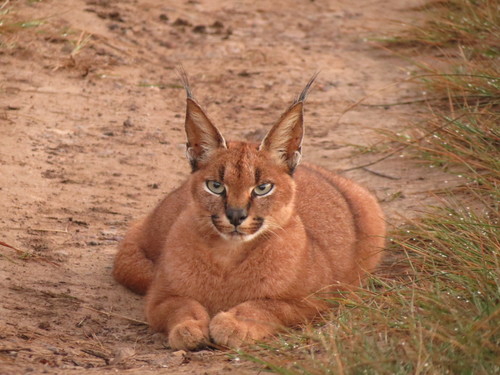
The closest relatives of the Slender-tailed Meerkat that you can see in Addo Elephant National Park (family Herpestidae, Mongooses) are Yellow Mongoose (about 40%) and Cape Gray Mongoose (about 20%), with each one's daily chance of a sighting.
Where does the Slender-tailed Meerkat sighting chance come from?
GBIF citizen-science records
It is estimated from how often the Slender-tailed Meerkat is recorded against all the mammals logged in Addo Elephant National Park (83 verified sightings from 2019 to 2026), calibrated against known sighting rates. Figures are rounded to the nearest 10% because citizen-science data supports honest approximations, not decimals, and months with records from fewer than five people show "—". How it works.
