













All 3 in 3 days here: ~40%
Kgalagadi Transfrontier Park
🇿🇦 South Africa
Southern Africa, South Africa 629 spp. recorded
Kgalagadi Transfrontier Park is a desert and dry‑scrub reserve that straddles the border of South Africa and Botswana. The landscape is a mosaic of red sand dunes, sparse grasslands and occasional rocky outcrops, offering open horizons that contrast sharply with nearby savanna parks.
-25.746° S 20.335° E
🦜 Nature

308 Species sighted
17,423 Verified sightings From 2019 to 2026
Sep Best month
⭐ Iconic Species
📊 Most Spotted
⭐ Iconic Species
📊 Most Spotted
⭐ Iconic Species
📊 Most Spotted
📊 Most Spotted
📊 Most Spotted
📊 Most Spotted
🌙 Most active after dark
+ 472 more species with insufficient data
Challenges you can complete here
Recent sightings in Kgalagadi Transfrontier Park
LIVEiNaturalistSighting Calendar
How many species you'd see in a day
38Jan
41Feb
39Mar
38Apr
17May
35Jun
37Jul
34Aug
42Sep
38Oct
40Nov
38Dec
Sighting Zones
Warmer areas are where all species together are recorded most often.
-
Mata Mata Camp
Daily sight. prob.vs avg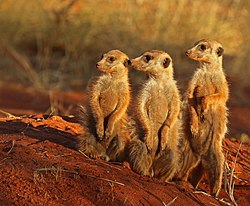 Slender-tailed Meerkat~80%+30%
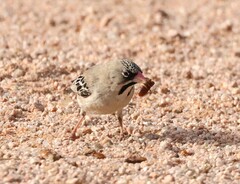
 White-browed Sparrow-Weaver~70%≈
 Cape Ground Squirrel~70%+20%
 Red-shouldered Glossy-starling~70%≈
 Yellow Mongoose~60%+20%
 Cape Turtle Dove~60%-20%
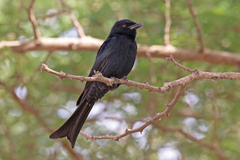 Fork-tailed Drongo~60%-20%
 Crimson-breasted Gonolek~60%≈
 Blue Wildebeest~50%≈
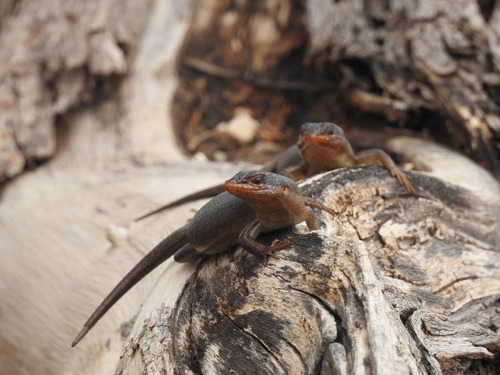
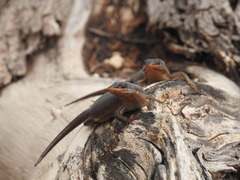 Karasburg Tree Skink~50%≈
 Gemsbok~40%-20%
 Springbok~30%-20%
-
Auchterlonie Museum
Daily sight. prob.vs avg -
Twee Rivieren Camp
Daily sight. prob.vs avg- Fork-tailed Drongo~70%-10%
- White-browed Sparrow-Weaver~70%-10%
- Yellow Mongoose~70%+20%
- Karasburg Tree Skink~60%+10%
- Cape Ground Squirrel~50%+10%
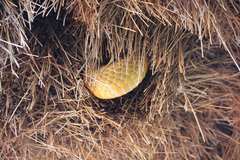
 Social Weaver~50%-10%
- Cape Turtle Dove~50%-30%
 Common Ostrich~50%-20%
- Gemsbok~50%-10%
 Pale Chanting Goshawk~40%-20%
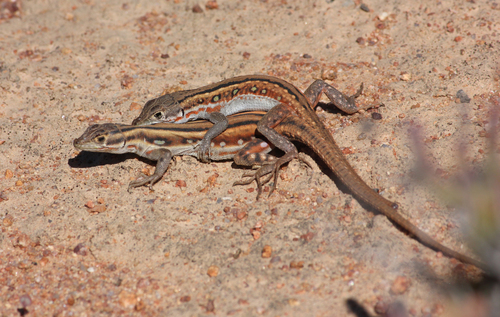
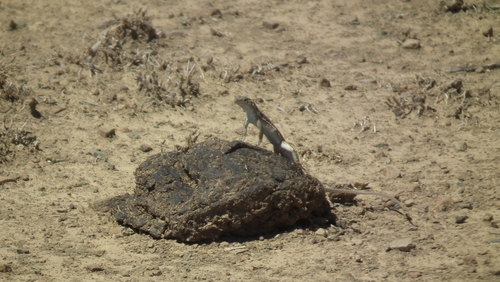
 Ground Agama~40%≈
- Red-shouldered Glossy-starling~40%-20%
-
Samevloeiing Pan
Daily sight. prob.vs avg -
Nossob Camp
Daily sight. prob.vs avg- Cape Ground Squirrel~70%+20%
- Yellow Mongoose~70%+20%
- Cape Turtle Dove~50%-30%
- Blue Wildebeest~50%≈
- Karasburg Tree Skink~50%≈
- Fork-tailed Drongo~40%-40%
- Red-shouldered Glossy-starling~40%-20%
- Ground Agama~40%≈
 Bibron's Thick-toed Gecko~40%+10%
- White-browed Sparrow-Weaver~40%-30%
- Springbok~40%-10%
 Common Barking Gecko~40%+20%




🏕️ Experience
Essentials
Entrance
Paid
Tourism
Low
Typical stay
4+
daysTrails
Easy
World Heritage
No
Climate
Temp °C Rain mm
JanFebMarAprMayJunJulAugSepOctNovDec
0.0 Excellent
Wallace's Line Score
How good is this park for seeing wildlife? 🦜
Biodiversity
Very goodHow rich is the wildlife?
4.2
Species by taxon
🦅 Birds 441
🐒 Mammals 96
🦎 Reptiles 83
🐸 Amphibians 9
629 Total Species
828 Global average across 316 parks
28 Threatened 13 Endemic
🔭
Sighting
Very goodHow likely to see animals?
3.9
🎯
Top-12 Avg Probability
66% 📊
Coverage (156 species at ≥5% of 629 in the inventory)
25% 🔀
Taxon variety in top 12 (11 bird, 1 mammal)
20% 🔭
Species per 10 outings (distinct species a visitor would meet over 10 outings — effort held equal across parks)
98 🌟
Iconic-group species (≥15%) (every species from the 19 iconic groups — monkeys, cats, toucans, macaws, sloths, crocodilians… — not just the 4 highlighted above)
25 ⭐
High-prob species (>40%)
32 🏕️
Experience
ExcellentHow easy and pleasant is the visit?
4.8
Climate Pleasant High
Entrance Paid Low
Tourism Low High
Trails Easy High
World Heritage No —
What visitors say
Another amazing encounter was when we spotted some Cheetah which were patiently watching Springbok grazing nearby.
So far, in our brief visit, we managed to see lions, cheetahs and African wild cats on multiple occasions, and on one morning we saw both bat-eared fox and the elusive cape fox, and of course black-back jackals everywhere!
Later in the trip we would see quite a few juvenile Black-winged Kites which I think are more attractive than the adult – as is with Pale Chanting Goshawks.
Their presence is crucial for the park’s predators, such as lions and cheetahs. - Spotted Hyena : The elusive hyena can be found across the African but sadly we never saw one.
Before you go
What animals can you see in Kgalagadi Transfrontier Park?
629 species
Kgalagadi Transfrontier Park has 629 recorded vertebrate species. The ones wildlife watchers report most often on a given day are Fork-tailed Drongo (about 80%), Cape Turtle Dove (about 80%), White-browed Sparrow-Weaver (about 70%), Common Ostrich (about 70%) and Social Weaver (about 70%). Among mammals, the most-seen is Gemsbok (about 60%); among reptiles, Karasburg Tree Skink (about 50%).
When is the best time to visit Kgalagadi Transfrontier Park for wildlife?
September
In that month the park's 12 most-seen species average about 80% on a given day, against about 50% in March. That is one of Kgalagadi Transfrontier Park's driest months, with almost no rain against 40 mm in January.
Can you see a Lion in Kgalagadi Transfrontier Park?
Yes
About 50% of wildlife watchers report a Lion sighting in Kgalagadi Transfrontier Park on a given day, based on 240 verified sightings from GBIF citizen-science data from 2019 to 2026. The best time is February (about 70%).
Can you see a Gemsbok in Kgalagadi Transfrontier Park?
Yes
About 60% of wildlife watchers report a Gemsbok sighting in Kgalagadi Transfrontier Park on a given day, based on 254 verified sightings from GBIF citizen-science data from 2019 to 2026. The best time is February and September (about 70%).
Can you see a Common Ostrich in Kgalagadi Transfrontier Park?
Yes
About 70% of wildlife watchers report a Common Ostrich sighting in Kgalagadi Transfrontier Park on a given day, based on 463 verified sightings from GBIF citizen-science data from 2019 to 2026. The best time is June, September and November (about 80%).
Where in Kgalagadi Transfrontier Park is wildlife easiest to see?
Around Mata Mata Camp
The richest sighting zone is around Mata Mata Camp, followed by Auchterlonie Museum and Twee Rivieren Camp, ranked by how many of the park's headline animals visitors can expect to see in each. See the zones on the map.
Is Kgalagadi Transfrontier Park good for wildlife watching?
3.9 out of 5
On the Wallace's Line Score, Kgalagadi Transfrontier Park rates 3.9/5: 127th of 316 parks worldwide and 51st in Africa. 37 of its species are reported by about 40% or more of wildlife watchers on a given day.


