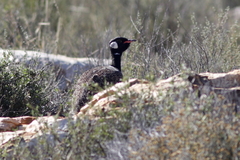
Southern Black Korhaan

Southern Black Korhaan

Afrotis afra

Endemic
Daily sighting probability <5% · Rare
at Addo Elephant National Park

In 3 days ~10% in a week ~20%

40 Verified sightings at Addo Elephant National Park From 2019 to 2026
908 In all 3 parks
September Best month
☀️ Diurnal When it's spotted

About the Southern Black Korhaan

The southern black korhaan (Afrotis afra), also known as the black bustard, is a species of bird in the bustard family, Otididae. This small bustard is found in southwestern South Africa, from Namaqualand, south to Cape Town and east to Makhanda. It prefers semi-arid habitats such as grasslands, shrublands and savannas where it can easily prey on ground-dwelling arthropods and eat seeds. It reproduces yearly in the spring and will lay about one or two eggs per breeding season.

Numbers have declined rapidly as much of its habitat has been converted to agricultural land and remaining tracts are often fragmented. Due to this habitat destruction, the species is considered vulnerable by the IUCN Red List.

The southern black korhaan was one of the many bird species originally described by Carl Linnaeus in the 1758 10th edition of his Systema Naturae, where it was given the binomial name of Otis afra. Formerly known as Eupodotis afra, it is now classified as Afrotis afra. They belong to the bustard family, Otididae.

It was previously thought that the southern black korhaan and the northern black korhaan were the same species (the northern black korhaan being a sub-species,... Wikipedia →

Sounds

Recording0:07

South Africa · 2021

© ChristianRM · iNaturalist · CC BY-NC 4.0

Recording0:06

South Africa · 2023

© Gigi Laidler · iNaturalist · CC BY-NC 4.0

Recording0:06

South Africa · 2022

© jacobus_h_visser · iNaturalist · CC BY-NC 4.0

Global Distribution

Parks Where Found

# Park Country Daily sighting probability
1 West Coast National Park 🇿🇦 South Africa
~50%
2 De Hoop Nature Reserve 🇿🇦 South Africa
<5%
3 Addo Elephant National Park 🇿🇦 South Africa
<5%

Before you go

What are the chances of seeing a Southern Black Korhaan in Addo Elephant National Park?

Rare

Under 5% of wildlife watchers report a Southern Black Korhaan sighting in Addo Elephant National Park on a given day, based on 40 verified sightings from GBIF citizen-science data from 2019 to 2026. It is the 172nd most-seen of the 243 birds we can rate there. Over three days the chance rises to about 10%, and over a week to about 20%, if each day is a fresh chance.

When is the best time to see a Southern Black Korhaan in Addo Elephant National Park?

February, September and December

In those months about 10% of wildlife watchers report a Southern Black Korhaan in Addo Elephant National Park on a given day, against under 5% in January, March–August and October–November, the lowest months.

What time of day is best to see a Southern Black Korhaan?

Between 2 and 5 pm

Across all the parks we cover, that three-hour window holds the most Southern Black Korhaan sightings with a recorded time, and about 9 in 10 of them come between 6 am and 6 pm: it is a daytime animal.

Is Addo Elephant National Park the best place to see a Southern Black Korhaan?

3rd of 3

Of the 3 parks where we can rate Southern Black Korhaan sightings, Addo Elephant National Park ranks 3rd at under 5%. The best odds are in West Coast National Park (South Africa, about 50%) and De Hoop Nature Reserve (South Africa, under 5%).

Which relatives of the Southern Black Korhaan live in Addo Elephant National Park?

Same family: Otididae

The closest relatives of the Southern Black Korhaan that you can see in Addo Elephant National Park (family Otididae, Bustards) are Denham's Bustard (about 20%) and Ludwig's Bustard (about 10%), with each one's daily chance of a sighting.

Where does the Southern Black Korhaan sighting chance come from?

GBIF citizen-science records

It is estimated from how often the Southern Black Korhaan is recorded against all the birds logged in Addo Elephant National Park (40 verified sightings from 2019 to 2026), calibrated against known sighting rates. Figures are rounded to the nearest 10% because citizen-science data supports honest approximations, not decimals, and months with records from fewer than five people show "—". How it works.

← Back to Addo Elephant National Park