Striped Stream Frog

Striped Stream Frog

Strongylopus fasciatus

Silhouette: Dmitry Bogdanov (vectorized by T. Michael Keesey) · PhyloPic

LCLeast ConcernNTVUENCR
Daily sighting probability ~10% · With luck
at Addo Elephant National Park

In 3 days ~20% in a week ~50%

12 Verified sightings at Addo Elephant National Park From 2019 to 2026
48 In all 2 parks
April Best month
☀️🌙 Day & Night When it's spotted

About the Striped Stream Frog

Strongylopus fasciatus, also known as the striped stream frog, striped grass frog, striped rana, striped long-toed frog or long-toed grass frog is a species of frog in the family Pyxicephalidae. It is endemic to southern Africa.

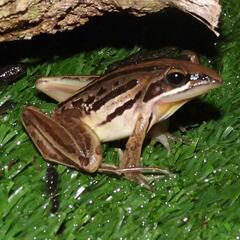
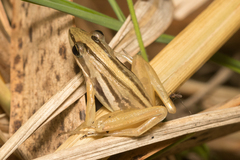
Strongylopus fasciatus is a small, long legged frog with a pointed snout. Its distinguishing features are the parallel yellow and brown longitudinal stripes along its back, with longitudinal dark stripes along its legs. It has a white belly and the males have yellow throats. The pupils are horizontal. It also has very long toes and, when crouched, the fourth toe on the rear feet extends past the front feet.

The call of Strongylopus fasciatus is a sharp "pip" which can be made singly or in a series of three or four calls. Strongylopus fasciatus occurs the Western Cape Province east through eastern South Africa to borders of Lesotho and Eswatini, then north into Zimbabwe, western Mozambique and south-western Zambia, its presence in Botswana has yet to be confirmed. In the Highveld of central South Africa it appears to be localised but extends as far west as the eastern Free State.

Strongylopus fasciatuscan... Wikipedia →

Sounds

Advertisement call0:22

South Africa · 2025

© Ruben Foquet · XC1000512 · CC BY-NC-SA 4.0

Recording0:37

South Africa · 2022

© Alex Rebelo · iNaturalist · CC BY-NC 4.0

Recording0:06

South Africa · 2005

© probreviceps · iNaturalist · CC BY-NC 4.0

Global Distribution

Parks Where Found

# Park Country Daily sighting probability
1 Garden Route National Park 🇿🇦 South Africa
~10%
2 Addo Elephant National Park 🇿🇦 South Africa
~10%

Before you go

What are the chances of seeing a Striped Stream Frog in Addo Elephant National Park?

With luck

About 10% of wildlife watchers report a Striped Stream Frog sighting in Addo Elephant National Park on a given day, based on 12 verified sightings from GBIF citizen-science data from 2019 to 2026. It is the 4th most-seen of the 8 amphibians we can rate there. Over three days the chance rises to about 20%, and over a week to about 50%, if each day is a fresh chance.

When is the best time to see a Striped Stream Frog in Addo Elephant National Park?

April

In that month about 30% of wildlife watchers report a Striped Stream Frog in Addo Elephant National Park on a given day, against under 5% in February–March, June–July, September and November, the lowest months.

What time of day is best to see a Striped Stream Frog?

Between 7 and 10 pm

Across all the parks we cover, that three-hour window holds the most Striped Stream Frog sightings with a recorded time, and about 6 in 10 of them come between 6 pm and 6 am: it is seen both by day and at night.

Is Addo Elephant National Park the best place to see a Striped Stream Frog?

Among the best

Of the 2 parks where we can rate Striped Stream Frog sightings, Addo Elephant National Park ranks 2nd at about 10%, level with the leaders once rounded. The best odds are in Garden Route National Park (South Africa, about 10%).

Which relatives of the Striped Stream Frog live in Addo Elephant National Park?

Same family: Pyxicephalidae

The closest relatives of the Striped Stream Frog that you can see in Addo Elephant National Park (family Pyxicephalidae, African Box-headed Frogs) are Boettger's dainty frog (about 10%), Cape sand frog (about 10%) and Dwarf Dainty Frog (about 10%), with each one's daily chance of a sighting.

Where does the Striped Stream Frog sighting chance come from?

GBIF citizen-science records

It is estimated from how often the Striped Stream Frog is recorded against all the amphibians logged in Addo Elephant National Park (12 verified sightings from 2019 to 2026), calibrated against known sighting rates. Figures are rounded to the nearest 10% because citizen-science data supports honest approximations, not decimals, and months with records from fewer than five people show "—". How it works.

← Back to Addo Elephant National Park