African Clawed Frog

African Clawed Frog

Xenopus laevis

Silhouette: Sarah Werning · PhyloPic

LCLeast ConcernNTVUENCR
Daily sighting probability ~10% · With luck
at Addo Elephant National Park

In 3 days ~20% in a week ~30%

5 Verified sightings at Addo Elephant National Park From 2019 to 2026
142 In all 8 parks
January Best month
☀️🌙 Day & Night When it's spotted

About the African Clawed Frog

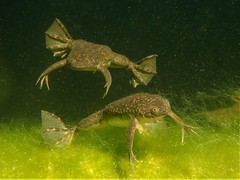
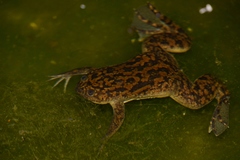
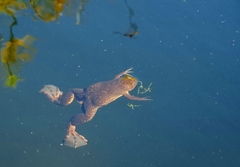
The African clawed frog (Xenopus laevis), also known as simply xenopus, African clawed toad, African claw-toed frog or the platanna) is a species of African aquatic frog of the family Pipidae. Its name is derived from the short black claws on its feet. The word Xenopus means 'strange foot' and laevis means 'smooth'.

The species is found throughout much of Sub-Saharan Africa (Nigeria and Sudan to South Africa), and in isolated, introduced populations in North America, South America, Europe, and Asia. All species of the family Pipidae are tongueless, toothless and completely aquatic. They use their hands to shove food in their mouths and down their throats and a hyobranchial pump to draw or suck things in their mouth. Pipidae have powerful legs for swimming and lunging after food. They also use the claws on their feet to tear pieces of large food. They have no external eardrums, but instead subcutaneous cartilaginous disks that serve the same function. They use their sensitive fingers and sense of smell to find food. Pipidae are scavengers and will eat almost anything living, dying, or dead and any type of organic waste.

It is considered an invasive species in several countries, including across Europe. Wikipedia →

Sounds

Recording0:07

South Africa · 2022

© Oliver Angus · iNaturalist · CC BY-NC 4.0

Recording

Brazil · 1988

© M.S. Hoogmoed · Xeno · CC BY 4.0

Global Distribution

Parks Where Found

# Park Country Daily sighting probability
1 De Hoop Nature Reserve 🇿🇦 South Africa
~20%
2 Garden Route National Park 🇿🇦 South Africa
~10%
3 iSimangaliso Wetland Park 🇿🇦 South Africa
~10%
4 Namib-Naukluft National Park 🇳🇦 Namibia
~10%
5 Table Mountain National Park 🇿🇦 South Africa
~10%
6 Channel Islands National Park 🇺🇸 United States
~10%
7 Addo Elephant National Park 🇿🇦 South Africa
~10%
8 Kruger National Park 🇿🇦 South Africa
<5%

Cities Where Found

# City Country Daily sighting probability
1 Harare 🇿🇼 Zimbabwe
~10%
2 Johannesburg 🇿🇦 South Africa
~10%
3 Pretoria 🇿🇦 South Africa
~10%
4 Cape Town 🇿🇦 South Africa
~10%
5 Santiago 🇨🇱 Chile
~10%
6 Durban 🇿🇦 South Africa
<5%
7 San Diego 🇺🇸 United States
<5%
8 Los Angeles 🇺🇸 United States
<5%

Zoos & Centres Where Found

# Zoo / Centre Country
1 San Diego Zoo 🇺🇸 United States In captivity
2 National Zoological Park 🇺🇸 United States In captivity
3 Antwerp Zoo 🇧🇪 Belgium In captivity
4 Belle Isle Aquarium 🇺🇸 United States In captivity
5 Beijing Wildlife Park 🇨🇳 China In captivity
6 Toronto Zoo 🇨🇦 Canada In captivity
7 Slimbridge Wetland Centre 🇬🇧 United Kingdom In captivity
8 Berlin Zoological Garden 🇩🇪 Germany In captivity
9 Virginia Zoological Park 🇺🇸 United States In captivity
10 Zoosafari Fasanolandia 🇮🇹 Italy In captivity
11 Hanover Zoo 🇩🇪 Germany In captivity
12 Nikolaev Zoo 🇺🇦 Ukraine In captivity
13 Amaru 🇪🇨 Ecuador In captivity
14 Tbilisi Zoo 🇬🇪 Georgia In captivity
15 Giraffe House 🇿🇦 South Africa In captivity
16 Ueno Zoological Gardens (West Garden) 🇯🇵 Japan In captivity
17 Manila Ocean Park 🇵🇭 Philippines In captivity
18 Yalta Zoo 🇺🇦 Ukraine In captivity
19 Aquarium Finisterrae 🇪🇸 Spain In captivity
20 Aquarium of the Pacific 🇺🇸 United States In captivity
21 Arequipa zoo 🇵🇪 Peru In captivity
22 Vancouver Aquarium 🇨🇦 Canada In captivity
23 Aquarium Barcelona 🇪🇸 Spain In captivity
24 Clearwater Marine Aquarium 🇺🇸 United States In captivity
25 Two Oceans Aquarium 🇿🇦 South Africa In captivity
26 Zoo Samara 🇷🇺 Russia In captivity
27 The Deep 🇬🇧 United Kingdom In captivity
28 Aquarium Berlin 🇩🇪 Germany In captivity
29 Aquário Vasco da Gama 🇵🇹 Portugal In captivity
30 Branson's Wild World 🇺🇸 United States In captivity
31 Dingle Oceanworld Aquarium 🇮🇪 Ireland In captivity
32 Woods Hole Science Aquarium 🇺🇸 United States In captivity
33 Acuario Inbursa 🇲🇽 Mexico In captivity
34 Aquatopia 🇧🇪 Belgium In captivity
35 Matlock Bath Aquarium 🇬🇧 United Kingdom In captivity
36 Sunshine Aquarium 🇯🇵 Japan In captivity
37 Zoológico del Parque de la Exposición 🇵🇪 Peru In captivity

Before you go

What are the chances of seeing an African Clawed Frog in Addo Elephant National Park?

With luck

About 10% of wildlife watchers report an African Clawed Frog sighting in Addo Elephant National Park on a given day, based on 5 verified sightings from GBIF citizen-science data from 2019 to 2026. It is the 7th most-seen of the 8 amphibians we can rate there. Over three days the chance rises to about 20%, and over a week to about 30%, if each day is a fresh chance.

When is the best time to see an African Clawed Frog in Addo Elephant National Park?

January, April and September–October

In those months about 10% of wildlife watchers report an African Clawed Frog in Addo Elephant National Park on a given day, against under 5% in February–March, May–August and November–December, the lowest months.

What time of day is best to see an African Clawed Frog?

Between 10 am and 1 pm

Across all the parks we cover, that three-hour window holds the most African Clawed Frog sightings with a recorded time, and about 7 in 10 of them come between 6 am and 6 pm: it is seen both by day and at night.

Is Addo Elephant National Park the best place to see an African Clawed Frog?

7th of 8

Of the 8 parks where we can rate African Clawed Frog sightings, Addo Elephant National Park ranks 7th at about 10%. The best odds are in De Hoop Nature Reserve (South Africa, about 20%), Garden Route National Park (South Africa, about 10%) and iSimangaliso Wetland Park (South Africa, about 10%).

Which relatives of the African Clawed Frog live in Addo Elephant National Park?

Same order: Anura

The closest relatives of the African Clawed Frog that you can see in Addo Elephant National Park (order Anura, Frogs and Toads) are Painted Reed Frog (about 20%), Leopard Toad (about 20%) and Ranger's Toad (about 10%), with each one's daily chance of a sighting.

Where does the African Clawed Frog sighting chance come from?

GBIF citizen-science records

It is estimated from how often the African Clawed Frog is recorded against all the amphibians logged in Addo Elephant National Park (5 verified sightings from 2019 to 2026), calibrated against known sighting rates. Figures are rounded to the nearest 10% because citizen-science data supports honest approximations, not decimals, and months with records from fewer than five people show "—". How it works.

← Back to Addo Elephant National Park