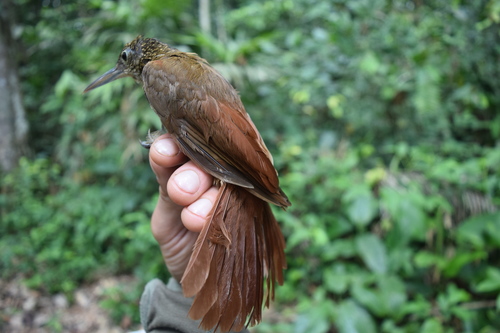
Pale-billed Hornero

Pale-billed Hornero

Furnarius torridus

Silhouette: Abraão B. Leite · PhyloPic

LCLeast ConcernNTVUENCR
Daily sighting probability <5% · Rare
at Amacayacu National Natural Park

In 3 days <5% in a week ~10%

8 Verified sightings at Amacayacu National Natural Park From 2019 to 2026
8 In 1 park
February Best month

About the Pale-billed Hornero

The bay hornero or pale-billed hornero (Furnarius torridus) is a species of bird in the Furnariinae subfamily of the ovenbird family Furnariidae. It is found in Brazil, Colombia, Peru, and possibly Ecuador. The bay hornero was originally described as a species but some early 20th century authors treated it as a subspecies of the pale-legged hornero (F. leucopus). Since the 1930s most taxonomists have again treated it as a species and early 2010s genetic data confirmed that treatment. However, even as late as 1973 one author considered it a color morph of the pale-legged.

The bay hornero is monotypic. The bay hornero is 16 to 19 cm (6.3 to 7.5 in) long and weighs about 53 g (1.9 oz). It is a stout hornero with a long and nearly straight bill. The sexes' plumages are alike. Adults have a dull buffy white supercilium. Their crown and nape are grayish brown. Their back, rump, uppertail and wing coverts, and tail are chestnut brown ("bay"). Most of their wing is also chestnut brown, with a small area of pale rufous on the inner primaries. Their throat is white with dark tawny brown sides. Their breast is dark tawny brown, their flanks buffy... Wikipedia →

Sounds

Song0:16

Brazil · 2020

© GABRIEL LEITE · XC591711 · CC BY-NC-SA 4.0

Call?0:34

Peru · 2010

© Peter Boesman · XC270693 · CC BY-NC-ND 4.0

Call0:21

Peru · 1997

© John V. Moore · XC258093 · CC BY-NC-SA 4.0

Global Distribution

Parks Where Found

# Park Country Daily sighting probability
1 Amacayacu National Natural Park 🇨🇴 Colombia
<5%

More parks will be added in future updates.

Before you go

What are the chances of seeing a Pale-billed Hornero in Amacayacu National Natural Park?

Rare

Under 5% of wildlife watchers report a Pale-billed Hornero sighting in Amacayacu National Natural Park on a given day, based on 8 verified sightings from GBIF citizen-science data from 2019 to 2026. It is the 395th most-seen of the 436 birds we can rate there. Over three days the chance rises to under 5%, and over a week to about 10%, if each day is a fresh chance.

When is the best time to see a Pale-billed Hornero in Amacayacu National Natural Park?

Any time of year

In every month with enough records, under 5% of wildlife watchers report a Pale-billed Hornero in Amacayacu National Natural Park on a given day, so our monthly data shows no clear season.

Where else can you see a Pale-billed Hornero?

Only Amacayacu National Natural Park, in our data

Amacayacu National Natural Park is the only park on Wallace's Line with enough records to rate Pale-billed Hornero sightings: under 5% of wildlife watchers there report one on a given day.

Where does the Pale-billed Hornero sighting chance come from?

GBIF citizen-science records

It is estimated from how often the Pale-billed Hornero is recorded against all the birds logged in Amacayacu National Natural Park (8 verified sightings from 2019 to 2026), calibrated against known sighting rates. Figures are rounded to the nearest 10% because citizen-science data supports honest approximations, not decimals, and months with records from fewer than five people show "—". How it works.

← Back to Amacayacu National Natural Park