Gray Toad

Gray Toad

Rhinella poeppigii

Silhouette: Dennis C. Murphy, after http://bit.ly/4q6IESe · PhyloPic

LCLeast ConcernNTVUENCR
Daily sighting probability ~50% · Likely
at Amboró National Park

In 3 days ~90% in a week >90%

6 Verified sightings at Amboró National Park From 2019 to 2026
6 In 1 park
May Best month
☀️🌙 Day & Night When it's spotted

About the Gray Toad

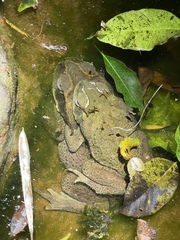
Rhinella poeppigii (common names: gray toad, Poepiggi's toad) is a species of toad in the family Bufonidae that is known from the eastern Andean slopes of Ecuador, Peru, and Bolivia, as well as from Serranía de Sira in Amazonian Peru. Its distinctiveness from Rhinella marina has been debated, but it is currently accepted as a valid species. It is named after Eduard Friedrich Poeppig, German botanist and naturalist who made scientific expeditions to South America.

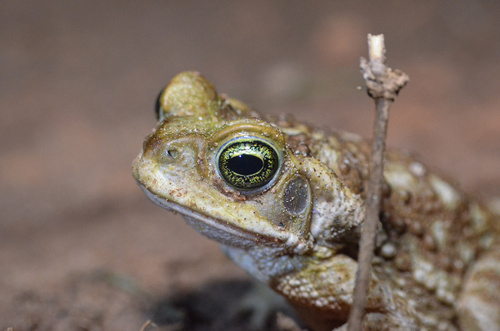
Rhinella poeppigii resembles Rhinella marina but is smaller. Males measure 81–111 mm (3.2–4.4 in) and females 122–128 mm (4.8–5.0 in) in snout–vent length. They are grayish brown in colour and with rough, tuberculate skin. Belly has lighter colour and lacks markings, or has pale markings only.

Natural habitats of Rhinella poeppigii are cloud forests on the Andean slopes, and tropical moist forest in the Amazonian foothills. It is typically found near streams and standing water. Its altitudinal range is 260–1,800 m (850–5,910 ft) asl.

There are no threats to this reasonably abundant species. It is also present in many protected areas. Wikipedia →
Global Distribution

Parks Where Found

# Park Country Daily sighting probability
1 Amboró National Park 🇧🇴 Bolivia
~50%

More parks will be added in future updates.

Before you go

What are the chances of seeing a Gray Toad in Amboró National Park?

Likely

About 50% of wildlife watchers report a Gray Toad sighting in Amboró National Park on a given day, based on 6 verified sightings from GBIF citizen-science data from 2019 to 2026. Over three days the chance rises to about 90%, and over a week to over 90%, if each day is a fresh chance.

When is the best time to see a Gray Toad in Amboró National Park?

May

In that month about 70% of wildlife watchers report a Gray Toad in Amboró National Park on a given day, against about 10% in April, the lowest month. February–March and December have too few records to rate.

What time of day is best to see a Gray Toad?

Between 6 and 9 pm

Across all the parks we cover, that three-hour window holds the most Gray Toad sightings with a recorded time, and about half of them come between 6 pm and 6 am: it is seen both by day and at night.

Where else can you see a Gray Toad?

Only Amboró National Park, in our data

Amboró National Park is the only park on Wallace's Line with enough records to rate Gray Toad sightings: about 50% of wildlife watchers there report one on a given day.

Where does the Gray Toad sighting chance come from?

GBIF citizen-science records

It is estimated from how often the Gray Toad is recorded against all the amphibians logged in Amboró National Park (6 verified sightings from 2019 to 2026), calibrated against known sighting rates. Figures are rounded to the nearest 10% because citizen-science data supports honest approximations, not decimals, and months with records from fewer than five people show "—". How it works.

← Back to Amboró National Park