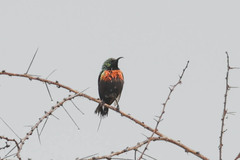
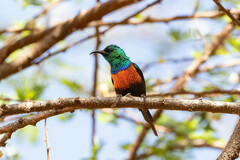
Black-bellied Sunbird

Black-bellied Sunbird

Cinnyris nectarinioides

Silhouette: Sheatherius · PhyloPic

LCLeast ConcernNTVUENCR
Daily sighting probability <5% · Rare
at Amboseli National Park

In 3 days <5% in a week ~10%

11 Verified sightings at Amboseli National Park From 2019 to 2026
551 In all 6 parks
December Best month
☀️ Diurnal When it's spotted

About the Black-bellied Sunbird

The black-bellied sunbird (Cinnyris nectarinioides) is a small sunbird located primarily in Africa. Two subspecies are recognized: the Cinnyris nectarinioides erlangeri, which is smaller and found in Ethiopia, Somalia, and Kenya; and the Cinnyris nectarinioides nectarinioides, which is larger and found in Kenya and Tanzania. This bird inhabits savannah, wetlands, and terrestrial freshwater areas.

This species has an average size of 13cm for males and 10 cm for females with both weights typically ranging from 4 to 6 grams. The black-bellied sunbird feeds on nectar, insects and spiders, the latter having gained it the nickname "spiderhunter". They forage in the higher levels of trees and perch in order to feed. These birds do not migrate in different seasons of the year, and inhabit the same area year round.

The black-bellied sunbird is part of the species Cinnyris nectarinioides and has two recognized subspecies. The smaller, the Cinnyris nectarinioides erlangeri inhabits Northeast Kenya and can also be found in Southeast Ethiopia and South Somalia. The larger subspecies, the Cinnyris nectarinioides nectarinioides, inhabits Southeast Kenya and Northeast Tanzania. Both... Wikipedia →

Sounds

Song and call0:20

Kenya · 2024

© Peter Boesman · XC948068 · CC BY-NC-ND 4.0

Call0:06

Kenya · 2020

© isaac kilusu · XC581954 · CC BY-NC-SA 4.0

Song0:28

Ethiopia · 2015

© Hans Matheve · XC305828 · CC BY-NC-ND 4.0

Global Distribution

Parks Where Found

# Park Country Daily sighting probability
1 Meru National Park 🇰🇪 Kenya
~50%
2 Mkomazi National Park 🇹🇿 Tanzania
~40%
3 Samburu National Reserve 🇰🇪 Kenya
~20%
4 Tsavo West National Park 🇰🇪 Kenya
~10%
5 Tsavo East National Park 🇰🇪 Kenya
~10%
6 Amboseli National Park 🇰🇪 Kenya
<5%

Before you go

What are the chances of seeing a Black-bellied Sunbird in Amboseli National Park?

Rare

Under 5% of wildlife watchers report a Black-bellied Sunbird sighting in Amboseli National Park on a given day, based on 11 verified sightings from GBIF citizen-science data from 2019 to 2026. It is the 298th most-seen of the 362 birds we can rate there. Over three days the chance rises to under 5%, and over a week to about 10%, if each day is a fresh chance.

When is the best time to see a Black-bellied Sunbird in Amboseli National Park?

December

In that month about 10% of wildlife watchers report a Black-bellied Sunbird in Amboseli National Park on a given day, against under 5% in January to November, the lowest months. That is one of Amboseli National Park's wettest months, with about 130 mm of rain against 10 mm in July.

What time of day is best to see a Black-bellied Sunbird?

Between 8 and 11 am

Across all the parks we cover, that three-hour window holds the most Black-bellied Sunbird sightings with a recorded time, and about 8 in 10 of them come between 6 am and 6 pm: it is a daytime animal.

Is Amboseli National Park the best place to see a Black-bellied Sunbird?

6th of 6

Of the 6 parks where we can rate Black-bellied Sunbird sightings, Amboseli National Park ranks 6th at under 5%. The best odds are in Meru National Park (Kenya, about 50%), Mkomazi National Park (Tanzania, about 40%) and Samburu National Reserve (Kenya, about 20%).

Where does the Black-bellied Sunbird sighting chance come from?

GBIF citizen-science records

It is estimated from how often the Black-bellied Sunbird is recorded against all the birds logged in Amboseli National Park (11 verified sightings from 2019 to 2026), calibrated against known sighting rates. Figures are rounded to the nearest 10% because citizen-science data supports honest approximations, not decimals, and months with records from fewer than five people show "—". How it works.

← Back to Amboseli National Park