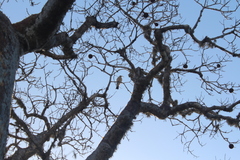

Sickle-billed Vanga

Sickle-billed Vanga

Falculea palliata

Silhouette: Sheatherius · PhyloPic

LCLeast ConcernNTVUENCR Endemic
Daily sighting probability ~50% · Likely
at Ankarafantsika National Park

In 3 days ~90% in a week >90%

297 Verified sightings at Ankarafantsika National Park From 2019 to 2026
297 In 1 park
November Best month
🌅 Crepuscular When it's spotted

About the Sickle-billed Vanga

The sickle-billed vanga (Falculea palliata) is a species of bird in the vanga family Vangidae. It is monotypic within the genus Falculea. It is endemic to Madagascar. Its natural habitats are tropical dry forests and tropical dry shrubland.

The sickle-billed vanga was described by Isidore Geoffroy Saint-Hilaire in 1836, who also erected the genus Falculea to place it in. There are no subspecies. Like many members of the vanga family it was previously placed in another family by early scientists. In the case of this species it was placed with the crows and jays in Corvidae by H. Gadow in the 1883 Catalogue of the British Museum. Within the Vangidae it seems that the closest relatives are the Bernier's vanga (Oriolia bernieri), the white-headed vanga (Artamella virdis) and the three species in the genus Xenopirostris. It is thought that the sickle-billed vanga split from the white-headed vanga around 1.1 million years ago. The two species share similar plumage but are very different in size and bill shape, reflecting the wide plasticity in body shape and feeding ecology in the vanga radiation. Both species, as well as their other close relatives, also share a unique intense... Wikipedia →

Sounds

Song0:11

Madagascar · 2025

© Frank Lambert · XC1066177 · CC BY-NC-ND 4.0

Call0:05

Madagascar · 2020

© Ken Behrens · XC651282 · CC BY-NC-SA 4.0

Song?0:21

Madagascar · 2012

© Hans Matheve · XC155299 · CC BY-NC-ND 3.0

Global Distribution

Parks Where Found

# Park Country Daily sighting probability
1 Ankarafantsika National Park 🇲🇬 Madagascar
~50%

More parks will be added in future updates.

Before you go

What are the chances of seeing a Sickle-billed Vanga in Ankarafantsika National Park?

Likely

About 50% of wildlife watchers report a Sickle-billed Vanga sighting in Ankarafantsika National Park on a given day, based on 297 verified sightings from GBIF citizen-science data from 2019 to 2026. It is the 22nd most-seen of the 83 birds we can rate there. Over three days the chance rises to about 90%, and over a week to over 90%, if each day is a fresh chance.

When is the best time to see a Sickle-billed Vanga in Ankarafantsika National Park?

November

In that month about 70% of wildlife watchers report a Sickle-billed Vanga in Ankarafantsika National Park on a given day, against about 30% in August and September, the lowest months. January–March and May have too few records to rate.

What time of day is best to see a Sickle-billed Vanga?

Between 5 and 8 am

Across all the parks we cover, that three-hour window holds the most Sickle-billed Vanga sightings with a recorded time, and about 6 in 10 of them come between 6 am and 6 pm: it is most active around dawn and dusk.

Where else can you see a Sickle-billed Vanga?

Only Ankarafantsika National Park, in our data

Ankarafantsika National Park is the only park on Wallace's Line with enough records to rate Sickle-billed Vanga sightings: about 50% of wildlife watchers there report one on a given day.

Which relatives of the Sickle-billed Vanga live in Ankarafantsika National Park?

Same family: Vangidae

The closest relatives of the Sickle-billed Vanga that you can see in Ankarafantsika National Park (family Vangidae, Vangas, Helmetshrikes, and Allies) are Common Newtonia (about 80%), Rufous Vanga (about 60%) and Van Dam's Vanga (about 40%), with each one's daily chance of a sighting.

Where does the Sickle-billed Vanga sighting chance come from?

GBIF citizen-science records

It is estimated from how often the Sickle-billed Vanga is recorded against all the birds logged in Ankarafantsika National Park (297 verified sightings from 2019 to 2026), calibrated against known sighting rates. Figures are rounded to the nearest 10% because citizen-science data supports honest approximations, not decimals, and months with records from fewer than five people show "—". How it works.

← Back to Ankarafantsika National Park