White-breasted Mesite

White-breasted Mesite

Mesitornis variegatus

Silhouette: Ferran Sayol · PhyloPic

LCNTVUVulnerableENCR Endemic
Daily sighting probability ~60% · Likely
at Ankarafantsika National Park

In 3 days ~90% in a week >90%

307 Verified sightings at Ankarafantsika National Park From 2019 to 2026
307 In 1 park
November Best month
🌅 Crepuscular When it's spotted

About the White-breasted Mesite

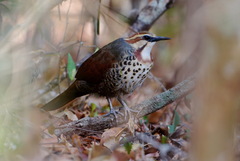
The white-breasted mesite or white-breasted roatelo (Mesitornis variegatus) is a ground-dwelling bird endemic to Madagascar. One of three species in the mesite family, Mesitornithidae, it is classified as vulnerable by the International Union for Conservation of Nature (IUCN). It has a small population and is restricted to five sites in the north and west of the island, and one in the east.

The white-breasted mesite is a medium-sized terrestrial bird which is often described as rail-like. The species has a white face with distinctive facial markings (a white supercilium and dark malar stripes) and a short dark straight bill. The upperparts are rufous brown, the underside is white with a tawny chest band and a barred belly. The wings are short and rounded and the bird only flies a few metres when pursued. It has a melodic song and sings in the early morning and during the day.

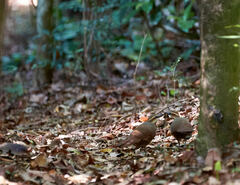
The white-breasted mesite is a forest species; living in groups of two to four individuals which can be seen resting, or feeding on the ground during the day. The brown upper plumage provides camouflage while the bird forage on the forest floor, flicking over leaf-litter to find... Wikipedia →

Sounds

Song0:47

Madagascar · 2025

© Frank Lambert · XC1066191 · CC BY-NC-ND 4.0

Call0:23

Madagascar · 2020

© Ken Behrens · XC624013 · CC BY-NC-SA 4.0

Song0:44

Madagascar · 2012

© Peter Boesman · XC762830 · CC BY-NC-ND 4.0

Global Distribution

Parks Where Found

# Park Country Daily sighting probability
1 Ankarafantsika National Park 🇲🇬 Madagascar
~60%

More parks will be added in future updates.

Closest Relatives at Ankarafantsika National Park

No species of the same family or order lives in Ankarafantsika National Park, so these are its closest relatives here: other birds.

Before you go

What are the chances of seeing a White-breasted Mesite in Ankarafantsika National Park?

Likely

About 60% of wildlife watchers report a White-breasted Mesite sighting in Ankarafantsika National Park on a given day, based on 307 verified sightings from GBIF citizen-science data from 2019 to 2026. It is the 13th most-seen of the 83 birds we can rate there. Over three days the chance rises to about 90%, and over a week to over 90%, if each day is a fresh chance.

When is the best time to see a White-breasted Mesite in Ankarafantsika National Park?

July and November

In those months about 70% of wildlife watchers report a White-breasted Mesite in Ankarafantsika National Park on a given day, against about 40% in April and August–September, the lowest months. Those are among Ankarafantsika National Park's driest months, with about 80 mm of rain a month against 560 mm in January. January–March and May have too few records to rate.

What time of day is best to see a White-breasted Mesite?

Between 6 and 9 am

Across all the parks we cover, that three-hour window holds the most White-breasted Mesite sightings with a recorded time, and about 6 in 10 of them come between 6 am and 6 pm: it is most active around dawn and dusk.

Where else can you see a White-breasted Mesite?

Only Ankarafantsika National Park, in our data

Ankarafantsika National Park is the only park on Wallace's Line with enough records to rate White-breasted Mesite sightings: about 60% of wildlife watchers there report one on a given day.

Where does the White-breasted Mesite sighting chance come from?

GBIF citizen-science records

It is estimated from how often the White-breasted Mesite is recorded against all the birds logged in Ankarafantsika National Park (307 verified sightings from 2019 to 2026), calibrated against known sighting rates. Figures are rounded to the nearest 10% because citizen-science data supports honest approximations, not decimals, and months with records from fewer than five people show "—". How it works.

← Back to Ankarafantsika National Park