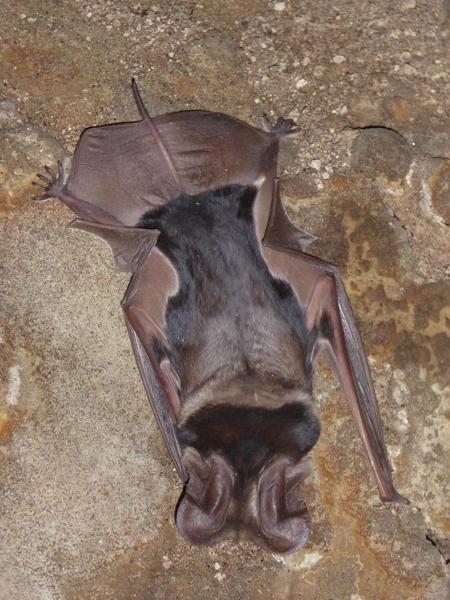
Madagascan Fruit Bat

Madagascan Fruit Bat

Eidolon dupreanum

LCNTVUVulnerableENCR
Daily sighting probability ~40% · Likely
at Ankarana National Park

In 3 days ~80% in a week >90%

17 Verified sightings at Ankarana National Park From 2019 to 2026
17 In 1 park
September Best month
☀️ Diurnal When it's spotted

About the Madagascan Fruit Bat

The Madagascan fruit bat (Eidolon dupreanum) is a species of bat in the family Pteropodidae. It is endemic to Madagascar and is listed as "Vulnerable" by the IUCN because it is hunted as bushmeat. Eidolon dupreanum is named after the Governor of Réunion from 1864 to 1869, Marie Jules Dupré, for the help he gave to scientific researchers. The Madagascan fruit bat is found both around the coastal plain and in the inland high plateau. It has not been recorded in some areas but that is likely to be because it has not been observed rather than that it is absent from these areas. It requires suitable rock fissures and caves in which to roost during the day. Colony size varies between about ten and five hundred individuals.

Examination of the droppings from the Madagascan fruit bat show that it mainly consumes fruit but also feeds on the flowers of Eucalyptus spp. It was found to fly as far as 5 kilometres (3.1 mi) to reach trees of Polyscias spp. while largely neglecting the guava trees Psidium near its roost. Seeds smaller than about 7 mm (0.3 in) in diameter were swallowed. This helped with dispersal of the seed and it has been shown that seed...

Wikipedia →

Sounds

Recording0:25

Madagascar · 2025

© Andrianiaina Angelo · iNaturalist · CC BY-NC 4.0

Recording0:35

Madagascar · 2025

© dbeadle · iNaturalist · CC BY-NC 4.0

Global Distribution

Parks Where Found

# Park Country Daily sighting probability
1 Ankarana National Park 🇲🇬 Madagascar
~40%

More parks will be added in future updates.

Zoos & Centres Where Found

# Zoo / Centre Country
1 Lemur Island 🇲🇬 Madagascar In captivity
2 Mandraka Reptile Farm 🇲🇬 Madagascar In captivity

Before you go

What are the chances of seeing a Madagascan Fruit Bat in Ankarana National Park?

Likely

About 40% of wildlife watchers report a Madagascan Fruit Bat sighting in Ankarana National Park on a given day, based on 17 verified sightings from GBIF citizen-science data from 2019 to 2026. It is the 3rd most-seen of the 9 mammals we can rate there. Over three days the chance rises to about 80%, and over a week to over 90%, if each day is a fresh chance.

When is the best time to see a Madagascan Fruit Bat in Ankarana National Park?

September

In that month about 60% of wildlife watchers report a Madagascan Fruit Bat in Ankarana National Park on a given day, against about 10% in April–May and December, the lowest months. That is one of Ankarana National Park's driest months, with about 10 mm of rain against 460 mm in January. March has too few records to rate.

What time of day is best to see a Madagascan Fruit Bat?

Between 2 and 5 pm

Across all the parks we cover, that three-hour window holds the most Madagascan Fruit Bat sightings with a recorded time, and about 8 in 10 of them come between 6 am and 6 pm: it is a daytime animal.

Where else can you see a Madagascan Fruit Bat?

Only Ankarana National Park, in our data

Ankarana National Park is the only park on Wallace's Line with enough records to rate Madagascan Fruit Bat sightings: about 40% of wildlife watchers there report one on a given day.

Where does the Madagascan Fruit Bat sighting chance come from?

GBIF citizen-science records

It is estimated from how often the Madagascan Fruit Bat is recorded against all the mammals logged in Ankarana National Park (17 verified sightings from 2019 to 2026), calibrated against known sighting rates. Figures are rounded to the nearest 10% because citizen-science data supports honest approximations, not decimals, and months with records from fewer than five people show "—". How it works.

← Back to Ankarana National Park