Madagascar free-tailed bat

Madagascar free-tailed bat

Otomops madagascariensis

Silhouette: T. Michael Keesey · PhyloPic

LCLeast ConcernNTVUENCR Endemic
Daily sighting probability ~40% · Likely
at Ankarana National Park

In 3 days ~80% in a week >90%

7 Verified sightings at Ankarana National Park From 2019 to 2026
7 In 1 park
July Best month
🌅 Crepuscular When it's spotted

About the Madagascar free-tailed bat

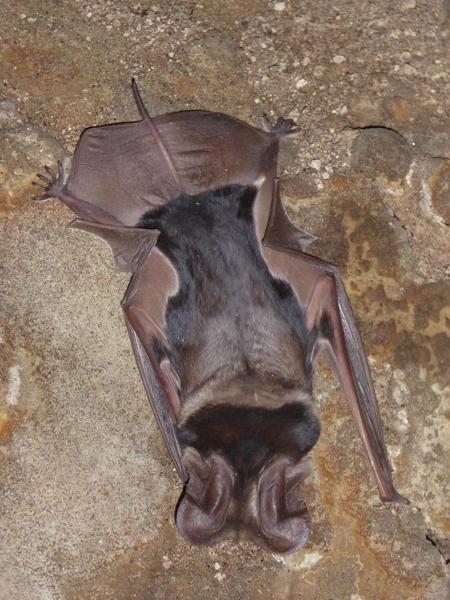
The Madagascar free-tailed bat or Malagasy giant mastiff bat (Otomops madagascariensis) is a species of free-tailed bat formerly included as a subspecies of the large-eared free-tailed bat, but that was later considered to be a distinct, Malagasy species. The Madagascar free-tailed bat is endemic to northern, western, and southern Madagascar.

The Madagascar free-tailed bat is listed as Least Concern by the IUCN Red List due to its widespread distribution in Madagascar. Threats to it are unclear and more research is needed into the possible disturbance of its roost sites. The species roosts in one cave that is considered to be fady, or taboo, and it has been recorded in five protected areas: Parc National du Tsingy de Bemaraha, Parc National de Namoroka, Parc National d’Isalo, Réserve Spéciale d’Ankarana and Réserve Spéciale d’Analamerana. There are nine currently known roosting colonies, and all are in areas that receive some sort of protection by Madagascar. The population of the Madagascar free-tailed bat is unknown.

The Madagascar free-tailed bat is supposed to be an obligate cave dweller and roosts in areas with sandstone and limestone outcrops. The caves where the species lived in Réserve Spéciale d’Ankarana were all associated with cool temperatures, high elevation, and a close proximity to water. The diet of the Madagascar free-tailed bat consists mostly of butterflies and beetles, and the foraging habitats are not believed to be associated with an intact forest.

Wikipedia →

Global Distribution

Parks Where Found

# Park Country Daily sighting probability
1 Ankarana National Park 🇲🇬 Madagascar
~40%

More parks will be added in future updates.

Before you go

What are the chances of seeing a Madagascar free-tailed bat in Ankarana National Park?

Likely

About 40% of wildlife watchers report a Madagascar free-tailed bat sighting in Ankarana National Park on a given day, based on 7 verified sightings from GBIF citizen-science data from 2019 to 2026. It is the 6th most-seen of the 9 mammals we can rate there. Over three days the chance rises to about 80%, and over a week to over 90%, if each day is a fresh chance.

When is the best time to see a Madagascar free-tailed bat in Ankarana National Park?

July and August

In those months about 60% of wildlife watchers report a Madagascar free-tailed bat in Ankarana National Park on a given day, against about 10% in April–May, September and November–December, the lowest months. Those are among Ankarana National Park's driest months, with about 10 mm of rain a month against 460 mm in January. January to March have too few records to rate.

What time of day is best to see a Madagascar free-tailed bat?

Between 4 and 7 pm

Across all the parks we cover, that three-hour window holds the most Madagascar free-tailed bat sightings with a recorded time, and about half of them come between 6 am and 6 pm: it is most active around dawn and dusk.

Where else can you see a Madagascar free-tailed bat?

Only Ankarana National Park, in our data

Ankarana National Park is the only park on Wallace's Line with enough records to rate Madagascar free-tailed bat sightings: about 40% of wildlife watchers there report one on a given day.

Which relatives of the Madagascar free-tailed bat live in Ankarana National Park?

Same order: Chiroptera

The closest relatives of the Madagascar free-tailed bat that you can see in Ankarana National Park (order Chiroptera, Bats) are Madagascan Fruit Bat (about 40%) and Madagascan Rousette (about 30%), with each one's daily chance of a sighting.

Where does the Madagascar free-tailed bat sighting chance come from?

GBIF citizen-science records

It is estimated from how often the Madagascar free-tailed bat is recorded against all the mammals logged in Ankarana National Park (7 verified sightings from 2019 to 2026), calibrated against known sighting rates. Figures are rounded to the nearest 10% because citizen-science data supports honest approximations, not decimals, and months with records from fewer than five people show "—". How it works.

← Back to Ankarana National Park
