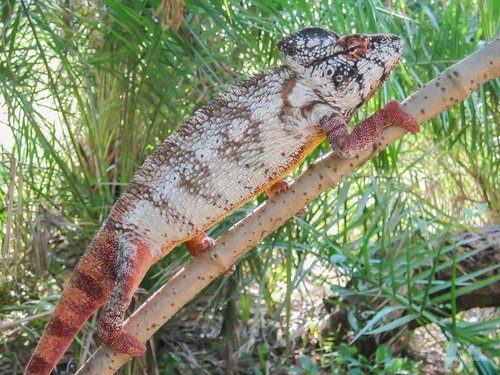
Petter's Chameleon

Petter's Chameleon

Furcifer petteri

LCNTVUVulnerableENCR Endemic
Daily sighting probability ~50% · Likely
at Ankarana National Park

In 3 days ~90% in a week >90%

21 Verified sightings at Ankarana National Park From 2019 to 2026
21 In 1 park
September Best month
🌙 Nocturnal When it's spotted

About the Petter's Chameleon

The Petter's chameleon (Furcifer petteri) is a species of chameleon, which is endemic to northern Madagascar. Furcifer petteri was initially described as the subspecies Chamaeleo willsii petteri by Édouard-Raoul Brygoo and Charles Domergue in 1966, but later transferred to the genus Furcifer and given full species status by Frank Glaw and Miguel Vences in 1994.

Both the specific name, petteri, and the common name, Petter's chameleon, are in honour of French primatologist Jean-Jacques Petter. Furcifer petteri is endemic to Madagascar. Its type locality is the eastern edge of the Ankarana Reserve, specifically the Ankarana massif (French: Bordure Est du massif de l'Ankarana, Madagascar).

Furcifer petteri is listed as a vulnerable species by the International Union for Conservation of Nature (IUCN) because its geographic range only covers an area of 11,000 square kilometres (4,200 square miles) in northern Madagascar, where the remaining forest is in decline. It lives between 120 and 850 metres (390 and 2,790 feet) above mean sea level, where it is threatened by mining, logging for rosewood and charcoal, and...

Wikipedia →

Global Distribution

Parks Where Found

# Park Country Daily sighting probability
1 Ankarana National Park 🇲🇬 Madagascar
~50%

More parks will be added in future updates.

Before you go

What are the chances of seeing a Petter's Chameleon in Ankarana National Park?

Likely

About 50% of wildlife watchers report a Petter's Chameleon sighting in Ankarana National Park on a given day, based on 21 verified sightings from GBIF citizen-science data from 2019 to 2026. It is the 7th most-seen of the 12 reptiles we can rate there. Over three days the chance rises to about 90%, and over a week to over 90%, if each day is a fresh chance.

When is the best time to see a Petter's Chameleon in Ankarana National Park?

June and September

In those months about 70% of wildlife watchers report a Petter's Chameleon in Ankarana National Park on a given day, against about 10% in April and May, the lowest months. Those are among Ankarana National Park's driest months, with about 15 mm of rain a month against 460 mm in January. March has too few records to rate.

What time of day is best to see a Petter's Chameleon?

Between 6 and 9 pm

Across all the parks we cover, that three-hour window holds the most Petter's Chameleon sightings with a recorded time, and about 8 in 10 of them come between 6 pm and 6 am: it is mostly seen at night.

Where else can you see a Petter's Chameleon?

Only Ankarana National Park, in our data

Ankarana National Park is the only park on Wallace's Line with enough records to rate Petter's Chameleon sightings: about 50% of wildlife watchers there report one on a given day.

Which relatives of the Petter's Chameleon live in Ankarana National Park?

Same genus: Furcifer

The closest relatives of the Petter's Chameleon that you can see in Ankarana National Park (genus Furcifer, Fork-footed Chameleons) are Panther Chameleon (about 80%) and Oustalet's Giant Chameleon (about 80%), with each one's daily chance of a sighting.

Where does the Petter's Chameleon sighting chance come from?

GBIF citizen-science records

It is estimated from how often the Petter's Chameleon is recorded against all the reptiles logged in Ankarana National Park (21 verified sightings from 2019 to 2026), calibrated against known sighting rates. Figures are rounded to the nearest 10% because citizen-science data supports honest approximations, not decimals, and months with records from fewer than five people show "—". How it works.

← Back to Ankarana National Park