Panther Chameleon

Panther Chameleon

Furcifer pardalis

LCLeast ConcernNTVUENCR
Daily sighting probability ~80% · Very likely
at Ankarana National Park

In 3 days >90%

62 Verified sightings at Ankarana National Park From 2019 to 2026
86 In all 2 parks
September Best month
🌅 Crepuscular When it's spotted

About the Panther Chameleon

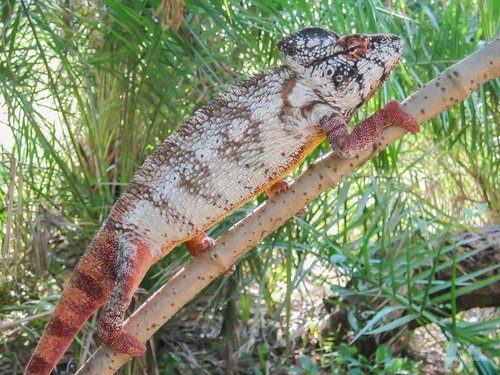
The panther chameleon (Furcifer pardalis) is a species of chameleon found in the eastern and northern parts of Madagascar in a tropical forest biome. Additionally, it has been introduced to Réunion and Mauritius, as well as the state of Florida within the United States.

The panther chameleon was first described by French naturalist Georges Cuvier in 1829. Its generic name (Furcifer) is derived from the Latin root furci meaning "forked" and refers to the shape of the animal's feet. The specific name pardalis refers to the animals' markings, as it is Latin for "leopard" or "spotted like a panther". The English word chameleon (also chamaeleon) derives from Latin chamaeleō, a borrowing of the Ancient Greek χαμαιλέων (khamailéōn), a compound of χαμαί (khamaí) "on the ground" and λέων (léōn) "lion". The Greek word is a calque translating the Akkadian nēš qaqqari, "ground lion".

Although currently regarded as a single widespread and variably-colored species, evidence from genetics and captive breeding indicates that it possibly should be split into several different species. Panther chameleons grow 16-20" (40–51 cm) long, with females typically being smaller...

Wikipedia →

Global Distribution

Parks Where Found

# Park Country Daily sighting probability
1 Ankarana National Park 🇲🇬 Madagascar
~80%
2 Montagne d'Ambre National Park 🇲🇬 Madagascar
~70%

Zoos & Centres Where Found

# Zoo / Centre Country
1 Moscow Zoo 🇷🇺 Russia In captivity
2 Pairi Daiza 🇧🇪 Belgium In captivity
3 ZooParc de Beauval 🇫🇷 France In captivity
4 Copenhagen Zoo 🇩🇰 Denmark In captivity
5 Skansen 🇸🇪 Sweden In captivity
6 Dublin Zoo 🇮🇪 Ireland In captivity
7 Zürich Zoo 🇨🇭 Switzerland In captivity
8 Aquarium of Genoa 🇮🇹 Italy In captivity
9 Nausicaà Centre National de la Mer 🇫🇷 France In captivity
10 Oceanarium in Saint Petersburg 🇷🇺 Russia In captivity
11 Paris Zoological Park 🇫🇷 France In captivity
12 Muséum de Besançon 🇫🇷 France In captivity
13 Abilene Zoological Gardens 🇺🇸 United States In captivity
14 Aquarium du palais de la Porte Dorée 🇫🇷 France In captivity
15 Minnesota Zoo 🇺🇸 United States In captivity
16 Safari Madrid 🇪🇸 Spain In captivity
17 Milwaukee County Zoo 🇺🇸 United States In captivity
18 Nuremberg Zoo 🇩🇪 Germany In captivity
19 Tiergarten Am Tiergarten 28 in Nürnberg 🇩🇪 Germany In captivity
20 Dallas Zoo 🇺🇸 United States In captivity
21 Toledo Zoo 🇺🇸 United States In captivity
22 Central Florida Zoo and Botanical Gardens 🇺🇸 United States In captivity
23 Parco Natura Viva 🇮🇹 Italy In captivity
24 Louisville Zoo 🇺🇸 United States In captivity
25 Ukumarí Biopark 🇨🇴 Colombia In captivity
26 Kyiv Zoo 🇺🇦 Ukraine In captivity
27 Berlin Zoological Garden 🇩🇪 Germany In captivity
28 Terra Natura Benidorm 🇪🇸 Spain In captivity
29 Wrocław Zoological Garden 🇵🇱 Poland In captivity
30 Calgary Zoo 🇨🇦 Canada In captivity
31 Paignton Zoo 🇬🇧 United Kingdom In captivity
32 Oregon Zoo 🇺🇸 United States In captivity
33 Memphis Zoo 🇺🇸 United States In captivity
34 Houston Zoo 🇺🇸 United States In captivity
35 Zoo Opole 🇵🇱 Poland In captivity
36 San Antonio Zoo 🇺🇸 United States In captivity
37 Tierpark Hagenbeck 🇩🇪 Germany In captivity
38 Cologne Zoological Garden 🇩🇪 Germany In captivity
39 Philadelphia Zoo 🇺🇸 United States In captivity
40 Wanpi World Zoo 🇹🇼 Taiwan In captivity
41 Łódź Zoo 🇵🇱 Poland In captivity
42 Zoom di Cumiana 🇮🇹 Italy In captivity
43 Krakow Zoo 🇵🇱 Poland In captivity
44 London Zoo 🇬🇧 United Kingdom In captivity
45 Pittsburgh Zoo & Aquarium 🇺🇸 United States In captivity
46 bioparco 🇮🇹 Italy In captivity
47 Zoo Neuwied 🇩🇪 Germany In captivity
48 John Ball Zoo 🇺🇸 United States In captivity
49 Valencia Bioparc 🇪🇸 Spain In captivity
50 Biotropica 🇫🇷 France In captivity

Before you go

What are the chances of seeing a Panther Chameleon in Ankarana National Park?

Very likely

About 80% of wildlife watchers report a Panther Chameleon sighting in Ankarana National Park on a given day, based on 62 verified sightings from GBIF citizen-science data from 2019 to 2026. It is the 2nd most-seen of the 12 reptiles we can rate there. Over three days the chance rises to over 90%, if each day is a fresh chance.

When is the best time to see a Panther Chameleon in Ankarana National Park?

August to October

In those months about 90% of wildlife watchers report a Panther Chameleon in Ankarana National Park on a given day, against about 50% in November, the lowest month. Those are among Ankarana National Park's driest months, with about 10 mm of rain a month against 460 mm in January. January to March have too few records to rate.

What time of day is best to see a Panther Chameleon?

Between 6 and 9 pm

Across all the parks we cover, that three-hour window holds the most Panther Chameleon sightings with a recorded time, and about 6 in 10 of them come between 6 am and 6 pm: it is most active around dawn and dusk.

Is Ankarana National Park the best place to see a Panther Chameleon?

Yes

Of the 2 parks where we can rate Panther Chameleon sightings, Ankarana National Park has the highest daily chance: about 80%. Next come Montagne d'Ambre National Park (Madagascar, about 70%).

Which relatives of the Panther Chameleon live in Ankarana National Park?

Same genus: Furcifer

The closest relatives of the Panther Chameleon that you can see in Ankarana National Park (genus Furcifer, Fork-footed Chameleons) are Oustalet's Giant Chameleon (about 80%) and Petter's Chameleon (about 50%), with each one's daily chance of a sighting.

Where does the Panther Chameleon sighting chance come from?

GBIF citizen-science records

It is estimated from how often the Panther Chameleon is recorded against all the reptiles logged in Ankarana National Park (62 verified sightings from 2019 to 2026), calibrated against known sighting rates. Figures are rounded to the nearest 10% because citizen-science data supports honest approximations, not decimals, and months with records from fewer than five people show "—". How it works.

← Back to Ankarana National Park