Ghost Glass Frog

Ghost Glass Frog

Sachatamia ilex

Silhouette: Dmitry Bogdanov (vectorized by T. Michael Keesey) · PhyloPic

LCLeast ConcernNTVUENCR
Daily sighting probability ~10% · With luck
at Arenal Volcano National Park

In 3 days ~20% in a week ~50%

14 Verified sightings at Arenal Volcano National Park From 2019 to 2026
32 In all 2 parks
April Best month
🌙 Nocturnal When it's spotted

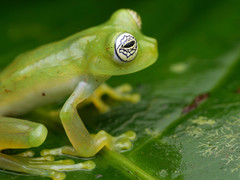
About the Ghost Glass Frog

Sachatamia ilex is a species of frog in the family Centrolenidae. It is found in eastern Nicaragua, Costa Rica, Panama, western Colombia (Pacific lowlands and the Pacific slopes of the Cordillera Occidental), and western Ecuador. The common name Limon giant glass frog has been coined for this species, apparently in reference to its type locality in the canton of Limón, Costa Rica, and it is also known as Holly's glassfrog and the ghost glass frog.

Adult males measure 27–29 mm (1.1–1.1 in) and females 28–34 mm (1.1–1.3 in) in snout–vent length. The snout is truncate in lateral view. Both fingers and toes have webbing and there are adhesive discs on the tips of the digits. The dorsal skin is shagreen. The dorsum is uniform dark green in color while the gular region and belly are creamy white. The iris is white or light gray with black reticulations.

This frog is active at night. In the day it crouches on the upper side of a leaf, adjusting its colour to match the background. The males call from the upper surfaces of the leaves near streams and may engage in fights. The eggs are black and are deposited on the upper surface of the leaves, and when they hatch, the larvae... Wikipedia →

Sounds

Advertisement call0:21

Costa Rica · 2025

© Chris Harrison · XC1029856 · CC BY-NC-SA 4.0

Global Distribution

Parks Where Found

# Park Country Daily sighting probability
1 Braulio Carrillo National Park 🇨🇷 Costa Rica
~10%
2 Arenal Volcano National Park 🇨🇷 Costa Rica
~10%

Zoos & Centres Where Found

# Zoo / Centre Country
1 Oklahoma City Zoo and Botanical Garden 🇺🇸 United States In captivity

Before you go

What are the chances of seeing a Ghost Glass Frog in Arenal Volcano National Park?

With luck

About 10% of wildlife watchers report a Ghost Glass Frog sighting in Arenal Volcano National Park on a given day, based on 14 verified sightings from GBIF citizen-science data from 2019 to 2026. It is the 25th most-seen of the 39 amphibians we can rate there. Over three days the chance rises to about 20%, and over a week to about 50%, if each day is a fresh chance.

When is the best time to see a Ghost Glass Frog in Arenal Volcano National Park?

June, August–September and November–April

In those months about 10% of wildlife watchers report a Ghost Glass Frog in Arenal Volcano National Park on a given day, against under 5% in May, July and October, the lowest months.

What time of day is best to see a Ghost Glass Frog?

Between 7 and 10 pm

Across all the parks we cover, that three-hour window holds the most Ghost Glass Frog sightings with a recorded time, and about 8 in 10 of them come between 6 pm and 6 am: it is mostly seen at night.

Is Arenal Volcano National Park the best place to see a Ghost Glass Frog?

Among the best

Of the 2 parks where we can rate Ghost Glass Frog sightings, Arenal Volcano National Park ranks 2nd at about 10%, level with the leaders once rounded. The best odds are in Braulio Carrillo National Park (Costa Rica, about 10%).

Which relatives of the Ghost Glass Frog live in Arenal Volcano National Park?

Same family: Centrolenidae

The closest relatives of the Ghost Glass Frog that you can see in Arenal Volcano National Park (family Centrolenidae, Glass Frogs) are Emerald Glass Frog (about 20%), Reticulated Glass Frog (about 20%) and Chiriqui Glass Frog (about 10%), with each one's daily chance of a sighting.

Where does the Ghost Glass Frog sighting chance come from?

GBIF citizen-science records

It is estimated from how often the Ghost Glass Frog is recorded against all the amphibians logged in Arenal Volcano National Park (14 verified sightings from 2019 to 2026), calibrated against known sighting rates. Figures are rounded to the nearest 10% because citizen-science data supports honest approximations, not decimals, and months with records from fewer than five people show "—". How it works.

← Back to Arenal Volcano National Park