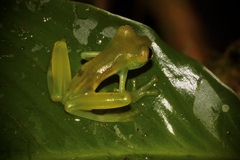
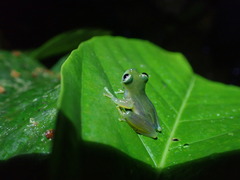
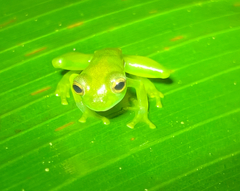

Dwarf Glass Frog

Dwarf Glass Frog

Teratohyla spinosa

Silhouette: Dmitry Bogdanov (vectorized by T. Michael Keesey) · PhyloPic

LCLeast ConcernNTVUENCR
Daily sighting probability ~10% · With luck
at Arenal Volcano National Park

In 3 days ~20% in a week ~40%

9 Verified sightings at Arenal Volcano National Park From 2019 to 2026
47 In all 4 parks
November Best month
🌙 Nocturnal When it's spotted

About the Dwarf Glass Frog

Teratohyla spinosa (common name: spiny Cochran frog) is a species of frog in the family Centrolenidae. It is found in the Pacific lowlands of northern and central Ecuador and western Colombia, northward on the Pacific slopes Panama and Costa Rica, as well as on the Caribbean slopes of Costa Rica, Nicaragua, and Honduras.

Teratohyla spinosa are small, green frogs with large, protuberant eyes. Males grow to a snout–vent length of 18–20 mm (0.71–0.79 in) and females to 20–23 mm (0.79–0.91 in). Tadpoles are 16 mm (0.63 in) in length when metamorphosing. Adult males have an exposed spine at the base of the thumb.

Males call throughout the wet season (May–October) from the low vegetation surrounding small streams. Females lay 18–25 eggs on the underside of vegetation in a single layer of loose jelly. Larvae develop in streams. Teratohyla spinosa inhabits lowland primary humid lowland forests at elevations between 20 and 800 m (66 and 2,625 ft) above sea level. It is found along streams in the low vegetation. Its habitat is threatened by deforestation, although the species is not considered threatened in view of its wide distribution and presumed... Wikipedia →

Sounds

Advertisement call0:13

Costa Rica · 2025

© Chris Harrison · XC1040056 · CC BY-NC-SA 4.0

Global Distribution

Parks Where Found

# Park Country Daily sighting probability
1 Tenorio Volcano National Park 🇨🇷 Costa Rica
~10%
2 Braulio Carrillo National Park 🇨🇷 Costa Rica
~10%
3 Soberanía National Park 🇵🇦 Panama
~10%
4 Arenal Volcano National Park 🇨🇷 Costa Rica
~10%

Before you go

What are the chances of seeing a Dwarf Glass Frog in Arenal Volcano National Park?

With luck

About 10% of wildlife watchers report a Dwarf Glass Frog sighting in Arenal Volcano National Park on a given day, based on 9 verified sightings from GBIF citizen-science data from 2019 to 2026. It is the 29th most-seen of the 39 amphibians we can rate there. Over three days the chance rises to about 20%, and over a week to about 40%, if each day is a fresh chance.

When is the best time to see a Dwarf Glass Frog in Arenal Volcano National Park?

November

In that month about 20% of wildlife watchers report a Dwarf Glass Frog in Arenal Volcano National Park on a given day, against under 5% in February–March, May and July–October, the lowest months. That is one of Arenal Volcano National Park's wettest months, with about 500 mm of rain against 140 mm in April.

What time of day is best to see a Dwarf Glass Frog?

Between 7 and 10 pm

Across all the parks we cover, that three-hour window holds the most Dwarf Glass Frog sightings with a recorded time, and about 9 in 10 of them come between 6 pm and 6 am: it is mostly seen at night.

Is Arenal Volcano National Park the best place to see a Dwarf Glass Frog?

Among the best

Of the 4 parks where we can rate Dwarf Glass Frog sightings, Arenal Volcano National Park ranks 4th at about 10%, level with the leaders once rounded. The best odds are in Tenorio Volcano National Park (Costa Rica, about 10%), Braulio Carrillo National Park (Costa Rica, about 10%) and Soberanía National Park (Panama, about 10%).

Where does the Dwarf Glass Frog sighting chance come from?

GBIF citizen-science records

It is estimated from how often the Dwarf Glass Frog is recorded against all the amphibians logged in Arenal Volcano National Park (9 verified sightings from 2019 to 2026), calibrated against known sighting rates. Figures are rounded to the nearest 10% because citizen-science data supports honest approximations, not decimals, and months with records from fewer than five people show "—". How it works.

← Back to Arenal Volcano National Park