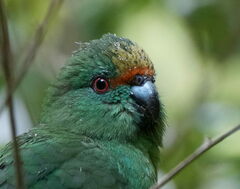
Malherbe's Parakeet

Malherbe's Parakeet

Cyanoramphus malherbi

Silhouette: Farelli (photo), John E. McCormack, Michael G. Harvey, Brant C. Faircloth, Nicholas G. Crawford, Travis C. Glenn, Robb T. Brumfield & T. Michael Keesey · PhyloPic

LCNTVUENCRCritically Endangered Endemic
Daily sighting probability ~10% · With luck
at Arthur's Pass National Park

In 3 days ~20% in a week ~40%

57 Verified sightings at Arthur's Pass National Park From 2019 to 2026
57 In 1 park
April Best month
☀️ Diurnal When it's spotted

About the Malherbe's Parakeet

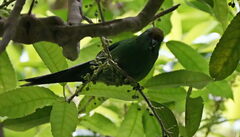
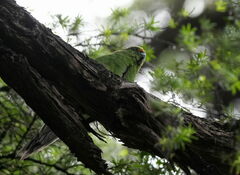
Orange-fronted parakeet (Cyanoramphus malherbi) or Malherbe's parakeet is a small parrot endemic to New Zealand. It is known in te reo māori as kākāriki karaka or orange-fronted kākāriki, with kākāriki translating to 'small parrot' and the colour green. The species shares the name "orange-fronted parakeet" with Eupsittula canicularis, a Central American species. Restricted to a few valleys in the South Island, its population declined to around 200 in the 1990s, and it is considered critically endangered by the International Union for Conservation of Nature, and Nationally Critical by the New Zealand Threat Classification System. The parakeet has since been translocated to several islands and a fenced mainland site.

The genus Cyanoramphus is endemic to New Zealand and surrounding islands and it has been proposed that the ancestor of Cyanoramphus dispersed from New Caledonia to New Zealand via Norfolk Island 500,000 years ago. Controversy has surrounded the classification of this bird; is it its own species or a colour morph of the similar yellow-crowned parakeet (C. auriceps)? It was described in 1857 from a museum specimen of unknown origin; its species name honours French... Wikipedia →

Sounds

Call0:26

New Zealand · 2016

© Dan Lane · XC344829 · CC BY-NC-SA 4.0

Recording0:02

New Zealand · 2025

© Judah G · iNaturalist · CC BY-NC 4.0

Recording0:18

New Zealand · 2023

© Alex Phelps · iNaturalist · CC BY-NC 4.0

Global Distribution

Parks Where Found

# Park Country Daily sighting probability
1 Arthur's Pass National Park 🇳🇿 New Zealand
~10%

More parks will be added in future updates.

Zoos & Centres Where Found

# Zoo / Centre Country
1 Pūkaha National Wildlife Centre 🇳🇿 New Zealand In captivity
2 Auckland Zoo 🇳🇿 New Zealand In captivity

Before you go

What are the chances of seeing a Malherbe's Parakeet in Arthur's Pass National Park?

With luck

About 10% of wildlife watchers report a Malherbe's Parakeet sighting in Arthur's Pass National Park on a given day, based on 57 verified sightings from GBIF citizen-science data from 2019 to 2026. It is the 40th most-seen of the 48 birds we can rate there. Over three days the chance rises to about 20%, and over a week to about 40%, if each day is a fresh chance.

When is the best time to see a Malherbe's Parakeet in Arthur's Pass National Park?

March and April

In those months about 20% of wildlife watchers report a Malherbe's Parakeet in Arthur's Pass National Park on a given day, against under 5% in February, June, August and October–December, the lowest months.

What time of day is best to see a Malherbe's Parakeet?

Between 10 am and 1 pm

Across all the parks we cover, that three-hour window holds the most Malherbe's Parakeet sightings with a recorded time, and about 9 in 10 of them come between 6 am and 6 pm: it is a daytime animal.

Where else can you see a Malherbe's Parakeet?

Only Arthur's Pass National Park, in our data

Arthur's Pass National Park is the only park on Wallace's Line with enough records to rate Malherbe's Parakeet sightings: about 10% of wildlife watchers there report one on a given day.

Where does the Malherbe's Parakeet sighting chance come from?

GBIF citizen-science records

It is estimated from how often the Malherbe's Parakeet is recorded against all the birds logged in Arthur's Pass National Park (57 verified sightings from 2019 to 2026), calibrated against known sighting rates. Figures are rounded to the nearest 10% because citizen-science data supports honest approximations, not decimals, and months with records from fewer than five people show "—". How it works.

← Back to Arthur's Pass National Park