
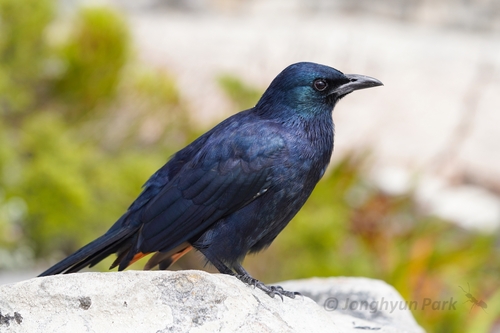
Abbott's Starling

Abbott's Starling

Poeoptera femoralis

Silhouette: Rafael Maia · PhyloPic

Daily sighting probability <5% · Rare
at Arusha National Park

In 3 days ~10% in a week ~30%

32 Verified sightings at Arusha National Park From 2019 to 2026
32 In 1 park
September Best month
☀️ Diurnal When it's spotted

About the Abbott's Starling

Abbott's starling (Arizelopsar femoralis) is a species of starling in the family Sturnidae. It is found in Kenya and Tanzania. Its natural habitat is subtropical or tropical moist montane forests. It is threatened by habitat loss, and its population is estimated at 2500–9999. This species, at 16 to 18 cm (6.3 to 7.1 in) long, is the smallest species of starling. It is in the monotypic genus Arizelopsar.

The name of the species commemorates William Louis Abbott (1860-1936), an American naturalist and collector, who studied the wildlife of the Indo-Malayan region. Abbott's starling has a black head and breast with white underparts and a yellow eye. Its voice is a musical whistled call moving up and down the scale. Abbott's starling feeds on insects and fruit, including the fruit of Cornus volkensii.

Abbott's starling is listed as endangered by the International Union for Conservation of Nature (IUCN). As of 2020, their population is determined to be decreasing, with an estimated 1,000—2,500 mature individuals in the wild. Deforestation due to illegal logging and agriculture are considered major threats to Abbott's starling.... Wikipedia →

Sounds

Song0:40

Tanzania · 2011

© Charles Davies · XC87801 · CC BY-NC-ND 2.5

Global Distribution

Parks Where Found

# Park Country Daily sighting probability
1 Arusha National Park 🇹🇿 Tanzania
<5%

More parks will be added in future updates.

Before you go

What are the chances of seeing an Abbott's Starling in Arusha National Park?

Rare

Under 5% of wildlife watchers report an Abbott's Starling sighting in Arusha National Park on a given day, based on 32 verified sightings from GBIF citizen-science data from 2019 to 2026. It is the 212th most-seen of the 373 birds we can rate there. Over three days the chance rises to about 10%, and over a week to about 30%, if each day is a fresh chance.

When is the best time to see an Abbott's Starling in Arusha National Park?

September

In that month about 20% of wildlife watchers report an Abbott's Starling in Arusha National Park on a given day, against under 5% in March–April, June–August and November–December, the lowest months. That is one of Arusha National Park's driest months, with about 65 mm of rain against 440 mm in April.

What time of day is best to see an Abbott's Starling?

Between 2 and 5 pm

Across all the parks we cover, that three-hour window holds the most Abbott's Starling sightings with a recorded time, and about 8 in 10 of them come between 6 am and 6 pm: it is a daytime animal.

Where else can you see an Abbott's Starling?

Only Arusha National Park, in our data

Arusha National Park is the only park on Wallace's Line with enough records to rate Abbott's Starling sightings: under 5% of wildlife watchers there report one on a given day.

Which relatives of the Abbott's Starling live in Arusha National Park?

Same genus: Poeoptera

The closest relatives of the Abbott's Starling that you can see in Arusha National Park (genus Poeoptera, Poeoptera Starlings) are Kenrick's Starling (about 20%) and Sharpe's Starling (about 10%), with each one's daily chance of a sighting.

Where does the Abbott's Starling sighting chance come from?

GBIF citizen-science records

It is estimated from how often the Abbott's Starling is recorded against all the birds logged in Arusha National Park (32 verified sightings from 2019 to 2026), calibrated against known sighting rates. Figures are rounded to the nearest 10% because citizen-science data supports honest approximations, not decimals, and months with records from fewer than five people show "—". How it works.

← Back to Arusha National Park