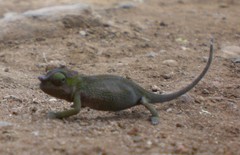
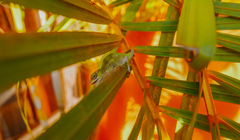
Kilimanjaro two-horned chamaeleon

Kilimanjaro two-horned chamaeleon

Kinyongia tavetana

Silhouette: Beth Reinke · PhyloPic

LCNTNear ThreatenedVUENCR
Daily sighting probability ~60% · Likely
at Arusha National Park

In 3 days ~90% in a week >90%

88 Verified sightings at Arusha National Park From 2019 to 2026
88 In 1 park
July Best month
☀️ Diurnal When it's spotted

About the Kilimanjaro two-horned chamaeleon

Kinyongia tavetana, the Kilimanjaro two-horned chameleon or Kilimanjaro blade-horned chameleon, is a species of chameleon in the genus Kinyongia. It is native to forests, woodlands, well-wooded gardens and plantations in the highlands of southern Kenya and northern Tanzania. Its type locality is Mount Kilimanjaro, but it is also known from Chyulu Hills and Mount Meru to the Pare Mountains.

Until 1991 when they were split, K. tavetana was generally considered a subpopulation or subspecies of K. fischeri. In 2002, the subpopulation from Taita Hills in Kenya was described as a new subspecies, K. tavetana boehmei, but in 2008 it was recommended that it instead should be recognized as a separate species, K. boehmei.

The species' reached up to c. 24 cm (9 in) in total length, with males growing larger than females. It varies in colour and pattern, partially depending on location and sex, but is generally various shades of brown, grey, green, yellow, red or blue. The adult male has a pair of diverging, blade-like "horns" on the nose, which are lacking in females. Wikipedia →

Global Distribution

Parks Where Found

# Park Country Daily sighting probability
1 Arusha National Park 🇹🇿 Tanzania
~60%

More parks will be added in future updates.

Before you go

What are the chances of seeing a Kilimanjaro two-horned chamaeleon in Arusha National Park?

Likely

About 60% of wildlife watchers report a Kilimanjaro two-horned chamaeleon sighting in Arusha National Park on a given day, based on 88 verified sightings from GBIF citizen-science data from 2019 to 2026. Over three days the chance rises to about 90%, and over a week to over 90%, if each day is a fresh chance.

When is the best time to see a Kilimanjaro two-horned chamaeleon in Arusha National Park?

May, July and November

In those months about 70% of wildlife watchers report a Kilimanjaro two-horned chamaeleon in Arusha National Park on a given day, against about 50% in April and December–January, the lowest months.

What time of day is best to see a Kilimanjaro two-horned chamaeleon?

Between 11 am and 2 pm

Across all the parks we cover, that three-hour window holds the most Kilimanjaro two-horned chamaeleon sightings with a recorded time, and about 9 in 10 of them come between 6 am and 6 pm: it is a daytime animal.

Where else can you see a Kilimanjaro two-horned chamaeleon?

Only Arusha National Park, in our data

Arusha National Park is the only park on Wallace's Line with enough records to rate Kilimanjaro two-horned chamaeleon sightings: about 60% of wildlife watchers there report one on a given day.

Where does the Kilimanjaro two-horned chamaeleon sighting chance come from?

GBIF citizen-science records

It is estimated from how often the Kilimanjaro two-horned chamaeleon is recorded against all the reptiles logged in Arusha National Park (88 verified sightings from 2019 to 2026), calibrated against known sighting rates. Figures are rounded to the nearest 10% because citizen-science data supports honest approximations, not decimals, and months with records from fewer than five people show "—". How it works.

← Back to Arusha National Park