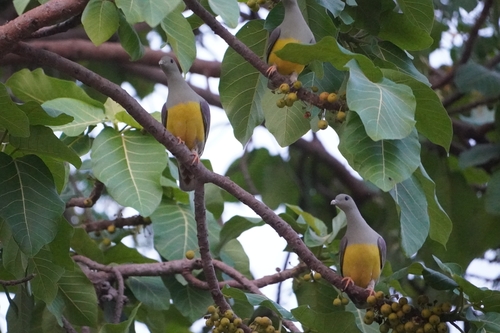


Bruce's Green-Pigeon

Bruce's Green-Pigeon

Treron waalia

Silhouette: Sheatherius · PhyloPic

LCLeast ConcernNTVUENCR
Daily sighting probability <5% · Rare
at Awash National Park

In 3 days ~10% in a week ~30%

5 Verified sightings at Awash National Park From 2019 to 2026
154 In all 4 parks
November Best month
☀️ Diurnal When it's spotted

About the Bruce's Green-Pigeon

Bruce's green pigeon (Treron waalia), also known as the yellow-bellied fruit pigeon or the yellow-bellied green pigeon, is a species of bird in the family Columbidae. Its range extends across the Sudan (region) towards the Red Sea and the Southwestern Arabian foothills savanna and Dhofar Mountains.

It is a frugivore bird species that specialises on eating the fruits of a single species of fig tree, Ficus platyphylla. Unlike most birds, it does not have a uropygial gland. Despite its name, Bruce's green pigeon is mostly grey with a light yellow breast and olive green upper wings. Wikipedia →

Sounds

Call0:21

Oman · 2014

© Matthias Feuersenger · XC371214 · CC BY-NC-SA 4.0

Song0:38

Ethiopia · 2015

© Hans Matheve · XC305857 · CC BY-NC-ND 4.0

Song0:08

Oman · 2026

© Tomasz Kułakowski · XC1078170 · CC BY-NC-SA 4.0

Global Distribution

Parks Where Found

# Park Country Daily sighting probability
1 Kidepo Valley National Park 🇺🇬 Uganda
~30%
2 Niokolo-Koba National Park 🇸🇳 Senegal
~10%
3 Awash National Park 🇪🇹 Ethiopia
<5%
4 Murchison Falls National Park 🇺🇬 Uganda
<5%

Cities Where Found

# City Country Daily sighting probability
1 Maiduguri 🇳🇬 Nigeria
~10%

Zoos & Centres Where Found

# Zoo / Centre Country
1 Disney's Animal Kingdom 🇺🇸 United States In captivity
2 San Diego Zoo 🇺🇸 United States In captivity
3 Bronx Zoo 🇺🇸 United States In captivity
4 Sedgwick County Zoo 🇺🇸 United States In captivity
5 Wilhelma 🇩🇪 Germany In captivity
6 San Antonio Zoo 🇺🇸 United States In captivity
7 Riverbanks Zoo 🇺🇸 United States In captivity
8 Vogelpark Avifauna 🇳🇱 Netherlands In captivity
9 Central Park Zoo 🇺🇸 United States In captivity
10 Palo Alto Junior Museum and Zoo 🇺🇸 United States In captivity

Before you go

What are the chances of seeing a Bruce's Green-Pigeon in Awash National Park?

Rare

Under 5% of wildlife watchers report a Bruce's Green-Pigeon sighting in Awash National Park on a given day, based on 5 verified sightings from GBIF citizen-science data from 2019 to 2026. It is the 199th most-seen of the 217 birds we can rate there. Over three days the chance rises to about 10%, and over a week to about 30%, if each day is a fresh chance.

When is the best time to see a Bruce's Green-Pigeon in Awash National Park?

November

In that month about 10% of wildlife watchers report a Bruce's Green-Pigeon in Awash National Park on a given day, against under 5% in April, June–August, October and December–January, the lowest months. February–March, May and September have too few records to rate.

What time of day is best to see a Bruce's Green-Pigeon?

Between 7 and 10 am

Across all the parks we cover, that three-hour window holds the most Bruce's Green-Pigeon sightings with a recorded time, and about 8 in 10 of them come between 6 am and 6 pm: it is a daytime animal.

Is Awash National Park the best place to see a Bruce's Green-Pigeon?

3rd of 4

Of the 4 parks where we can rate Bruce's Green-Pigeon sightings, Awash National Park ranks 3rd at under 5%. The best odds are in Kidepo Valley National Park (Uganda, about 30%) and Niokolo-Koba National Park (Senegal, about 10%).

Which relatives of the Bruce's Green-Pigeon live in Awash National Park?

Same family: Columbidae

The closest relatives of the Bruce's Green-Pigeon that you can see in Awash National Park (family Columbidae, Pigeons and Doves) are Namaqua Dove (about 50%), Speckled Pigeon (about 40%) and African Mourning Dove (about 40%), with each one's daily chance of a sighting.

Where does the Bruce's Green-Pigeon sighting chance come from?

GBIF citizen-science records

It is estimated from how often the Bruce's Green-Pigeon is recorded against all the birds logged in Awash National Park (5 verified sightings from 2019 to 2026), calibrated against known sighting rates. Figures are rounded to the nearest 10% because citizen-science data supports honest approximations, not decimals, and months with records from fewer than five people show "—". How it works.

← Back to Awash National Park