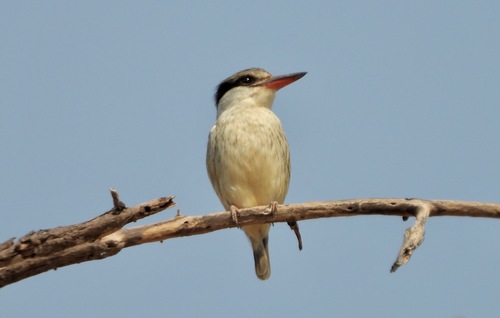
Ethiopian Bee-eater

Ethiopian Bee-eater

Merops lafresnayii

Daily sighting probability ~10% · With luck
at Awash National Park

In 3 days ~30% in a week ~50%

12 Verified sightings at Awash National Park From 2019 to 2026
12 In 1 park
July Best month
☀️ Diurnal When it's spotted

About the Ethiopian Bee-eater

The Ethiopian bee-eater (Merops lafresnayii) is a species of bird in the family Meropidae. It is found in Ethiopia and Sudan. It was formerly considered a subspecies of either blue-breasted bee-eater M. variegatus or cinnamon-chested bee-eater M. oreobates, from both of which it is allopatric with a separate distribution.

The Ethiopian bee-eater is a bird of open montane woodland (including coffee and eucalyptus plantations), occurring at 1,000–3,200 metres (3,300–10,500 ft) altitude, often on steep slopes, but also on flatter land on the Ethiopian plateau. Like its two relatives, it is usually solitary or in pairs, not gregarious like many other bee-eaters. It perches on a branch in the canopy beside tracks and clearings and swoops down on small butterflies, bees, and other insects before returning to its original or another perch.

Ethiopian bee-eater is one of a group of African species that have sometimes been classified in a separate genus Mellitophagus, distinguished by small size, rounded wingtips, lack of tail streamers, and non-colonial behaviour. The other species in this group are blue-breasted bee-eater M. variegatus, cinnamon-chested bee-eater M. oreobates... Wikipedia →

Global Distribution

Parks Where Found

# Park Country Daily sighting probability
1 Awash National Park 🇪🇹 Ethiopia
~10%

More parks will be added in future updates.

Cities Where Found

# City Country Daily sighting probability
1 Addis Ababa 🇪🇹 Ethiopia
~30%

Before you go

What are the chances of seeing an Ethiopian Bee-eater in Awash National Park?

With luck

About 10% of wildlife watchers report an Ethiopian Bee-eater sighting in Awash National Park on a given day, based on 12 verified sightings from GBIF citizen-science data from 2019 to 2026. It is the 142nd most-seen of the 217 birds we can rate there. Over three days the chance rises to about 30%, and over a week to about 50%, if each day is a fresh chance.

When is the best time to see an Ethiopian Bee-eater in Awash National Park?

July

In that month about 30% of wildlife watchers report an Ethiopian Bee-eater in Awash National Park on a given day, against under 5% in January, April and November, the lowest months. That is one of Awash National Park's wettest months, with about 70 mm of rain against 10 mm in January. February–March, May and September have too few records to rate.

What time of day is best to see an Ethiopian Bee-eater?

Between 8 and 11 am

Across all the parks we cover, that three-hour window holds the most Ethiopian Bee-eater sightings with a recorded time, and about 8 in 10 of them come between 6 am and 6 pm: it is a daytime animal.

Where else can you see an Ethiopian Bee-eater?

Only Awash National Park, in our data

Awash National Park is the only park on Wallace's Line with enough records to rate Ethiopian Bee-eater sightings: about 10% of wildlife watchers there report one on a given day.

Which relatives of the Ethiopian Bee-eater live in Awash National Park?

Same genus: Merops

The closest relatives of the Ethiopian Bee-eater that you can see in Awash National Park (genus Merops, Typical Bee-eaters) are Northern Carmine Bee-eater (about 60%), Little Bee-eater (about 40%) and Whitethroated Bee-eater (about 20%), with each one's daily chance of a sighting.

Where does the Ethiopian Bee-eater sighting chance come from?

GBIF citizen-science records

It is estimated from how often the Ethiopian Bee-eater is recorded against all the birds logged in Awash National Park (12 verified sightings from 2019 to 2026), calibrated against known sighting rates. Figures are rounded to the nearest 10% because citizen-science data supports honest approximations, not decimals, and months with records from fewer than five people show "—". How it works.

← Back to Awash National Park