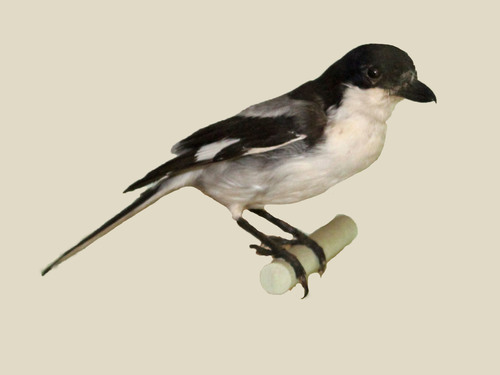
Lichtenstein's Sandgrouse

Lichtenstein's Sandgrouse

Pterocles lichtensteinii

Silhouette: PhyloPic

LCLeast ConcernNTVUENCR
Daily sighting probability ~10% · With luck
at Awash National Park

In 3 days ~20% in a week ~40%

8 Verified sightings at Awash National Park From 2019 to 2026
240 In all 2 parks
January Best month
☀️ Diurnal When it's spotted

About the Lichtenstein's Sandgrouse

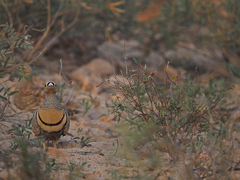
Lichtenstein's sandgrouse (Pterocles lichtensteinii) is a species of sandgrouse in the family Pteroclidae. It is named after the German naturalist Martin Lichtenstein. A small, closely barred bird of stony deserts and arid hills, it ranges across northern and eastern Africa, the Middle East and south-western Asia to Pakistan. It is nomadic and mostly nocturnal, drinking before dawn and after dusk.

Lichtenstein's sandgrouse is a small, stocky sandgrouse about 25 cm (9.8 in) long and weighing 175–250 g (6.2–8.8 oz). It lacks the elongated central tail feathers of some other sandgrouse, and both sexes are closely barred blackish on a buff ground, above and below.

Lichtenstein's sandgrouse has a very large range, covering some 18,200,000 square kilometres (7,000,000 sq mi) across Africa and south-western Asia. It is found from near the equator in Kenya north and east through the Middle East to Afghanistan and Pakistan. In Africa it occurs in Algeria, Chad, Djibouti, Egypt, Eritrea, Ethiopia, Libya, Mali, Mauritania, Morocco, Niger, Senegal, Somalia, Sudan and Uganda; in Asia it occurs in Iran, Iraq, Israel, Jordan, Oman, Pakistan, Palestine... Wikipedia →

Sounds

Alarm call0:07

Morocco · 2023

© Azens · XC798402 · CC BY-NC-SA 4.0

Call0:48

Oman · 2016

© Garry Bakker · XC574444 · CC BY-NC-SA 4.0

Call0:46

Ethiopia · 2014

© Andrew Spencer · XC266676 · CC BY-NC-SA 4.0

Global Distribution

Parks Where Found

# Park Country Daily sighting probability
1 Samburu National Reserve 🇰🇪 Kenya
~20%
2 Awash National Park 🇪🇹 Ethiopia
~10%

Before you go

What are the chances of seeing a Lichtenstein's Sandgrouse in Awash National Park?

With luck

About 10% of wildlife watchers report a Lichtenstein's Sandgrouse sighting in Awash National Park on a given day, based on 8 verified sightings from GBIF citizen-science data from 2019 to 2026. It is the 177th most-seen of the 217 birds we can rate there. Over three days the chance rises to about 20%, and over a week to about 40%, if each day is a fresh chance.

When is the best time to see a Lichtenstein's Sandgrouse in Awash National Park?

January

In that month about 30% of wildlife watchers report a Lichtenstein's Sandgrouse in Awash National Park on a given day, against under 5% in April, June–August and October–November, the lowest months. That is one of Awash National Park's driest months, with about 10 mm of rain against 85 mm in August. February–March, May and September have too few records to rate.

What time of day is best to see a Lichtenstein's Sandgrouse?

Between 3 and 6 pm

Across all the parks we cover, that three-hour window holds the most Lichtenstein's Sandgrouse sightings with a recorded time, and about 8 in 10 of them come between 6 am and 6 pm: it is a daytime animal.

Is Awash National Park the best place to see a Lichtenstein's Sandgrouse?

2nd of 2

Of the 2 parks where we can rate Lichtenstein's Sandgrouse sightings, Awash National Park ranks 2nd at about 10%. The best odds are in Samburu National Reserve (Kenya, about 20%).

Where does the Lichtenstein's Sandgrouse sighting chance come from?

GBIF citizen-science records

It is estimated from how often the Lichtenstein's Sandgrouse is recorded against all the birds logged in Awash National Park (8 verified sightings from 2019 to 2026), calibrated against known sighting rates. Figures are rounded to the nearest 10% because citizen-science data supports honest approximations, not decimals, and months with records from fewer than five people show "—". How it works.

← Back to Awash National Park