Somali Bunting

Somali Bunting

Emberiza poliopleura

Silhouette: L. Shyamal · PhyloPic

LCLeast ConcernNTVUENCR
Daily sighting probability <5% · Rare
at Awash National Park

In 3 days ~10% in a week ~30%

5 Verified sightings at Awash National Park From 2019 to 2026
662 In all 5 parks
April Best month
☀️ Diurnal When it's spotted

About the Somali Bunting

The Somali bunting or Somali golden-breasted bunting (Emberiza poliopleura) is a species of bird in the family Emberizidae. It is found in Ethiopia, Kenya, Somalia, South Sudan, Tanzania, and Uganda. Its natural habitats are dry savannah and subtropical or tropical dry shrubland, typically observed in pairs.

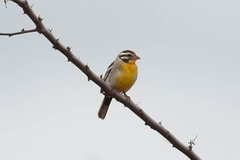
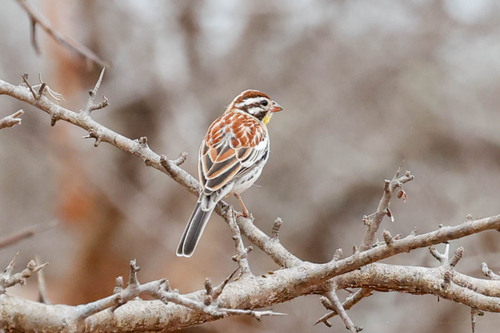
The Somali Bunting is a medium-large bunting, 14–15 cm (5.5–5.9 in) long, and weigh 14–18 g (0.49–0.63 oz). It is an attractive passerine, its distinctive features include a striking black-and-white facial pattern, a grey back streaked with russet, a grey rump, and a bright yellow breast with pale flanks. Females are duller than males, with brown wash on head. Juveniles are similar to females.

Similar to the closely related Golden-breasted Bunting, but the Somali Bunting exhibits a generally paler coloration, narrower black facial stripes, a more subdued gray back and rump, and pronounced pale sides. In addition, its preferred habitat is drier, and range overlap with the Golden-breasted Bunting is minimal.

Vocalization includes a repeated series of short, whistled phrases, each composed of two distinct notes; one of which is a long ascending whistle. Wikipedia →
Sounds

Song0:35

Tanzania · 2023

© isaac kilusu · XC777044 · CC BY-NC-SA 4.0

Call0:54

Ethiopia · 2014

© Andrew Spencer · XC266845 · CC BY-NC-SA 4.0

Song0:33

Ethiopia · 2015

© Peter Boesman · XC300269 · CC BY-NC-ND 4.0

Global Distribution

Parks Where Found

# Park Country Daily sighting probability
1 Tsavo West National Park 🇰🇪 Kenya
~30%
2 Tsavo East National Park 🇰🇪 Kenya
~30%
3 Samburu National Reserve 🇰🇪 Kenya
~20%
4 Mkomazi National Park 🇹🇿 Tanzania
~10%
5 Awash National Park 🇪🇹 Ethiopia
<5%

Zoos & Centres Where Found

# Zoo / Centre Country
1 Walsrode World Bird Park 🇩🇪 Germany In captivity

Before you go

What are the chances of seeing a Somali Bunting in Awash National Park?

Rare

Under 5% of wildlife watchers report a Somali Bunting sighting in Awash National Park on a given day, based on 5 verified sightings from GBIF citizen-science data from 2019 to 2026. It is the 199th most-seen of the 217 birds we can rate there. Over three days the chance rises to about 10%, and over a week to about 30%, if each day is a fresh chance.

When is the best time to see a Somali Bunting in Awash National Park?

April and July

In those months about 10% of wildlife watchers report a Somali Bunting in Awash National Park on a given day, against under 5% in June, August and October–January, the lowest months. Those are among Awash National Park's wettest months, with about 75 mm of rain a month against 10 mm in January. February–March, May and September have too few records to rate.

What time of day is best to see a Somali Bunting?

Between 9 am and noon

Across all the parks we cover, that three-hour window holds the most Somali Bunting sightings with a recorded time, and about 7 in 10 of them come between 6 am and 6 pm: it is a daytime animal.

Which relatives of the Somali Bunting live in Awash National Park?

Same genus: Emberiza

The closest relatives of the Somali Bunting that you can see in Awash National Park (genus Emberiza, Old World Buntings) are Striolated Bunting (about 20%) and Cinnamon-breasted Bunting (about 10%), with each one's daily chance of a sighting.

Where does the Somali Bunting sighting chance come from?

GBIF citizen-science records

It is estimated from how often the Somali Bunting is recorded against all the birds logged in Awash National Park (5 verified sightings from 2019 to 2026), calibrated against known sighting rates. Figures are rounded to the nearest 10% because citizen-science data supports honest approximations, not decimals, and months with records from fewer than five people show "—". How it works.

← Back to Awash National Park