Black-vented Shearwater

Black-vented Shearwater

Puffinus opisthomelas

Silhouette: Juan Carlos Jerí · PhyloPic

LCNTNear ThreatenedVUENCR
Daily sighting probability <5% · Rare
at Bahía de Loreto National Park

In 3 days <5%

11 Verified sightings at Bahía de Loreto National Park From 2019 to 2026
247 In all 4 parks
August Best month
☀️ Diurnal When it's spotted

About the Black-vented Shearwater

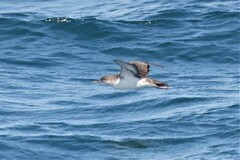
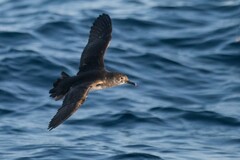
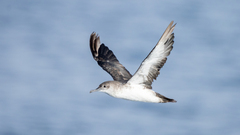
The black-vented shearwater (Puffinus opisthomelas) is a species of seabird endemic to islands off of the Pacific coast of Mexico and the Gulf of California. It is a smaller shearwater, with a length of 30–38 cm, 76–89 cm wingspan and a mass of around 400 g. This species is pelagic and feeds mainly on small fish. It is nocturnal, and is most active in low light settings.

The name "puffin" is thought to originate from the Middle English term "pophyn," which was used in the Middle Ages to describe the fatty, preserved young shearwaters that were prepared as food. Since shearwaters and Atlantic puffins (Fratercula arctica) often nest in close proximity, the name 'puffin' was mistakenly applied to the Atlantic puffin. Over time, the name stuck, and today it is used for the Atlantic puffin species. The name "puffin" also remained associated with the shearwaters and the genus Puffinus.

The black-vented shearwater is one of around 21 other species in the genus Puffinus, eight of which reside in North and Middle America (see Christmas shearwater, Galápagos shearwater, Manx shearwater, Townsend's shearwater, Newell's shearwater, Bryan's shearwater, Sargasso shearwater... Wikipedia →

Sounds

Call0:29

United States · 2014

© Justyn Stahl · XC190213 · CC BY-NC-SA 4.0

Global Distribution

Parks Where Found

# Park Country Daily sighting probability
1 Cabo Pulmo National Park 🇲🇽 Mexico
<5%
2 Channel Islands National Park 🇺🇸 United States
<5%
3 El Vizcaíno Biosphere Reserve 🇲🇽 Mexico
<5%
4 Bahía de Loreto National Park 🇲🇽 Mexico
<5%

Cities Where Found

# City Country Daily sighting probability
1 San Diego 🇺🇸 United States
<5%
2 Los Angeles 🇺🇸 United States
<5%

Before you go

What are the chances of seeing a Black-vented Shearwater in Bahía de Loreto National Park?

Rare

Under 5% of wildlife watchers report a Black-vented Shearwater sighting in Bahía de Loreto National Park on a given day, based on 11 verified sightings from GBIF citizen-science data from 2019 to 2026. It is the 159th most-seen of the 169 birds we can rate there. Over three days the chance rises to under 5%, if each day is a fresh chance.

When is the best time to see a Black-vented Shearwater in Bahía de Loreto National Park?

July and August

In those months about 10% of wildlife watchers report a Black-vented Shearwater in Bahía de Loreto National Park on a given day, against under 5% in September to June, the lowest months.

What time of day is best to see a Black-vented Shearwater?

Between 8 and 11 am

Across all the parks we cover, that three-hour window holds the most Black-vented Shearwater sightings with a recorded time, and nearly all of them come between 6 am and 6 pm: it is a daytime animal.

Is Bahía de Loreto National Park the best place to see a Black-vented Shearwater?

Among the best

Of the 4 parks where we can rate Black-vented Shearwater sightings, Bahía de Loreto National Park ranks 4th at under 5%, level with the leaders once rounded. The best odds are in Cabo Pulmo National Park (Mexico, under 5%), Channel Islands National Park (United States, under 5%) and El Vizcaíno Biosphere Reserve (Mexico, under 5%).

Where does the Black-vented Shearwater sighting chance come from?

GBIF citizen-science records

It is estimated from how often the Black-vented Shearwater is recorded against all the birds logged in Bahía de Loreto National Park (11 verified sightings from 2019 to 2026), calibrated against known sighting rates. Figures are rounded to the nearest 10% because citizen-science data supports honest approximations, not decimals, and months with records from fewer than five people show "—". How it works.

← Back to Bahía de Loreto National Park