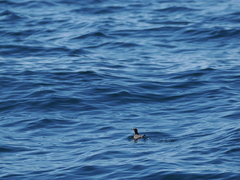
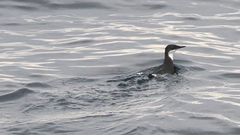
Craveri's Murrelet

Craveri's Murrelet

Synthliboramphus craveri

Silhouette: Sheatherius · PhyloPic

LCNTVUVulnerableENCR
Daily sighting probability <5% · Rare
at Bahía de Loreto National Park

In 3 days <5% in a week ~10%

19 Verified sightings at Bahía de Loreto National Park From 2019 to 2026
58 In all 2 parks
February Best month
☀️ Diurnal When it's spotted

About the Craveri's Murrelet

Craveri's murrelet (Synthliboramphus craveri) is a small seabird which breeds on offshore islands in both the Pacific Ocean and the Gulf of California off the Baja peninsula of Mexico. It also wanders fairly regularly as far as central California in the US, primarily during post-breeding dispersal. It is almost never seen from or near the shore. With an estimated population of 6,000-10,000 breeding pairs, its population is listed as vulnerable.

The Craveri's murrelet is a small black and white auk with a small head and thin sharp bill. It resembles the closely related Scripps's murrelet, with which it shares the distinction of being the most southerly living of all the auk species.

The Craveri's murrelet has a partial neck collar (Scripps's has none), and dusky underwings (Scripps's has white underwings). Craveri's black face mask dips a bit further down the face compared to the Scripps's. Both species can be also separated by voice. Craveri's murrelet also has a tendency to hold its tail upward when sitting on the water, a trait Scripps's does not show.

Craveri's murrelet feeds far out at sea on larval fish such as herring, rockfish... Wikipedia →

Sounds

Call0:07

United States · 2021

© Paul Marvin · XC677265 · CC BY-NC-SA 4.0

Call0:46

Mexico · 2020

© Andrew Spencer · XC615040 · CC BY-NC-ND 4.0

Global Distribution

Parks Where Found

# Park Country Daily sighting probability
1 Bahía de Loreto National Park 🇲🇽 Mexico
<5%
2 Channel Islands National Park 🇺🇸 United States
<5%

Before you go

What are the chances of seeing a Craveri's Murrelet in Bahía de Loreto National Park?

Rare

Under 5% of wildlife watchers report a Craveri's Murrelet sighting in Bahía de Loreto National Park on a given day, based on 19 verified sightings from GBIF citizen-science data from 2019 to 2026. It is the 137th most-seen of the 169 birds we can rate there. Over three days the chance rises to under 5%, and over a week to about 10%, if each day is a fresh chance.

When is the best time to see a Craveri's Murrelet in Bahía de Loreto National Park?

Any time of year

In every month with enough records, under 5% of wildlife watchers report a Craveri's Murrelet in Bahía de Loreto National Park on a given day, so our monthly data shows no clear season.

What time of day is best to see a Craveri's Murrelet?

Between 9 am and noon

Across all the parks we cover, that three-hour window holds the most Craveri's Murrelet sightings with a recorded time, and nearly all of them come between 6 am and 6 pm: it is a daytime animal.

Is Bahía de Loreto National Park the best place to see a Craveri's Murrelet?

Yes

Of the 2 parks where we can rate Craveri's Murrelet sightings, Bahía de Loreto National Park has the highest daily chance: under 5%. Next come Channel Islands National Park (United States, under 5%).

Which relatives of the Craveri's Murrelet live in Bahía de Loreto National Park?

Same order: Charadriiformes

The closest relatives of the Craveri's Murrelet that you can see in Bahía de Loreto National Park (order Charadriiformes, Shorebirds and Allies) are Yellow-footed Gull (about 80%), Spotted Sandpiper (about 50%) and Willet (about 30%), with each one's daily chance of a sighting.

Where does the Craveri's Murrelet sighting chance come from?

GBIF citizen-science records

It is estimated from how often the Craveri's Murrelet is recorded against all the birds logged in Bahía de Loreto National Park (19 verified sightings from 2019 to 2026), calibrated against known sighting rates. Figures are rounded to the nearest 10% because citizen-science data supports honest approximations, not decimals, and months with records from fewer than five people show "—". How it works.

← Back to Bahía de Loreto National Park