

Gray Thrasher

Gray Thrasher

Toxostoma cinereum

Silhouette: Sheatherius · PhyloPic

LCLeast ConcernNTVUENCR Endemic
Daily sighting probability ~10% · With luck
at Bahía de Loreto National Park

In 3 days ~40% in a week ~70%

211 Verified sightings at Bahía de Loreto National Park From 2019 to 2026
443 In all 3 parks
October Best month
🌅 Crepuscular When it's spotted

About the Gray Thrasher

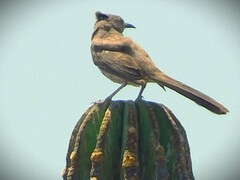
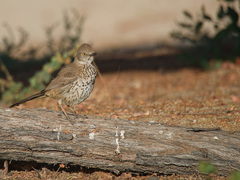
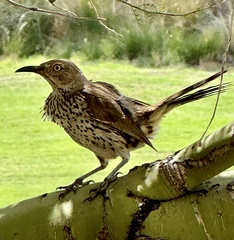
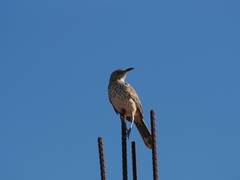
The gray thrasher (Toxostoma cinereum) is a medium-sized passerine bird belonging to the family Mimidae. It is endemic to the Baja California peninsula of Mexico. The gray thrasher is 21.4 to 25.0 cm (8.4 to 9.8 in) long. Four males weighed 58.6 to 69.8 g (2.07 to 2.46 oz) and a female 54.4 g (1.92 oz). It is gray-brown above with cinnamon tones on the rump. Its underparts are white with arrow-shaped black spots. The outer tail feathers have white tips. Its eyes are golden yellow. The subspecies are similar, with T. c. mearnsi being somewhat darker overall.

The gray thrasher is found only in Mexico's Baja California, where its range extends from approximately north latitude 31°14' to its southern tip. On the east side of the peninsula, however, it is found only as far north as approximately 28°. There is a record of this species in the Famosa Slough, San Diego County, California. T. c. mearnsi occupies approximately the northern half of the range and the nominate subspecies the southern half.

The gray thrasher inhabits arid... Wikipedia →

Sounds

Call0:06

Mexico · 2023

© Sue Riffe · XC785553 · CC BY-NC-SA 4.0

Song1:00

Mexico · 2007

© Richard E Webster · XC21416 · CC BY-NC-ND 2.5

Call0:06

Mexico · 2018

© David Vander Pluym · XC441000 · CC BY-NC-SA 4.0

Global Distribution

Parks Where Found

# Park Country Daily sighting probability
1 Cabo Pulmo National Park 🇲🇽 Mexico
~50%
2 Bahía de Loreto National Park 🇲🇽 Mexico
~10%
3 El Vizcaíno Biosphere Reserve 🇲🇽 Mexico
~10%

Before you go

What are the chances of seeing a Gray Thrasher in Bahía de Loreto National Park?

With luck

About 10% of wildlife watchers report a Gray Thrasher sighting in Bahía de Loreto National Park on a given day, based on 211 verified sightings from GBIF citizen-science data from 2019 to 2026. It is the 58th most-seen of the 169 birds we can rate there. Over three days the chance rises to about 40%, and over a week to about 70%, if each day is a fresh chance.

When is the best time to see a Gray Thrasher in Bahía de Loreto National Park?

October

In that month about 40% of wildlife watchers report a Gray Thrasher in Bahía de Loreto National Park on a given day, against about 10% in April–July, September and November–February, the lowest months. That is one of Bahía de Loreto National Park's wettest months, with about 20 mm of rain against almost none in April.

What time of day is best to see a Gray Thrasher?

Between 5 and 8 pm

Across all the parks we cover, that three-hour window holds the most Gray Thrasher sightings with a recorded time, and about 6 in 10 of them come between 6 am and 6 pm: it is most active around dawn and dusk.

Is Bahía de Loreto National Park the best place to see a Gray Thrasher?

2nd of 3

Of the 3 parks where we can rate Gray Thrasher sightings, Bahía de Loreto National Park ranks 2nd at about 10%. The best odds are in Cabo Pulmo National Park (Mexico, about 50%).

Where does the Gray Thrasher sighting chance come from?

GBIF citizen-science records

It is estimated from how often the Gray Thrasher is recorded against all the birds logged in Bahía de Loreto National Park (211 verified sightings from 2019 to 2026), calibrated against known sighting rates. Figures are rounded to the nearest 10% because citizen-science data supports honest approximations, not decimals, and months with records from fewer than five people show "—". How it works.

← Back to Bahía de Loreto National Park