four-ridged toad

four-ridged toad

Ingerophrynus quadriporcatus

Silhouette: Michael Scroggie, from original photograph by Gary M. Stolz, USFWS (original photograph in public domain). · PhyloPic

LCLeast ConcernNTVUENCR
Daily sighting probability ~30% · Possible
at Bako National Park

In 3 days ~70% in a week ~90%

9 Verified sightings at Bako National Park From 2019 to 2026
9 In 1 park
December Best month
☀️🌙 Day & Night When it's spotted

About the four-ridged toad

Ingerophrynus quadriporcatus is a species of toad in the family Bufonidae. Its common names are long-glanded toad, four-ridged toad and greater Malacca toad. It is found in Peninsular Malaysia, Singapore, Borneo (Sabah, Brunei, Sarawak, and Kalimantan), Sumatra, and the Natuna Islands.

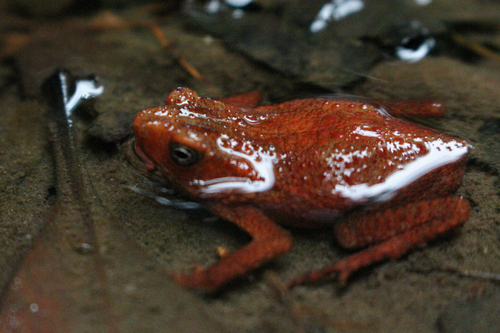
Its natural habitats are swamp forests, but it has also been found on rubber plantations. It breeds in standing water. Male Ingerophrynus quadriporcatus grow to a snout–vent length of about 48 mm (1.9 in) and females to 53–63 mm (2.1–2.5 in). They have a distinct tympanum. The dorsum is dark or light brown above and on sides, usually uniform in colour, and without distinct markings. Ventral colour is yellowish brown, possibly with dark spots. Skin on top of head and body is covered with many conical spines.

Ingerophrynus quadriporcatus may be common in suitable swampy habitats, but it is not abundant. It is threatened by habitat loss caused by expanding oil palm plantations, infrastructure development, and logging. Wikipedia →
Sounds

Uncertain0:16

Singapore · 2026

© Qiu Jiahui · XC1153453 · CC BY-NC-SA 4.0

Advertisement call0:09

Singapore · 2025

© dmtorres · XC1051488 · CC BY-NC-SA 4.0

Advertisement call0:29

Singapore · 2020

© Ding Li Yong · XC884157 · CC BY-NC-ND 4.0

Global Distribution

Parks Where Found

# Park Country Daily sighting probability
1 Bako National Park 🇲🇾 Malaysia
~30%

More parks will be added in future updates.

Cities Where Found

# City Country Daily sighting probability
1 Singapore 🇸🇬 Singapore
<5%

Before you go

What are the chances of seeing a four-ridged toad in Bako National Park?

Possible

About 30% of wildlife watchers report a four-ridged toad sighting in Bako National Park on a given day, based on 9 verified sightings from GBIF citizen-science data from 2019 to 2026. It is the 6th most-seen of the 11 amphibians we can rate there. Over three days the chance rises to about 70%, and over a week to about 90%, if each day is a fresh chance.

When is the best time to see a four-ridged toad in Bako National Park?

December

In that month about 50% of wildlife watchers report a four-ridged toad in Bako National Park on a given day, against under 5% in February, April–May, July and September, the lowest months.

What time of day is best to see a four-ridged toad?

Between 2 and 5 pm

Across all the parks we cover, that three-hour window holds the most four-ridged toad sightings with a recorded time, and about 6 in 10 of them come between 6 am and 6 pm: it is seen both by day and at night.

Where else can you see a four-ridged toad?

Only Bako National Park, in our data

Bako National Park is the only park on Wallace's Line with enough records to rate four-ridged toad sightings: about 30% of wildlife watchers there report one on a given day.

Which relatives of the four-ridged toad live in Bako National Park?

Same family: Bufonidae

The closest relatives of the four-ridged toad that you can see in Bako National Park (family Bufonidae, True Toads) are Lowland Dwarf Toad (about 40%) and Common Indian Toad (about 20%), with each one's daily chance of a sighting.

Where does the four-ridged toad sighting chance come from?

GBIF citizen-science records

It is estimated from how often the four-ridged toad is recorded against all the amphibians logged in Bako National Park (9 verified sightings from 2019 to 2026), calibrated against known sighting rates. Figures are rounded to the nearest 10% because citizen-science data supports honest approximations, not decimals, and months with records from fewer than five people show "—". How it works.

← Back to Bako National Park