Green Junglefowl

Green Junglefowl

Gallus varius

Silhouette: Bernard Dupont (vectorized by T. Michael Keesey) · PhyloPic

LCLeast ConcernNTVUENCR
Daily sighting probability ~50% · Likely
at Bali Barat National Park

In 3 days ~90% in a week >90%

520 Verified sightings at Bali Barat National Park From 2019 to 2026
710 In all 2 parks
March Best month
🌅 Crepuscular When it's spotted

About the Green Junglefowl

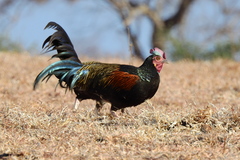
The green junglefowl (Gallus varius), also known as Javan junglefowl, forktail or green Javanese junglefowl, is the most distantly related and the first to diverge at least 4 million years ago among the four species of the junglefowl. Hybridization with domestic chicken has also been reported. Green junglefowl is a medium-sized (up to 75 cm long) bird in the pheasant family Phasianidae.

The colouration of the green junglefowl is sexually dimorphic. The male's plumage is dark and blackish at a distance. A closer view reveals an iridescent mantle of gleaming scales reminiscent in colour and pattern to those seen in the ocellated turkey and green peafowl. Each scale is vivid blue at its base and moves through various shades of gold and bronzed green. Specialized plumes framing the throat of the male green junglefowl are highly light-reflective and appear violet at the proximal and sky blue at the distal edges. The lesser coverts of the wing are a striking burnt orange with bronzed black centers. The distal edges of the greater secondary coverts are vivid ocher.

Like the related red junglefowl, the breast and ventral regions are a dense, light-absorbing black. Like its... Wikipedia →

Sounds

Song0:52

Indonesia · 2016

© Ding Li Yong · XC654488 · CC BY-NC-ND 4.0

Call1:10

Indonesia · 1996

© Teus Luijendijk · XC618819 · CC BY-NC-ND 4.0

Alarm call0:16

Indonesia · 2019

© Panji Gusti Akbar · XC498702 · CC BY-NC-SA 4.0

Global Distribution

Parks Where Found

# Park Country Daily sighting probability
1 Komodo National Park 🇮🇩 Indonesia
~70%
2 Bali Barat National Park 🇮🇩 Indonesia
~50%

Zoos & Centres Where Found

# Zoo / Centre Country
1 Disney's Animal Kingdom 🇺🇸 United States In captivity
2 Zoo Pilsen 🇨🇿 Czechia In captivity
3 Bronx Zoo 🇺🇸 United States In captivity
4 Gembira Loka Zoo 🇮🇩 Indonesia In captivity
5 Staten Island Zoo 🇺🇸 United States In captivity

Before you go

What are the chances of seeing a Green Junglefowl in Bali Barat National Park?

Likely

About 50% of wildlife watchers report a Green Junglefowl sighting in Bali Barat National Park on a given day, based on 520 verified sightings from GBIF citizen-science data from 2019 to 2026. It is the 13th most-seen of the 173 birds we can rate there. Over three days the chance rises to about 90%, and over a week to over 90%, if each day is a fresh chance.

When is the best time to see a Green Junglefowl in Bali Barat National Park?

January and March

In those months about 60% of wildlife watchers report a Green Junglefowl in Bali Barat National Park on a given day, against about 40% in May and September–December, the lowest months. Those are among Bali Barat National Park's wettest months, with about 240 mm of rain a month against 20 mm in August.

What time of day is best to see a Green Junglefowl?

Between 1 and 4 am

Across all the parks we cover, that three-hour window holds the most Green Junglefowl sightings with a recorded time, and about 6 in 10 of them come between 6 pm and 6 am: it is most active around dawn and dusk.

Is Bali Barat National Park the best place to see a Green Junglefowl?

2nd of 2

Of the 2 parks where we can rate Green Junglefowl sightings, Bali Barat National Park ranks 2nd at about 50%. The best odds are in Komodo National Park (Indonesia, about 70%).

Where does the Green Junglefowl sighting chance come from?

GBIF citizen-science records

It is estimated from how often the Green Junglefowl is recorded against all the birds logged in Bali Barat National Park (520 verified sightings from 2019 to 2026), calibrated against known sighting rates. Figures are rounded to the nearest 10% because citizen-science data supports honest approximations, not decimals, and months with records from fewer than five people show "—". How it works.

← Back to Bali Barat National Park