



Completed

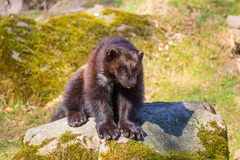


Wolverine
Gulo gulo
Silhouette: Steven Traver · PhyloPic
- KingdomAnimalia (Animals)
- PhylumChordata (Chordates)
- ClassMammalia (Mammals)
- OrderCarnivora (Carnivorans)
- FamilyMustelidae (Mustelids)
- GenusGulo (Wolverines)
- SpeciesGulo gulo (Wolverine)
In 3 days ~20% in a week ~40%
15 Verified sightings at Banff National Park From 2019 to 2026
34 In all 4 parks
January Best month
☀️ Diurnal When it's spotted
About the Wolverine
The wolverine ( WUUL-və-reen, US also WUUL-və-REEN; Gulo gulo), also called the carcajou or quickhatch (from East Cree, kwiihkwahaacheew), is the largest land-dwelling member of the family Mustelidae. It is a muscular carnivore and a solitary animal. The wolverine has a reputation for ferocity and strength out of proportion to its size, with the documented ability to kill prey many times larger than itself.
The wolverine is found primarily in remote reaches of the northern boreal forests and subarctic and alpine tundra of the Northern Hemisphere, with the greatest numbers in Northern Canada, the U.S. state of Alaska, the mainland Nordic countries of Europe, and throughout western Russia and Siberia. Its population has steadily declined since the 19th century owing to trapping, range reduction and habitat fragmentation. The wolverine has become essentially absent from the southern end of its range in both Europe and North America.
The wolverine's questionable reputation as an insatiable glutton (reflected in its Latin genus name Gulo, meaning "glutton") may be in part due to a false etymology. The less common name for the animal in Norwegian, fjellfross, meaning "mountain... Wikipedia →
Recent sightings of Wolverine in Banff National Park
LIVEiNaturalistGlobal Distribution
Parks Where Found
| # | Park | Country | Daily sighting probability |
|---|---|---|---|
| 1 | Kluane National Park | 🇨🇦 Canada | |
| 2 | Denali National Park | 🇺🇸 United States | |
| 3 | Banff National Park | 🇨🇦 Canada | |
| 4 | Glacier National Park | 🇺🇸 United States |
Zoos & Centres Where Found
Closest Relatives at Banff National Park


Before you go
What are the chances of seeing a Wolverine in Banff National Park?
With luck
About 10% of wildlife watchers report a Wolverine sighting in Banff National Park on a given day, based on 15 verified sightings from GBIF citizen-science data from 2019 to 2026. It is the 27th most-seen of the 29 mammals we can rate there. Over three days the chance rises to about 20%, and over a week to about 40%, if each day is a fresh chance.
When is the best time to see a Wolverine in Banff National Park?
January
In that month about 30% of wildlife watchers report a Wolverine in Banff National Park on a given day, against under 5% in May–June, August and October–December, the lowest months.
What time of day is best to see a Wolverine?
Between noon and 3 pm
Across all the parks we cover, that three-hour window holds the most Wolverine sightings with a recorded time, and about 9 in 10 of them come between 6 am and 6 pm: it is a daytime animal.
Is Banff National Park the best place to see a Wolverine?
Among the best
Of the 4 parks where we can rate Wolverine sightings, Banff National Park ranks 3rd at about 10%, level with the leaders once rounded. The best odds are in Kluane National Park (Canada, about 10%) and Denali National Park (United States, about 10%).
Which relatives of the Wolverine live in Banff National Park?
Same family: Mustelidae
The closest relatives of the Wolverine that you can see in Banff National Park (family Mustelidae, Mustelids) are American Marten (about 20%), Northern River Otter (about 10%) and Stoat (about 10%), with each one's daily chance of a sighting.
Where does the Wolverine sighting chance come from?
GBIF citizen-science records
It is estimated from how often the Wolverine is recorded against all the mammals logged in Banff National Park (15 verified sightings from 2019 to 2026), calibrated against known sighting rates. Figures are rounded to the nearest 10% because citizen-science data supports honest approximations, not decimals, and months with records from fewer than five people show "—". How it works.
