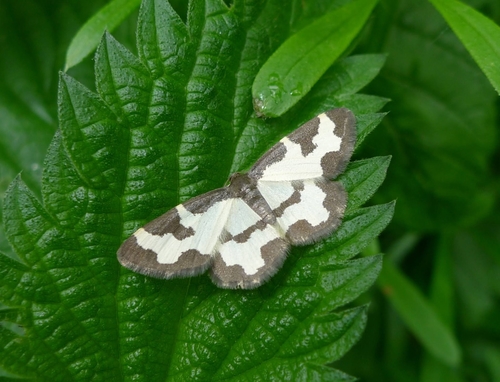
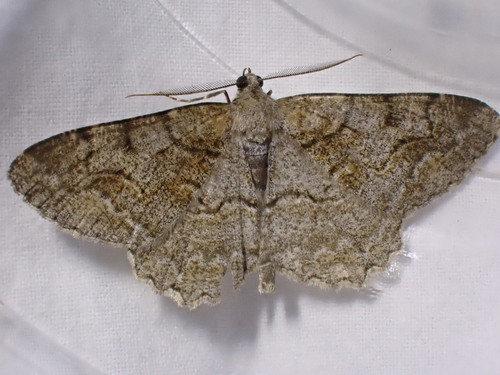
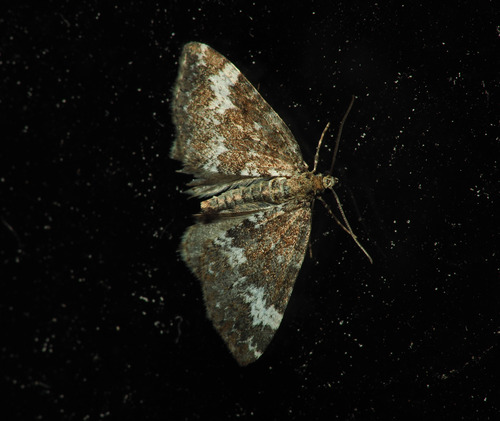
Dark Marbled Carpet

Dark Marbled Carpet

Dysstroma citrata

Daily sighting probability <5% · Rare
at Bavarian Forest National Park

In 3 days ~10% in a week ~30%

5 Verified sightings at Bavarian Forest National Park From 2019 to 2026
33 In all 3 parks
July Best month
☀️🌙 Day & Night When it's spotted

About the Dark Marbled Carpet

Dysstroma citrata, the dark marbled carpet or northern marbled carpet, is a moth of the family Geometridae. The species was first described by Carl Linnaeus in 1761. It is found across the Holarctic ecozone and has been reported from India.

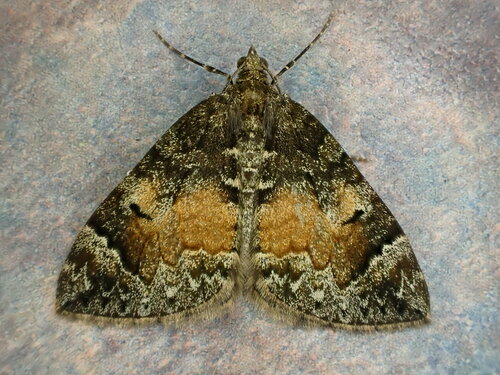
The wingspan is 25–32 mm. The ground colour of the forewings may show whitish, grey, black or brown tints but the colour is extremely variable and there are strongly darkened forms. Prout describes some aberrations. Characteristic is the protruding post medial line on the front wings, which usually reaches the post discal wavy line or interrupts it. Very similar to Dysstroma truncata.

Adult larvae are light green with two white dorsal lines. They have an approximately cylindrical shape as well as a blunt anus flap. The pupa is of green with whitish wing sheaths and has a brown, blunt rounded cremaster.

Adults are on wing from July to August. It is found from Europe through the temperate zone of Asia through northwest China, Mongolia to the Russian Far East and Japan. It is absent in Portugal, on the Mediterranean islands and Greece. In the north, it occurs in Scandinavia up to Lapland and Iceland and the Faroe Islands. In North America it is found from Alaska and Newfoundland to New England and California. It is also reported in India.

It has been found at a height of about 2,400 metres in the Alps. It prefers mountainous areas, wetlands, mountain forests and bushy slopes. The larvae feed on various shrubs and herbaceous plants, including Vaccinium species such as V. myrtillus and V. uliginosum as well as Aster tripolium, Alnus and Salix. Wikipedia →

Global Distribution

Parks Where Found

# Park Country Daily sighting probability
1 Vanoise National Park 🇫🇷 France
~10%
2 Cairngorms National Park 🇬🇧 United Kingdom
~10%
3 Bavarian Forest National Park 🇩🇪 Germany
<5%

Cities Where Found

# City Country Daily sighting probability
1 Helsinki 🇫🇮 Finland
<5%
2 Portland 🇺🇸 United States
<5%
3 Seattle 🇺🇸 United States
<5%

Before you go

What are the chances of seeing a Dark Marbled Carpet in Bavarian Forest National Park?

Rare

Under 5% of wildlife watchers report a Dark Marbled Carpet sighting in Bavarian Forest National Park on a given day, based on 5 verified sightings from GBIF citizen-science data from 2019 to 2026. It is the 964th most-seen of the 1115 insects we can rate there. Over three days the chance rises to about 10%, and over a week to about 30%, if each day is a fresh chance.

When is the best time to see a Dark Marbled Carpet in Bavarian Forest National Park?

July and August

In those months about 10% of wildlife watchers report a Dark Marbled Carpet in Bavarian Forest National Park on a given day, against under 5% in September to June, the lowest months.

What time of day is best to see a Dark Marbled Carpet?

Between 7 and 10 am

Across all the parks we cover, that three-hour window holds the most Dark Marbled Carpet sightings with a recorded time, and about half of them come between 6 pm and 6 am: it is seen both by day and at night.

Is Bavarian Forest National Park the best place to see a Dark Marbled Carpet?

3rd of 3

Of the 3 parks where we can rate Dark Marbled Carpet sightings, Bavarian Forest National Park ranks 3rd at under 5%. The best odds are in Vanoise National Park (France, about 10%) and Cairngorms National Park (United Kingdom, about 10%).

Where does the Dark Marbled Carpet sighting chance come from?

GBIF citizen-science records

It is estimated from how often the Dark Marbled Carpet is recorded against all the insects logged in Bavarian Forest National Park (5 verified sightings from 2019 to 2026), calibrated against known sighting rates. Figures are rounded to the nearest 10% because citizen-science data supports honest approximations, not decimals, and months with records from fewer than five people show "—". How it works.

← Back to Bavarian Forest National Park