

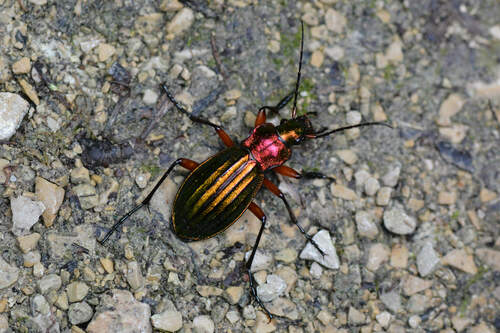
Horned Dor Beetle

Horned Dor Beetle

Odonteus armiger

Daily sighting probability <5% · Rare
at Bavarian Forest National Park

In 3 days ~10% in a week ~30%

5 Verified sightings at Bavarian Forest National Park From 2019 to 2026
5 In 1 park
August Best month
🌙 Nocturnal When it's spotted

About the Horned Dor Beetle

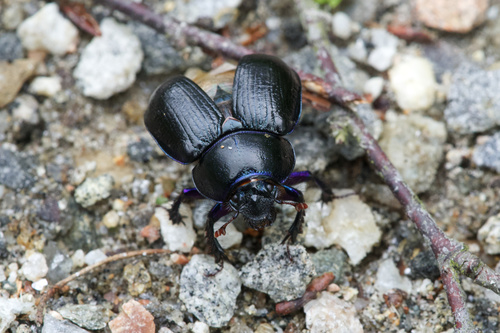
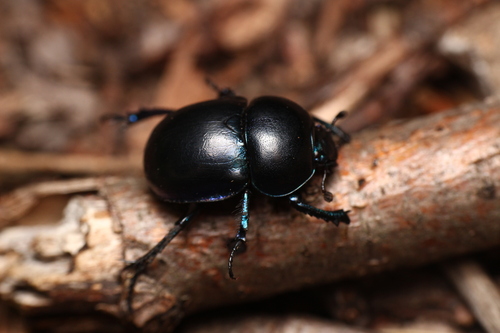
Odonteus armiger is the only European species of the genus Odonteus. It belongs to the superfamily Scarabaeoidea. This species lives a very hidden life and is therefore little known about it, despite its wide distribution.

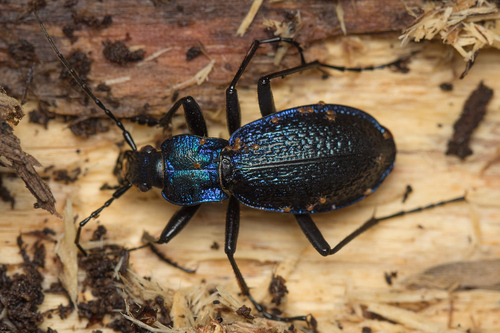
Its body length is of 7–10 mm (0.28–0.39 in). The deep black, shiny body is short, rounded, and strongly arched. Males have a narrow, movable horn at the base of the head. There are also two smaller horns on the sides of the male's neck shield. The females have a transverse ridge with two small bumps at this point. Other native beetles with a head horn are, for example, the european rhinoceros beetle or Copris lunaris. The antennae consist of movable leaves. Other similar genera are Geotrupes and Typhaeus, which lack the horn, the rimmed seam edge of the elytra and the tomentum spot on the front of the forelegs. Odonteus armiger are also usually smaller than them.

The species has a wide distribution in Europe. In the north, the species is found as far south as Sweden and the south of Great Britain. In the west, the species can be found as far as France and the north-eastern parts of Spain. In the south, the species... Wikipedia →

Global Distribution

Parks Where Found

# Park Country Daily sighting probability
1 Bavarian Forest National Park 🇩🇪 Germany
<5%

More parks will be added in future updates.

Cities Where Found

# City Country Daily sighting probability
1 Vienna 🇦🇹 Austria
<5%

Before you go

What are the chances of seeing a Horned Dor Beetle in Bavarian Forest National Park?

Rare

Under 5% of wildlife watchers report a Horned Dor Beetle sighting in Bavarian Forest National Park on a given day, based on 5 verified sightings from GBIF citizen-science data from 2019 to 2026. It is the 964th most-seen of the 1115 insects we can rate there. Over three days the chance rises to about 10%, and over a week to about 30%, if each day is a fresh chance.

When is the best time to see a Horned Dor Beetle in Bavarian Forest National Park?

August

In that month about 10% of wildlife watchers report a Horned Dor Beetle in Bavarian Forest National Park on a given day, against under 5% in September to July, the lowest months.

What time of day is best to see a Horned Dor Beetle?

Between 8 and 11 pm

Across all the parks we cover, that three-hour window holds the most Horned Dor Beetle sightings with a recorded time, and about 8 in 10 of them come between 6 pm and 6 am: it is mostly seen at night.

Where else can you see a Horned Dor Beetle?

Only Bavarian Forest National Park, in our data

Bavarian Forest National Park is the only park on Wallace's Line with enough records to rate Horned Dor Beetle sightings: under 5% of wildlife watchers there report one on a given day.

Which relatives of the Horned Dor Beetle live in Bavarian Forest National Park?

Same family: Geotrupidae

The closest relatives of the Horned Dor Beetle that you can see in Bavarian Forest National Park (family Geotrupidae, Earth-boring Beetles) are Woodland Dor Beetle (about 30%) and Springtime Dung Beetle (about 10%), with each one's daily chance of a sighting.

Where does the Horned Dor Beetle sighting chance come from?

GBIF citizen-science records

It is estimated from how often the Horned Dor Beetle is recorded against all the insects logged in Bavarian Forest National Park (5 verified sightings from 2019 to 2026), calibrated against known sighting rates. Figures are rounded to the nearest 10% because citizen-science data supports honest approximations, not decimals, and months with records from fewer than five people show "—". How it works.

← Back to Bavarian Forest National Park