About the Ivy Cellophane Bee
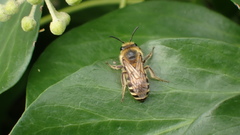
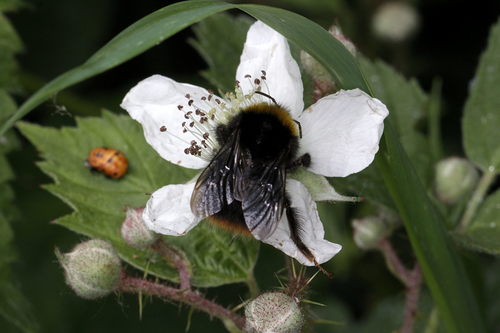
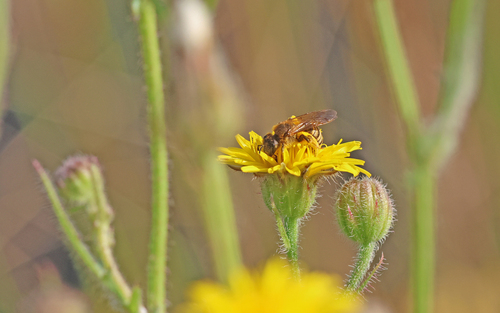
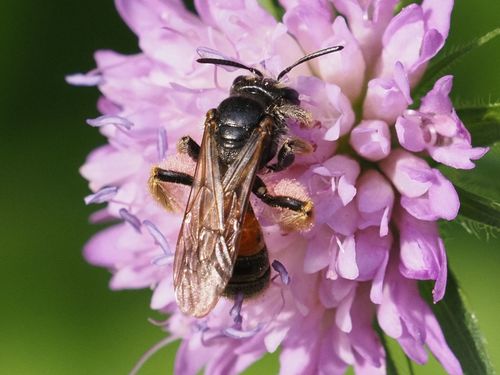
Colletes hederae, the ivy bee, is a species of plasterer bee belonging to the family Colletidae subfamily Colletinae. Colletes hederae has been only recently described (Schmidt & Westrich 1993) as a distinct species. Until then, they were confused with another species of Colletes that are morphologically similar, but ecologically distinctive, Colletes halophilus.
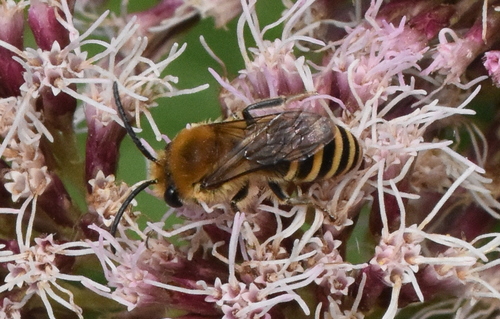
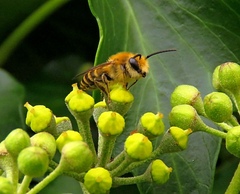
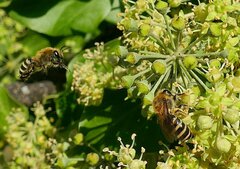
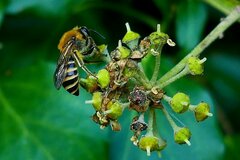
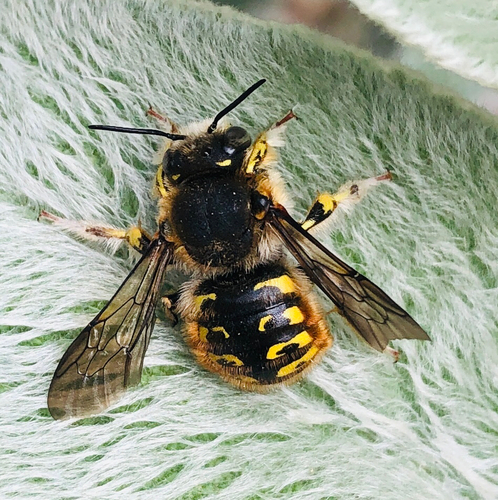
Ivy bees are known from Austria, Belgium, Channel Islands, Croatia, Cyprus, southern England, Wales, France, Germany, Greece, Ireland, Italy, Luxembourg, Netherlands, Serbia, Slovenia, Spain and Switzerland. The females of Colletes hederae are on average 13 millimetres (0.51 in) long, while the males are about 10 mm (0.39 in) long, significantly larger than the common colletes. The thorax of the adults is covered by dense orange-brown hair, while each abdominal segment has an apical orangey hair-band.
This species is very similar to the closely related heather colletes (Colletes succinctus) and even more to the sea aster mining bee (Colletes halophilus). The adults emerge late in the year (the males from late August and the females a little later in early September... Wikipedia →