King Rail

King Rail

Rallus elegans

Silhouette: Ferran Sayol · PhyloPic

LCNTNear ThreatenedVUENCR
Daily sighting probability ~10% · With luck
at Big Cypress National Preserve

In 3 days ~10% in a week ~30%

128 Verified sightings at Big Cypress National Preserve From 2019 to 2026
455 In all 4 parks
October Best month
☀️ Diurnal When it's spotted

About the King Rail

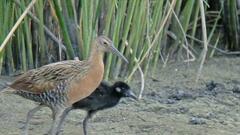
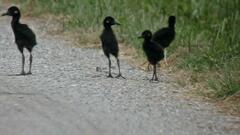
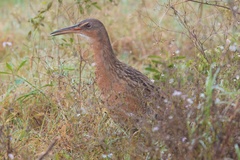
The king rail (Rallus elegans) is a large, mostly brown rail native to North America, where it breeds in marshes. Distinct features are a long bill with a slight downward curve, with adults being brown on the back and rusty-brown on the face and breast with a dark brown cap. They also have a white throat and a light belly with barred flanks. Undertail coverts are white and are displayed by the male during courtship. Immature birds are covered in down, with light brown on the head and darker brown on the back and wings.

The males are larger than females, the male weighing on average 369 g (13.0 oz) and the female weighing 309 g (10.9 oz). This bird's call is a low repeated grunt transcribed as kek-kek-kek. This bird breeds in marshes in eastern North America. Birds along the southeastern coasts of the United States are permanent residents. Other birds migrate to the southern United States and Mexico; in Canada, they are found in southern Ontario. An adult king rail will molt completely after nesting and it becomes flightless for almost a month.

This bird is diurnal, contrasting with its smaller, nocturnal relatives. �... Wikipedia →

Sounds

Call0:23

United States · 2025

© John A. Middleton Jr. · XC1083029 · CC BY-NC-SA 4.0

Duet0:28

United States · 2022

© Paul Driver · XC705417 · CC BY-NC-SA 4.0

Song0:46

United States · 2020

© John Middleton · XC550485 · CC BY-NC-SA 4.0

Global Distribution

Parks Where Found

# Park Country Daily sighting probability
1 Big Cypress National Preserve 🇺🇸 United States
~10%
2 Ciénaga de Zapata 🇨🇺 Cuba
<5%
3 Everglades National Park 🇺🇸 United States
<5%
4 Merritt Island National Wildlife Refuge 🇺🇸 United States
<5%

Cities Where Found

# City Country Daily sighting probability
1 Miami 🇺🇸 United States
<5%
2 Washington 🇺🇸 United States
<5%
3 Orlando 🇺🇸 United States
<5%
4 Chicago 🇺🇸 United States
<5%

Before you go

What are the chances of seeing a King Rail in Big Cypress National Preserve?

With luck

About 10% of wildlife watchers report a King Rail sighting in Big Cypress National Preserve on a given day, based on 128 verified sightings from GBIF citizen-science data from 2019 to 2026. It is the 77th most-seen of the 199 birds we can rate there. Over three days the chance rises to about 10%, and over a week to about 30%, if each day is a fresh chance.

When is the best time to see a King Rail in Big Cypress National Preserve?

June and October

In those months about 20% of wildlife watchers report a King Rail in Big Cypress National Preserve on a given day, against under 5% in February to May, the lowest months. Those are among Big Cypress National Preserve's wettest months, with about 190 mm of rain a month against 40 mm in March.

What time of day is best to see a King Rail?

Between 7 and 10 am

Across all the parks we cover, that three-hour window holds the most King Rail sightings with a recorded time, and about 8 in 10 of them come between 6 am and 6 pm: it is a daytime animal.

Is Big Cypress National Preserve the best place to see a King Rail?

Yes

Of the 4 parks where we can rate King Rail sightings, Big Cypress National Preserve has the highest daily chance: about 10%. Next come Ciénaga de Zapata (Cuba, under 5%) and Everglades National Park (United States, under 5%).

Where does the King Rail sighting chance come from?

GBIF citizen-science records

It is estimated from how often the King Rail is recorded against all the birds logged in Big Cypress National Preserve (128 verified sightings from 2019 to 2026), calibrated against known sighting rates. Figures are rounded to the nearest 10% because citizen-science data supports honest approximations, not decimals, and months with records from fewer than five people show "—". How it works.

← Back to Big Cypress National Preserve