Mudsnake

Mudsnake

Farancia abacura

Silhouette: Alex Slavenko · PhyloPic

LCLeast ConcernNTVUENCR Endemic
Daily sighting probability ~30% · Possible
at Big Cypress National Preserve

In 3 days ~60% in a week ~90%

46 Verified sightings at Big Cypress National Preserve From 2019 to 2026
79 In all 3 parks
October Best month
☀️🌙 Day & Night When it's spotted

About the Mudsnake

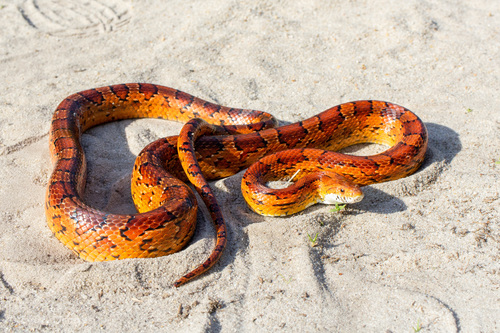
The mud snake (Farancia abacura) is a species of nonvenomous, semiaquatic, colubrid snake endemic to the southeastern United States. The mud snake usually grows to a total length (including tail) of 40 to 54 inches (1-1.4 m), with the record total length being slightly over 80 inches (2 m).

This species is sexually dimorphic in size. Female adults are larger than males in total length. The upperside of the mud snake is glossy black. The underside is red and black, and the red extends up the sides to form bars of reddish-pink, although some have a completely black body with slightly lighter black spots instead of the common reddish colors.

The heavy body is cylindrical in cross section, and the short tail has a terminal spine. The head scalation is distinctive in that there is only one internasal scale, no preocular scale, and one anterior temporal scale. The dorsal scales are smooth, and are arranged in 19 rows at midbody. There are 168–208 ventral scales and 31–55 subcaudal scales. The anal plate is divided.

Farancia abacura is closely related to Farancia erytrogramma, also called the rainbow snake. There are two recognized subspecies of Farancia... Wikipedia →

Global Distribution

Parks Where Found

# Park Country Daily sighting probability
1 Big Cypress National Preserve 🇺🇸 United States
~30%
2 Everglades National Park 🇺🇸 United States
~10%
3 Merritt Island National Wildlife Refuge 🇺🇸 United States
<5%

Before you go

What are the chances of seeing a Mudsnake in Big Cypress National Preserve?

Possible

About 30% of wildlife watchers report a Mudsnake sighting in Big Cypress National Preserve on a given day, based on 46 verified sightings from GBIF citizen-science data from 2019 to 2026. It is the 20th most-seen of the 37 reptiles we can rate there. Over three days the chance rises to about 60%, and over a week to about 90%, if each day is a fresh chance.

When is the best time to see a Mudsnake in Big Cypress National Preserve?

July and October

In those months about 50% of wildlife watchers report a Mudsnake in Big Cypress National Preserve on a given day, against under 5% in December, the lowest month.

What time of day is best to see a Mudsnake?

Between 8 and 11 pm

Across all the parks we cover, that three-hour window holds the most Mudsnake sightings with a recorded time, and about half of them come between 6 am and 6 pm: it is seen both by day and at night.

Is Big Cypress National Preserve the best place to see a Mudsnake?

Yes

Of the 3 parks where we can rate Mudsnake sightings, Big Cypress National Preserve has the highest daily chance: about 30%. Next come Everglades National Park (United States, about 10%) and Merritt Island National Wildlife Refuge (United States, under 5%).

Which relatives of the Mudsnake live in Big Cypress National Preserve?

Same family: Colubridae

The closest relatives of the Mudsnake that you can see in Big Cypress National Preserve (family Colubridae, Colubrid Snakes) are Banded Water Snake (about 60%), Brown Watersnake (about 50%) and Scarletsnake (about 40%), with each one's daily chance of a sighting.

Where does the Mudsnake sighting chance come from?

GBIF citizen-science records

It is estimated from how often the Mudsnake is recorded against all the reptiles logged in Big Cypress National Preserve (46 verified sightings from 2019 to 2026), calibrated against known sighting rates. Figures are rounded to the nearest 10% because citizen-science data supports honest approximations, not decimals, and months with records from fewer than five people show "—". How it works.

← Back to Big Cypress National Preserve