Pig Frog

Pig Frog

Lithobates grylio

Silhouette: Jose Carlos Arenas-Monroy · PhyloPic

Endemic
Daily sighting probability ~40% · Likely
at Big Cypress National Preserve

In 3 days ~80% in a week >90%

106 Verified sightings at Big Cypress National Preserve From 2019 to 2026
194 In all 3 parks
August Best month
☀️🌙 Day & Night When it's spotted

About the Pig Frog

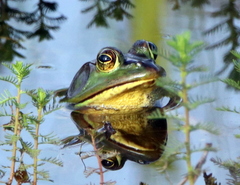
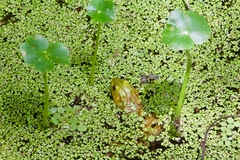
The pig frog (Lithobates grylio) is a species of aquatic frog found in the Southeastern United States, from South Carolina to Texas. Some sources also refer to it as the lagoon frog or the southern bullfrog. Pig frogs (Lithobates grylio) are a species of frog that belong to the class Amphibia, the order Anura, the family Ranidae, and the genus Lithobates. They are part of the phylum Chordata, which includes animals with a notochord and a hollow nerve cord. Pig frogs are vertebrates, meaning they have a backbone, and they are tetrapods, meaning they have four limbs. They are adapted to living both on land and in water, and they are commonly found in the southeastern United States. Norwegian-American naturalist Leonhard Stejneger described the pig frog in 1901, and it still bears its original name. The name comes from the calls the frog makes, sounding like a pig grunting.

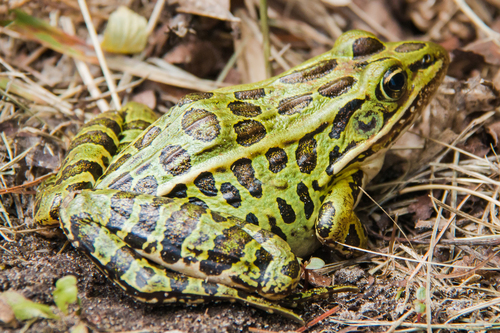
The pig frog is green or grey-green in color, with brown or black blotching. It has fully webbed feet, a sharply pointed nose, and large tympana (eardrums). The Pig frog is sexually dimorphic in size and coloration, the males also have a larger tympanum than the females. It is easily... Wikipedia →

Sounds

Recording0:07

United States · 2022

© snakebite46 · iNaturalist · CC BY-NC 4.0

Recording0:01

United States · 2022

© chrisz52 · iNaturalist · CC BY-NC 4.0

Recording0:25

United States · 2023

© lyvisky · iNaturalist · CC BY-NC 4.0

Global Distribution

Parks Where Found

# Park Country Daily sighting probability
1 Big Cypress National Preserve 🇺🇸 United States
~40%
2 Everglades National Park 🇺🇸 United States
~10%
3 Merritt Island National Wildlife Refuge 🇺🇸 United States
~10%

Cities Where Found

# City Country Daily sighting probability
1 Miami 🇺🇸 United States
~10%
2 Orlando 🇺🇸 United States
<5%

Before you go

What are the chances of seeing a Pig Frog in Big Cypress National Preserve?

Likely

About 40% of wildlife watchers report a Pig Frog sighting in Big Cypress National Preserve on a given day, based on 106 verified sightings from GBIF citizen-science data from 2019 to 2026. It is the 4th most-seen of the 12 amphibians we can rate there. Over three days the chance rises to about 80%, and over a week to over 90%, if each day is a fresh chance.

When is the best time to see a Pig Frog in Big Cypress National Preserve?

August

In that month about 60% of wildlife watchers report a Pig Frog in Big Cypress National Preserve on a given day, against about 30% in March and September, the lowest months. That is one of Big Cypress National Preserve's wettest months, with about 210 mm of rain against 40 mm in March.

What time of day is best to see a Pig Frog?

Between 8 and 11 pm

Across all the parks we cover, that three-hour window holds the most Pig Frog sightings with a recorded time, and about half of them come between 6 pm and 6 am: it is seen both by day and at night.

Is Big Cypress National Preserve the best place to see a Pig Frog?

Yes

Of the 3 parks where we can rate Pig Frog sightings, Big Cypress National Preserve has the highest daily chance: about 40%. Next come Everglades National Park (United States, about 10%) and Merritt Island National Wildlife Refuge (United States, about 10%).

Where does the Pig Frog sighting chance come from?

GBIF citizen-science records

It is estimated from how often the Pig Frog is recorded against all the amphibians logged in Big Cypress National Preserve (106 verified sightings from 2019 to 2026), calibrated against known sighting rates. Figures are rounded to the nearest 10% because citizen-science data supports honest approximations, not decimals, and months with records from fewer than five people show "—". How it works.

← Back to Big Cypress National Preserve