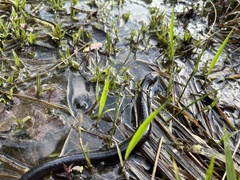
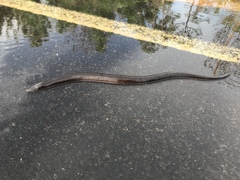
Two-toed Amphiuma

Two-toed Amphiuma

Amphiuma means

Silhouette: Johann Wagler · PhyloPic

LCLeast ConcernNTVUENCR Endemic
Daily sighting probability ~20% · Possible
at Big Cypress National Preserve

In 3 days ~40% in a week ~70%

17 Verified sightings at Big Cypress National Preserve From 2019 to 2026
17 In 1 park
September Best month
☀️🌙 Day & Night When it's spotted

About the Two-toed Amphiuma

The two-toed amphiuma (Amphiuma means) is an aquatic salamander widely distributed in the southeastern United States. It is commonly, but incorrectly, called "congo snake", "conger eel" or the "blind eel". Two-toed amphiumas are the most prominent in the Amphiumidae family and the longest salamander species in the United States, that can grow from 39 to 1,042 g (1.4 to 36.8 oz) in mass and from 34.8 to 116 cm (13.7 to 45.7 in) in length. They have four vestigial legs that end in two toes; the number of toes is one of the primary differences between Amphiuma means and its relatives, the one-toed and three-toed amphiumas. Additional genetic studies have been conducted on the three species; genetic distance estimates suggest that there is high levels of similarity between two-toed amphiumas and three-toed amphiumas, and much greater dissimilarity between the one-toed amphiuma and the two-toed amphiuma. The head is pointed and wedge-shaped, and the eyes are small. Adults retain a single gill slit on each side of the head. They are black, dark grey or dark brown in color. Two-toed amphiumas tend to be unicolored. Their dark dorsum contrasts with their slightly lighter ventrum... Wikipedia →

Global Distribution

Parks Where Found

# Park Country Daily sighting probability
1 Big Cypress National Preserve 🇺🇸 United States
~20%

More parks will be added in future updates.

Cities Where Found

# City Country Daily sighting probability
1 Orlando 🇺🇸 United States
<5%

Zoos & Centres Where Found

# Zoo / Centre Country
1 Cincinnati Zoo and Botanical Garden 🇺🇸 United States In captivity
2 Riverbanks Zoo 🇺🇸 United States In captivity
3 Alabama Gulf Coast Zoo 🇺🇸 United States In captivity
4 Reptile Gardens 🇺🇸 United States In captivity

Before you go

What are the chances of seeing a Two-toed Amphiuma in Big Cypress National Preserve?

Possible

About 20% of wildlife watchers report a Two-toed Amphiuma sighting in Big Cypress National Preserve on a given day, based on 17 verified sightings from GBIF citizen-science data from 2019 to 2026. It is the 11th most-seen of the 12 amphibians we can rate there. Over three days the chance rises to about 40%, and over a week to about 70%, if each day is a fresh chance.

When is the best time to see a Two-toed Amphiuma in Big Cypress National Preserve?

August and September

In those months about 30% of wildlife watchers report a Two-toed Amphiuma in Big Cypress National Preserve on a given day, against under 5% in April–May, July and November, the lowest months. Those are among Big Cypress National Preserve's wettest months, with about 220 mm of rain a month against 40 mm in March.

What time of day is best to see a Two-toed Amphiuma?

Between 9 am and noon

Across all the parks we cover, that three-hour window holds the most Two-toed Amphiuma sightings with a recorded time, and about half of them come between 6 am and 6 pm: it is seen both by day and at night.

Where else can you see a Two-toed Amphiuma?

Only Big Cypress National Preserve, in our data

Big Cypress National Preserve is the only park on Wallace's Line with enough records to rate Two-toed Amphiuma sightings: about 20% of wildlife watchers there report one on a given day.

Where does the Two-toed Amphiuma sighting chance come from?

GBIF citizen-science records

It is estimated from how often the Two-toed Amphiuma is recorded against all the amphibians logged in Big Cypress National Preserve (17 verified sightings from 2019 to 2026), calibrated against known sighting rates. Figures are rounded to the nearest 10% because citizen-science data supports honest approximations, not decimals, and months with records from fewer than five people show "—". How it works.

← Back to Big Cypress National Preserve