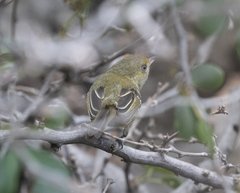
Jamaican Vireo

Jamaican Vireo

Vireo modestus

Silhouette: Caleb Gordon · PhyloPic

LCLeast ConcernNTVUENCR Endemic
Daily sighting probability ~70% · Very likely
at Blue and John Crow Mountains National Park

In 3 days >90%

792 Verified sightings at Blue and John Crow Mountains National Park From 2019 to 2026
792 In 1 park
April Best month
☀️ Diurnal When it's spotted

About the Jamaican Vireo

The Jamaican vireo (Vireo modestus) is a species of bird in the family Vireonidae, the vireos, greenlets, and shrike-babblers. It is endemic to Jamaica. The Jamaican vireo was originally described in 1861 as Vireo modestus, its current binomial. It is monotypic.

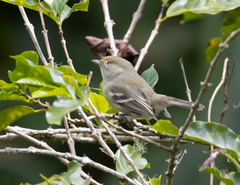
The Jamaican vireo is about 12.5 cm (4.9 in) long and weighs about 9 to 10 g (0.32 to 0.35 oz). The sexes have the same plumage. Adults have a mostly greenish olive to grayish olive head with yellowish olive gray above the lores and on the chin and throat. Their upperparts are greenish olive to grayish olive with a slightly brighter rump. Their wing coverts are brownish gray with wide yellowish white tips that form two wing bars. Their primaries and secondaries are dusky to grayish with paler olive green outer edges and whitish inner edges. Their breast is yellowish gray, their belly brighter yellow gray, and their sides and flanks pale greenish olive. They have a gray iris, a gray maxilla, a lighter, sometimes pinkish, mandible, and grayish blue legs and feet. Juveniles have grayer heads and more brownish olive upperparts than adults, with buffier yellow underparts. Wikipedia →

Sounds

Call0:17

Jamaica · 2025

© Brendan Sloan · XC1052394 · CC BY-NC-ND 4.0

Song0:41

Jamaica · 2018

© George Wagner · XC438066 · CC BY-NC-SA 4.0

Call0:58

Jamaica · 2023

© Peter de Rouw · XC783867 · CC BY-NC-SA 4.0

Global Distribution

Parks Where Found

# Park Country Daily sighting probability
1 Blue and John Crow Mountains National Park 🇯🇲 Jamaica
~70%

More parks will be added in future updates.

Before you go

What are the chances of seeing a Jamaican Vireo in Blue and John Crow Mountains National Park?

Very likely

About 70% of wildlife watchers report a Jamaican Vireo sighting in Blue and John Crow Mountains National Park on a given day, based on 792 verified sightings from GBIF citizen-science data from 2019 to 2026. It is the 15th most-seen of the 91 birds we can rate there. Over three days the chance rises to over 90%, if each day is a fresh chance.

When is the best time to see a Jamaican Vireo in Blue and John Crow Mountains National Park?

April

In that month about 80% of wildlife watchers report a Jamaican Vireo in Blue and John Crow Mountains National Park on a given day, against about 50% in May and August–September, the lowest months. June has too few records to rate.

What time of day is best to see a Jamaican Vireo?

Between 7 and 10 am

Across all the parks we cover, that three-hour window holds the most Jamaican Vireo sightings with a recorded time, and about 9 in 10 of them come between 6 am and 6 pm: it is a daytime animal.

Where else can you see a Jamaican Vireo?

Only Blue and John Crow Mountains National Park, in our data

Blue and John Crow Mountains National Park is the only park on Wallace's Line with enough records to rate Jamaican Vireo sightings: about 70% of wildlife watchers there report one on a given day.

Which relatives of the Jamaican Vireo live in Blue and John Crow Mountains National Park?

Same genus: Vireo

The closest relatives of the Jamaican Vireo that you can see in Blue and John Crow Mountains National Park (genus Vireo, Vireos) are Blue Mountain Vireo (about 50%) and Black-whiskered Vireo (about 20%), with each one's daily chance of a sighting.

Where does the Jamaican Vireo sighting chance come from?

GBIF citizen-science records

It is estimated from how often the Jamaican Vireo is recorded against all the birds logged in Blue and John Crow Mountains National Park (792 verified sightings from 2019 to 2026), calibrated against known sighting rates. Figures are rounded to the nearest 10% because citizen-science data supports honest approximations, not decimals, and months with records from fewer than five people show "—". How it works.

← Back to Blue and John Crow Mountains National Park