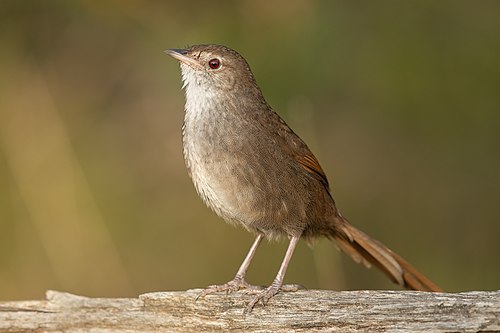

Eastern Bristlebird

Eastern Bristlebird

Dasyornis brachypterus

Silhouette: Sheatherius · PhyloPic

LCNTVUVulnerableENCR Endemic
Daily sighting probability ~30% · Possible
at Booderee National Park

In 3 days ~60% in a week ~90%

281 Verified sightings at Booderee National Park From 2019 to 2026
281 In 1 park
August Best month
☀️ Diurnal When it's spotted

About the Eastern Bristlebird

The eastern bristlebird (Dasyornis brachypterus) is a species of bird in the bristlebird family, Dasyornithidae. It is endemic to Australia. Its natural habitats are temperate forests, temperate shrubland, and temperate grassland. It is threatened by habitat loss.

The eastern bristlebird is very territorial and will often use a distinct, loud melodic song to mark its territory. Surveys have found the bird prefers to live in small, localised populations, and prefer to build their nests on the ground in areas of dense, clumped grasses.

An isolated colony was found in the Conondale Range in southeastern Queensland in the 1980s. In late 2021, it was estimated that there were only about 2,500 of the species left in the wild, existing in isolated populations in eastern New South Wales and southern Queensland. There are four separate populations: one in northern NSW and into southern Queensland, including the Border Ranges National Park (around 40 birds); one in the Southern Highlands; one in the Jervis Bay area; and one southern population around the NSW border with Victoria, which includes Nadgee Nature Reserve and Croajingolong National Park... Wikipedia →

Sounds

Song1:10

Australia · 2017

© Eddy Smith · XC748420 · CC BY-NC-SA 4.0

Call1:23

Australia · 2016

© Greg McLachlan · XC345055 · CC BY-NC-SA 4.0

Alarm call0:30

Australia · 2015

© Pieter de Groot Boersma · XC326388 · CC BY-NC-SA 4.0

Global Distribution

Parks Where Found

# Park Country Daily sighting probability
1 Booderee National Park 🇦🇺 Australia
~30%

More parks will be added in future updates.

Before you go

What are the chances of seeing an Eastern Bristlebird in Booderee National Park?

Possible

About 30% of wildlife watchers report an Eastern Bristlebird sighting in Booderee National Park on a given day, based on 281 verified sightings from GBIF citizen-science data from 2019 to 2026. It is the 29th most-seen of the 128 birds we can rate there. Over three days the chance rises to about 60%, and over a week to about 90%, if each day is a fresh chance.

When is the best time to see an Eastern Bristlebird in Booderee National Park?

March–May and August

In those months about 40% of wildlife watchers report an Eastern Bristlebird in Booderee National Park on a given day, against about 20% in January, July and September–October, the lowest months.

What time of day is best to see an Eastern Bristlebird?

Between 4 and 7 pm

Across all the parks we cover, that three-hour window holds the most Eastern Bristlebird sightings with a recorded time, and about 9 in 10 of them come between 6 am and 6 pm: it is a daytime animal.

Where else can you see an Eastern Bristlebird?

Only Booderee National Park, in our data

Booderee National Park is the only park on Wallace's Line with enough records to rate Eastern Bristlebird sightings: about 30% of wildlife watchers there report one on a given day.

Which relatives of the Eastern Bristlebird live in Booderee National Park?

Same order: Passeriformes

The closest relatives of the Eastern Bristlebird that you can see in Booderee National Park (order Passeriformes, Perching Birds) are New Holland Honeyeater (about 60%), Eastern Yellow Robin (about 60%) and Little Wattlebird (about 60%), with each one's daily chance of a sighting.

Where does the Eastern Bristlebird sighting chance come from?

GBIF citizen-science records

It is estimated from how often the Eastern Bristlebird is recorded against all the birds logged in Booderee National Park (281 verified sightings from 2019 to 2026), calibrated against known sighting rates. Figures are rounded to the nearest 10% because citizen-science data supports honest approximations, not decimals, and months with records from fewer than five people show "—". How it works.

← Back to Booderee National Park