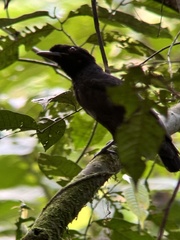
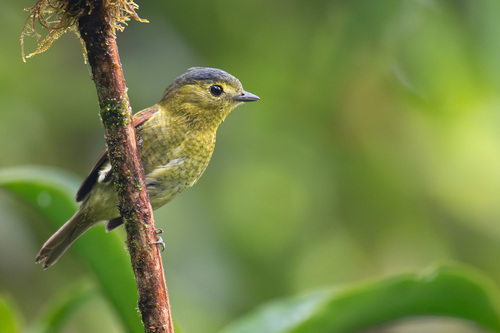
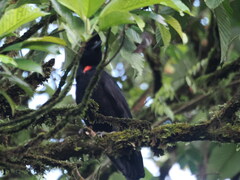
Bare-necked Umbrellabird

Bare-necked Umbrellabird

Cephalopterus glabricollis

Silhouette: Steven Traver · PhyloPic

LCNTVUENEndangeredCR
Daily sighting probability <5% · Rare
at Braulio Carrillo National Park

In 3 days ~10% in a week ~20%

145 Verified sightings at Braulio Carrillo National Park From 2019 to 2026
288 In all 4 parks
November Best month
☀️ Diurnal When it's spotted

About the Bare-necked Umbrellabird

The bare-necked umbrellabird (Cephalopterus glabricollis) is a species of bird in the family Cotingidae. It is found in the Talamancan montane forests of Costa Rica and Panama. Bare-necked umbrellabirds live only in forests and their diet consists mainly of fruits.

Its natural habitats are subtropical or tropical moist lowland forest and subtropical or tropical moist montane forest. It is threatened by habitat loss. The bare-necked umbrellabird is one of three species in the genus Cephalopterus, commonly known as the umbrellabirds. It was first described by John Gould in 1851, on the basis of specimens collected by Warzewickz at elevations of 8,000 ft (2,400 m) in Panama. The generic name Cephalopterus comes from the Greek κεφαλη (kephalē), meaning head, and πτερος (pteros), meaning feathered, referring to the head plumes of the Amazonian umbrellabird. The specific epithet glabricollis is from the Latin glaber, meaning bald, and collis, meaning necked. It is monotypic.

The bare-necked umbrellabird is a large, bulky, and crow-like bird, being the largest passerine in its range. It is also among the largest of the cotingas, with only the... Wikipedia →

Sounds

Song0:59

Costa Rica · 1988

© Rolf A. de By · XC10948 · CC BY-NC-ND 2.5

Global Distribution

Parks Where Found

# Park Country Daily sighting probability
1 Braulio Carrillo National Park 🇨🇷 Costa Rica
<5%
2 Arenal Volcano National Park 🇨🇷 Costa Rica
<5%
3 Tenorio Volcano National Park 🇨🇷 Costa Rica
<5%
4 Monteverde Cloud Forest Reserve 🇨🇷 Costa Rica
<5%

Before you go

What are the chances of seeing a Bare-necked Umbrellabird in Braulio Carrillo National Park?

Rare

Under 5% of wildlife watchers report a Bare-necked Umbrellabird sighting in Braulio Carrillo National Park on a given day, based on 145 verified sightings from GBIF citizen-science data from 2019 to 2026. It is the 287th most-seen of the 505 birds we can rate there. Over three days the chance rises to about 10%, and over a week to about 20%, if each day is a fresh chance.

When is the best time to see a Bare-necked Umbrellabird in Braulio Carrillo National Park?

November

In that month about 10% of wildlife watchers report a Bare-necked Umbrellabird in Braulio Carrillo National Park on a given day, against under 5% in December to October, the lowest months. That is one of Braulio Carrillo National Park's wettest months, with about 550 mm of rain against 170 mm in April.

What time of day is best to see a Bare-necked Umbrellabird?

Between 9 am and noon

Across all the parks we cover, that three-hour window holds the most Bare-necked Umbrellabird sightings with a recorded time, and about 8 in 10 of them come between 6 am and 6 pm: it is a daytime animal.

Is Braulio Carrillo National Park the best place to see a Bare-necked Umbrellabird?

Yes

Of the 4 parks where we can rate Bare-necked Umbrellabird sightings, Braulio Carrillo National Park has the highest daily chance: under 5%. Next come Arenal Volcano National Park (Costa Rica, under 5%) and Tenorio Volcano National Park (Costa Rica, under 5%).

Which relatives of the Bare-necked Umbrellabird live in Braulio Carrillo National Park?

Same family: Cotingidae

The closest relatives of the Bare-necked Umbrellabird that you can see in Braulio Carrillo National Park (family Cotingidae, Cotingas) are Cinnamon Becard (about 20%), Masked Tityra (about 10%) and Barred Becard (about 10%), with each one's daily chance of a sighting.

Where does the Bare-necked Umbrellabird sighting chance come from?

GBIF citizen-science records

It is estimated from how often the Bare-necked Umbrellabird is recorded against all the birds logged in Braulio Carrillo National Park (145 verified sightings from 2019 to 2026), calibrated against known sighting rates. Figures are rounded to the nearest 10% because citizen-science data supports honest approximations, not decimals, and months with records from fewer than five people show "—". How it works.

← Back to Braulio Carrillo National Park