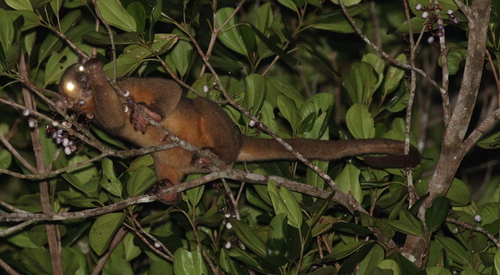
Chiriqui Olingo

Chiriqui Olingo

Bassaricyon gabbii

Silhouette: Margot Michaud · PhyloPic

LCLeast ConcernNTVUENCR
Daily sighting probability ~10% · With luck
at Braulio Carrillo National Park

In 3 days ~20% in a week ~40%

7 Verified sightings at Braulio Carrillo National Park From 2019 to 2026
23 In all 2 parks
July Best month
🌅 Crepuscular When it's spotted

About the Chiriqui Olingo

The northern olingo (Bassaricyon gabbii), also known as the bushy-tailed olingo or, simply, the olingo (due to it being the most common of the species), is an arboreal (tree-dwelling) member of the raccoon family, Procyonidae, which also includes the coatimundis and kinkajou. Native to Central America, it was the first species of olingo to be scientifically described; while it is considered by some authors to be the only "true" olingo species, a review of the genus Bassaricyon had shown there to be a total of four species, two of those now being considered synonymous with the northern olingo. Its specific name honors William More Gabb (1839-1878), who found and collected the first specimen for western science.

The northern olingo is a slender arboreal animal, with hind legs distinctly longer than the fore legs, and a long, bushy tail. The face is short and rounded, with relatively large eyes and short round ears. The fur is thick and colored brown or grey-brown over most of the body, becoming slightly darker along the middle of the back, while the underparts are light cream to yellowish. A band of yellowish fur runs around the throat and sides of the head, where it... Wikipedia →

Global Distribution

Parks Where Found

# Park Country Daily sighting probability
1 Monteverde Cloud Forest Reserve 🇨🇷 Costa Rica
~10%
2 Braulio Carrillo National Park 🇨🇷 Costa Rica
~10%

Before you go

What are the chances of seeing a Chiriqui Olingo in Braulio Carrillo National Park?

With luck

About 10% of wildlife watchers report a Chiriqui Olingo sighting in Braulio Carrillo National Park on a given day, based on 7 verified sightings from GBIF citizen-science data from 2019 to 2026. It is the 27th most-seen of the 31 mammals we can rate there. Over three days the chance rises to about 20%, and over a week to about 40%, if each day is a fresh chance.

When is the best time to see a Chiriqui Olingo in Braulio Carrillo National Park?

July and December

In those months about 20% of wildlife watchers report a Chiriqui Olingo in Braulio Carrillo National Park on a given day, against under 5% in January–March, May–June and October–November, the lowest months.

What time of day is best to see a Chiriqui Olingo?

Between 6 and 9 pm

Across all the parks we cover, that three-hour window holds the most Chiriqui Olingo sightings with a recorded time, and about 6 in 10 of them come between 6 pm and 6 am: it is most active around dawn and dusk.

Is Braulio Carrillo National Park the best place to see a Chiriqui Olingo?

Among the best

Of the 2 parks where we can rate Chiriqui Olingo sightings, Braulio Carrillo National Park ranks 2nd at about 10%, level with the leaders once rounded. The best odds are in Monteverde Cloud Forest Reserve (Costa Rica, about 10%).

Which relatives of the Chiriqui Olingo live in Braulio Carrillo National Park?

Same family: Procyonidae

The closest relatives of the Chiriqui Olingo that you can see in Braulio Carrillo National Park (family Procyonidae, Raccoons, Coatis, and Allies) are White-nosed Coati (about 50%), Kinkajou (about 10%) and Common Raccoon (about 10%), with each one's daily chance of a sighting.

Where does the Chiriqui Olingo sighting chance come from?

GBIF citizen-science records

It is estimated from how often the Chiriqui Olingo is recorded against all the mammals logged in Braulio Carrillo National Park (7 verified sightings from 2019 to 2026), calibrated against known sighting rates. Figures are rounded to the nearest 10% because citizen-science data supports honest approximations, not decimals, and months with records from fewer than five people show "—". How it works.

← Back to Braulio Carrillo National Park