Vampire Bat

Vampire Bat

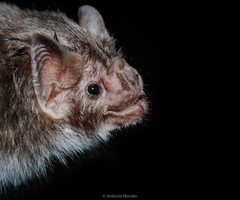
Desmodus rotundus

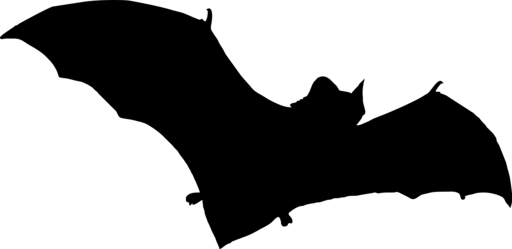
Silhouette: Roberto Díaz Sibaja · PhyloPic

LCLeast ConcernNTVUENCR
Daily sighting probability ~10% · With luck
at Braulio Carrillo National Park

In 3 days ~20% in a week ~50%

11 Verified sightings at Braulio Carrillo National Park From 2019 to 2026
20 In all 2 parks
December Best month
☀️🌙 Day & Night When it's spotted

About the Vampire Bat

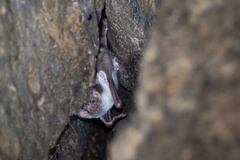
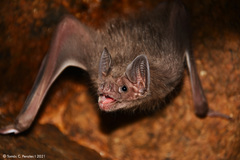
The common vampire bat (Desmodus rotundus) is a small, leaf-nosed bat native to the Americas. It is one of three extant species of vampire bats, the other two being the hairy-legged and the white-winged vampire bats. The common vampire bat practices hematophagy, mainly feeding on the blood of livestock. The bat usually approaches its prey at night while they are sleeping. It then uses its razor-sharp teeth to cut open the skin of its hosts and lap up their blood with its long tongue. The species is highly polygynous, and dominant adult males defend groups of females. It is one of the most social of bat species with a number of cooperative behaviors such as social grooming and food sharing. Because it feeds on livestock and is a carrier of rabies, the common vampire bat is considered a pest. Its conservation status is categorized as least concern by the International Union for Conservation of Nature because of "its wide distribution, presumed large population tolerance of a degree of habitat modification, and because it is unlikely to be declining at nearly the rate required to qualify for listing in a threatened category."

The common vampire bat was first described... Wikipedia →

Sounds

Recording0:13

Panama · 2021

© Larry Chen · iNaturalist · CC BY-NC 4.0

Global Distribution

Parks Where Found

# Park Country Daily sighting probability
1 Braulio Carrillo National Park 🇨🇷 Costa Rica
~10%
2 Monteverde Cloud Forest Reserve 🇨🇷 Costa Rica
~10%

Zoos & Centres Where Found

# Zoo / Centre Country
1 Cincinnati Zoo and Botanical Garden 🇺🇸 United States In captivity
2 North Carolina Zoo 🇺🇸 United States In captivity
3 Omaha’s Henry Doorly Zoo and Aquarium 🇺🇸 United States In captivity
4 Milwaukee County Zoo 🇺🇸 United States In captivity
5 Louisville Zoo 🇺🇸 United States In captivity
6 Moody Gardens 🇺🇸 United States In captivity
7 Vallazoo 🇲🇽 Mexico In captivity
8 Philadelphia Zoo 🇺🇸 United States In captivity
9 Connecticut's Beardsley Zoo 🇺🇸 United States In captivity
10 Wonders of Wildlife Museum & Aquarium 🇺🇸 United States In captivity
11 Dallas World Aquarium 🇺🇸 United States In captivity

Before you go

What are the chances of seeing a Vampire Bat in Braulio Carrillo National Park?

With luck

About 10% of wildlife watchers report a Vampire Bat sighting in Braulio Carrillo National Park on a given day, based on 11 verified sightings from GBIF citizen-science data from 2019 to 2026. It is the 24th most-seen of the 31 mammals we can rate there. Over three days the chance rises to about 20%, and over a week to about 50%, if each day is a fresh chance.

When is the best time to see a Vampire Bat in Braulio Carrillo National Park?

December

In that month about 20% of wildlife watchers report a Vampire Bat in Braulio Carrillo National Park on a given day, against under 5% in January–February, April–May, July and September–October, the lowest months.

What time of day is best to see a Vampire Bat?

Between 7 and 10 pm

Across all the parks we cover, that three-hour window holds the most Vampire Bat sightings with a recorded time, and about 6 in 10 of them come between 6 pm and 6 am: it is seen both by day and at night.

Is Braulio Carrillo National Park the best place to see a Vampire Bat?

Yes

Of the 2 parks where we can rate Vampire Bat sightings, Braulio Carrillo National Park has the highest daily chance: about 10%. Next come Monteverde Cloud Forest Reserve (Costa Rica, about 10%).

Where does the Vampire Bat sighting chance come from?

GBIF citizen-science records

It is estimated from how often the Vampire Bat is recorded against all the mammals logged in Braulio Carrillo National Park (11 verified sightings from 2019 to 2026), calibrated against known sighting rates. Figures are rounded to the nearest 10% because citizen-science data supports honest approximations, not decimals, and months with records from fewer than five people show "—". How it works.

← Back to Braulio Carrillo National Park