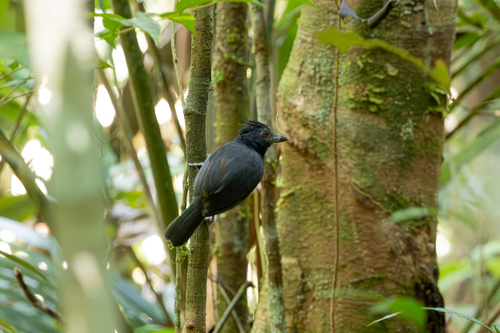

Black-throated Antshrike

Black-throated Antshrike

Frederickena viridis

Silhouette: Sheatherius · PhyloPic

LCLeast ConcernNTVUENCR
Daily sighting probability ~30% · Possible
at Brownsberg Nature Park

In 3 days ~60% in a week ~90%

78 Verified sightings at Brownsberg Nature Park From 2019 to 2026
78 In 1 park
December Best month
☀️🌙 Day & Night When it's spotted

About the Black-throated Antshrike

The black-throated antshrike (Frederickena viridis) is a species of bird in subfamily Thamnophilinae of family Thamnophilidae, the "typical antbirds". It is native to the Guiana Shield. The black-throated antshrike shares genus Frederickena with the undulated antshrike (F. unduliger) and fulvous antshrike (F. fulva). It is monotypic.

The black-throated antshrike is a large dark antbird, 19 to 22 cm (7.5 to 8.7 in) long and weighing 65 to 75 g (2.3 to 2.6 oz). The species exhibits significant sexual dimorphism, though both sexes have a crest (that usually is flattened), red irises, and a heavy black bill with a hook at the end like true shrikes. Adult males are mostly slate gray with a black head, throat, and breast, a usually hidden small white patch between their scapulars, and faint white bars on their tail. Adult females have a rufous crest, nape, upperparts, and wings. Their forehead, sides of their head, underparts, and tail are barred with pale buff to white and blackish brown; their flanks have a rufous tinge. Subadult males have mixed gray and brown upperparts and underparts like adult females'. Wikipedia →

Sounds

Song0:24

Brazil · 2021

© Matheus Fernandes Moraes Silva · XC649627 · CC BY-NC-ND 4.0

Song0:42

Brazil · 2017

© GABRIEL LEITE · XC391065 · CC BY-NC-SA 4.0

Song0:37

Suriname · 2015

© Peter Boesman · XC272407 · CC BY-NC-ND 4.0

Global Distribution

Parks Where Found

# Park Country Daily sighting probability
1 Brownsberg Nature Park 🇸🇷 Suriname
~30%

More parks will be added in future updates.

Before you go

What are the chances of seeing a Black-throated Antshrike in Brownsberg Nature Park?

Possible

About 30% of wildlife watchers report a Black-throated Antshrike sighting in Brownsberg Nature Park on a given day, based on 78 verified sightings from GBIF citizen-science data from 2019 to 2026. It is the 65th most-seen of the 221 birds we can rate there. Over three days the chance rises to about 60%, and over a week to about 90%, if each day is a fresh chance.

When is the best time to see a Black-throated Antshrike in Brownsberg Nature Park?

December

In that month about 40% of wildlife watchers report a Black-throated Antshrike in Brownsberg Nature Park on a given day, against about 20% in February–March and August–October, the lowest months. May to July have too few records to rate.

What time of day is best to see a Black-throated Antshrike?

Between midnight and 3 am

Across all the parks we cover, that three-hour window holds the most Black-throated Antshrike sightings with a recorded time, and about half of them come between 6 am and 6 pm: it is seen both by day and at night.

Where else can you see a Black-throated Antshrike?

Only Brownsberg Nature Park, in our data

Brownsberg Nature Park is the only park on Wallace's Line with enough records to rate Black-throated Antshrike sightings: about 30% of wildlife watchers there report one on a given day.

Which relatives of the Black-throated Antshrike live in Brownsberg Nature Park?

Same family: Thamnophilidae

The closest relatives of the Black-throated Antshrike that you can see in Brownsberg Nature Park (family Thamnophilidae, Typical Antbirds) are Guianan Warbling-Antbird (about 60%), Mouse-colored Antshrike (about 50%) and Gray Antbird (about 50%), with each one's daily chance of a sighting.

Where does the Black-throated Antshrike sighting chance come from?

GBIF citizen-science records

It is estimated from how often the Black-throated Antshrike is recorded against all the birds logged in Brownsberg Nature Park (78 verified sightings from 2019 to 2026), calibrated against known sighting rates. Figures are rounded to the nearest 10% because citizen-science data supports honest approximations, not decimals, and months with records from fewer than five people show "—". How it works.

← Back to Brownsberg Nature Park