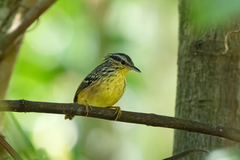
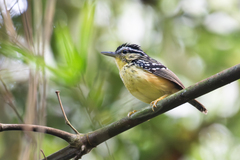

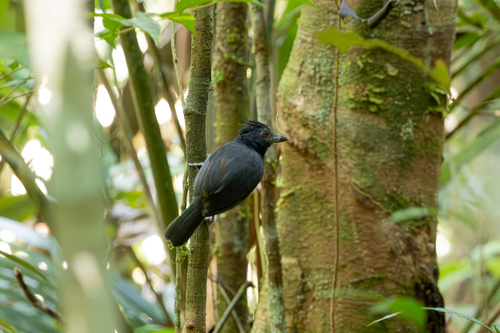
Guianan Warbling-Antbird

Guianan Warbling-Antbird

Hypocnemis cantator

Silhouette: Sheatherius · PhyloPic

LCLeast ConcernNTVUENCR
Daily sighting probability ~60% · Likely
at Brownsberg Nature Park

In 3 days ~90% in a week >90%

157 Verified sightings at Brownsberg Nature Park From 2019 to 2026
157 In 1 park
December Best month
☀️ Diurnal When it's spotted

About the Guianan Warbling-Antbird

The Guianan warbling antbird, or Guianan antwarbler, (Hypocnemis cantator) is an insectivorous bird in subfamily Thamnophilinae of family Thamnophilidae, the "typical antbirds". It is found in Brazil, French Guiana, Guyana, Suriname, and Venezuela.

The French polymath Georges-Louis Leclerc, Comte de Buffon described the Guianan warbling antbird in his Histoire Naturelle des Oiseaux in 1779. The bird was also illustrated in a hand-colored plate engraved by François-Nicolas Martinet in the Planches Enluminées D'Histoire Naturelle which was produced under the supervision of Edme-Louis Daubenton to accompany Buffon's text. Buffon did not include a scientific name with his description but in 1783 the Dutch naturalist Pieter Boddaert coined the binomial name Formicarius cantatar in his catalogue of the Planches Enluminées. Its present genus Hypocnemis was introduced by the German ornithologist Jean Cabanis in 1847. The specific epithet is from the Latin cantator "a singer".

The Imeri (Hypocnemis flavescens), Peruvian (H. peruviana), yellow-breasted (H. subflava), and Spix's warbling antbird (H. striata) were all formerly treated as subspecies of what is now... Wikipedia →

Sounds

Song0:58

French Guiana · 2024

© Tristan Guillebot de Nerville · XC1162907 · CC BY-NC-SA 4.0

Call0:31

Brazil · 2023

© João Capurucho · XC985069 · CC BY-NC-SA 4.0

Duet0:38

Brazil · 2024

© JAYRSON ARAUJO DE OLIVEIRA · XC939729 · CC BY-NC-SA 4.0

Global Distribution

Parks Where Found

# Park Country Daily sighting probability
1 Brownsberg Nature Park 🇸🇷 Suriname
~60%

More parks will be added in future updates.

Before you go

What are the chances of seeing a Guianan Warbling-Antbird in Brownsberg Nature Park?

Likely

About 60% of wildlife watchers report a Guianan Warbling-Antbird sighting in Brownsberg Nature Park on a given day, based on 157 verified sightings from GBIF citizen-science data from 2019 to 2026. It is the 6th most-seen of the 221 birds we can rate there. Over three days the chance rises to about 90%, and over a week to over 90%, if each day is a fresh chance.

When is the best time to see a Guianan Warbling-Antbird in Brownsberg Nature Park?

December

In that month about 80% of wildlife watchers report a Guianan Warbling-Antbird in Brownsberg Nature Park on a given day, against about 40% in September and November, the lowest months. May to July have too few records to rate.

What time of day is best to see a Guianan Warbling-Antbird?

Between 9 am and noon

Across all the parks we cover, that three-hour window holds the most Guianan Warbling-Antbird sightings with a recorded time, and about 8 in 10 of them come between 6 am and 6 pm: it is a daytime animal.

Where else can you see a Guianan Warbling-Antbird?

Only Brownsberg Nature Park, in our data

Brownsberg Nature Park is the only park on Wallace's Line with enough records to rate Guianan Warbling-Antbird sightings: about 60% of wildlife watchers there report one on a given day.

Which relatives of the Guianan Warbling-Antbird live in Brownsberg Nature Park?

Same family: Thamnophilidae

The closest relatives of the Guianan Warbling-Antbird that you can see in Brownsberg Nature Park (family Thamnophilidae, Typical Antbirds) are Mouse-colored Antshrike (about 50%), Gray Antbird (about 50%) and Cinereous Antshrike (about 40%), with each one's daily chance of a sighting.

Where does the Guianan Warbling-Antbird sighting chance come from?

GBIF citizen-science records

It is estimated from how often the Guianan Warbling-Antbird is recorded against all the birds logged in Brownsberg Nature Park (157 verified sightings from 2019 to 2026), calibrated against known sighting rates. Figures are rounded to the nearest 10% because citizen-science data supports honest approximations, not decimals, and months with records from fewer than five people show "—". How it works.

← Back to Brownsberg Nature Park