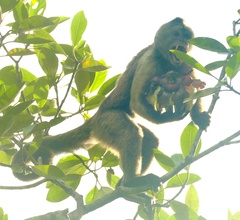
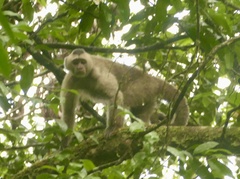

chestnut weeper capuchin

chestnut weeper capuchin

Cebus castaneus

Silhouette: Sarah Werning · PhyloPic

LCLeast ConcernNTVUENCR
Daily sighting probability ~30% · Possible
at Brownsberg Nature Park

In 3 days ~70% in a week ~90%

6 Verified sightings at Brownsberg Nature Park From 2019 to 2026
6 In 1 park
April Best month
☀️ Diurnal When it's spotted

About the chestnut weeper capuchin

The chestnut capuchin or chestnut weeper capuchin (Cebus castaneus) is a species of capuchin monkey from northeastern Brazil, southern Guyana, Suriname, and French Guiana. It was described in 1851 as a subspecies of the wedge-capped capuchin (C. olivaceus). However, a 2012 study found grounds to at least tentatively recognize it as a distinct species. The American Society of Mammalogists, IUCN Red List, and ITIS all follow this classification.

It is found in northeastern Brazil, southern Guyana, and most of Suriname and French Guiana. It inhabits the uplands of the Guiana Shield north of the Amazon River, east of the Rio Negro, limited on both sides by the Branco River, and from here ranges north, east of the Orinoco and Ventuari rivers, to Guyana. Its range still remains poorly known. Wikipedia →

Global Distribution

Parks Where Found

# Park Country Daily sighting probability
1 Brownsberg Nature Park 🇸🇷 Suriname
~30%

More parks will be added in future updates.

Before you go

What are the chances of seeing a chestnut weeper capuchin in Brownsberg Nature Park?

Possible

About 30% of wildlife watchers report a chestnut weeper capuchin sighting in Brownsberg Nature Park on a given day, based on 6 verified sightings from GBIF citizen-science data from 2019 to 2026. It is the 4th most-seen of the 5 mammals we can rate there. Over three days the chance rises to about 70%, and over a week to about 90%, if each day is a fresh chance.

When is the best time to see a chestnut weeper capuchin in Brownsberg Nature Park?

April and November

In those months about 50% of wildlife watchers report a chestnut weeper capuchin in Brownsberg Nature Park on a given day, against under 5% in January to March, the lowest months. June and August–September have too few records to rate.

What time of day is best to see a chestnut weeper capuchin?

Between 8 and 11 am

Across all the parks we cover, that three-hour window holds the most chestnut weeper capuchin sightings with a recorded time, and about 9 in 10 of them come between 6 am and 6 pm: it is a daytime animal.

Where else can you see a chestnut weeper capuchin?

Only Brownsberg Nature Park, in our data

Brownsberg Nature Park is the only park on Wallace's Line with enough records to rate chestnut weeper capuchin sightings: about 30% of wildlife watchers there report one on a given day.

Which relatives of the chestnut weeper capuchin live in Brownsberg Nature Park?

Same order: Primates

The closest relatives of the chestnut weeper capuchin that you can see in Brownsberg Nature Park (order Primates) are Guianan Red Howler Monkey (about 60%) and White-faced Saki (about 60%), with each one's daily chance of a sighting.

Where does the chestnut weeper capuchin sighting chance come from?

GBIF citizen-science records

It is estimated from how often the chestnut weeper capuchin is recorded against all the mammals logged in Brownsberg Nature Park (6 verified sightings from 2019 to 2026), calibrated against known sighting rates. Figures are rounded to the nearest 10% because citizen-science data supports honest approximations, not decimals, and months with records from fewer than five people show "—". How it works.

← Back to Brownsberg Nature Park